
India: Double Speak On Nuclear Disarmament – Analysis
By IPCS
By PR Chari
Call it unintended irony. But India’s Foreign Minister and National Security Adviser using a forum to discuss the resurrected Rajiv Gandhi Action Plan and the Holy Grail of nuclear disarmament to emphasise India’s devotion to nuclear deterrence is surely an oddity.
What these officials said is worth quoting. SM Krishna, External Affairs Minister, said, “Nuclear weapons today are [an] integral part of our national security and will remain so, pending nondiscriminatory and global nuclear disarmament.” And, the National Security Adviser, Shiv Shankar Menon, observed that India would be safer pursuing global nuclear disarmament, “but until we arrive at that happy state, we have no choice and a responsibility towards our own people, to have nuclear weapons to protect them from nuclear threats.” These enunciations are in synch with India’s overall nuclear disarmament policy to make hortatory statements on eliminating nuclear weapons, but proceeding quietly to strengthen its own nuclear arsenal and further refine its own missile capabilities.
Nothing new, therefore, in these expressions of India’s nuclear disarmament policy. Except for the further confession by the National Security Adviser that “On at least three occasions before 1998 other powers used the explicit or implicit threat of nuclear weapons to try and change India’s behavior.” He gave no further details. One is not privy to the Government’s intelligence on these occasions. But information available in the public domain on the nuclear weapons-related crises involving India and Pakistan before their nuclear tests in 1998 can be reviewed.
- A series of alarms and feverish diplomatic activity occurred over 1984-86 when Pakistan voiced suspicions that India was planning to attack its nuclear installations in Kahuta that housed its weapons programme. India had strenuously denied having any such intentions, but the US felt impelled to persuade India to desist. An unintended effect of these manoeuvres was that the US got committed to protecting Pakistan’s nuclear programme, which they had always opposed.
- Shortly thereafter, a major crisis erupted in 1986-87 between India and Pakistan centering on India’s massive Brasstacks exercise that was conducted along the India-Pakistan border. Pakistan then made provocative counter-deployments, leading to a tinder-box situation where a minor skirmish could have triggered an all-out war. Fortunately, this crisis was defused by good sense ultimately prevailing on both sides. During this episode Pakistan’s controversial nuclear scientist, AQ Khan, had delivered a warning to India through an Indian journalist, Kuldip Nayyar, that Pakistan possessed nuclear weapons and would use them against India, if provoked. This warning was treated with skepticism in India, and was denied by Pakistan. Neither did it serve any purpose since the crisis had abated.
- Again a huge uprising occurred in the Kashmir Valley in the early 1990s, triggered by perceived unfair elections held in 1989 that was further inflamed by extreme elements in Pakistan. That led to large-scale deployment of troops by India and counter-deployments by Pakistan. Beliefs that this crisis had a nuclear dimension are based on an ambiguous statement by Pakistan’s Foreign Minister Yakub Khan, that “lightning is flashing in the skies” and a sensational story published in the New Yorker by the journalist Seymour Hersh in 1993 alleging that Pakistan had armed its aircraft with nuclear weapons that were placed on “strip alert.”
None of these crises, therefore, contained any credible “explicit or implicit threat of nuclear weapons to try and change India’s behavior.” Much lies in the eyes and ears of the beholder. But, having made such large assertions in public the National Security Adviser must clarify himself. Or is he only tilting at windmills in seeking to justify India’s nuclear deterrent? And deride any effort by India to proceed unilaterally towards nuclear disarmament? These clever postures are a far cry from the Nehruvian era when India enjoyed a certain élan in the sphere of nuclear disarmament and the search for a safer world. India’s highly publicised contribution in recent years to revive this élan is the Rajiv Gandhi Action Plan (1988), which has been resurrected to refurbish the besmirched image of the NDA Government. But India is not prepared to join the Comprehensive Test Ban Treaty (CTBT) and permanently eschew nuclear testing. Nor is it willing to cease manufacturing fissile materials for weapons purposes before the Fissile Materials Cutoff Treaty (FMCT) is negotiated, of which there is no sign.
The final irony surely is that India fervently wishes to gain entry into the Nuclear Suppliers Group (MSG), the Missile Technology Control Regime (MTCR), Wassenaar Arrangement and Australia Group. All of them are multinational export control regimes designed to ensure the non-proliferation of all weapons of mass destruction. In other words, India would not like more countries to acquire nuclear weapons, while supporting nuclear disarmament as a desirable end, and keeping its powder dry. We are like that only!
PR Chari
Visiting Professor, IPCS
email: [email protected]

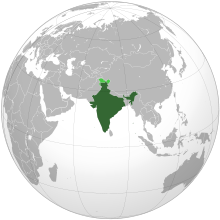
Can Eurasiareview please elaborate on the two different colors used in the maps they show? In the present article, written hopefully by an Indian born, the maps shows part of India in dark green while the small portion is light green. Please note the entire region is India. No Indian should accept such aberrations in the national map.