

From Protecting Chokepoints To Breaking Their Grip: Why The ASTRA Corridor Debate Matters – Analysis
By Amb. Prof. Mohamed A. Qubaty
For decades, the central strategic concern in the Gulf revolved around protecting the Strait of Hormuz and Bab al-Mandeb from disruption.
Recent regional confrontations, however, have exposed a deeper geo-economic reality: the vulnerability lies not merely in conflict itself, but in the excessive concentration of global energy flows, trade networks, and emerging water-security dependencies within a handful of fragile maritime chokepoints.
This raises a more consequential question:
What if the principal strategic challenge is no longer simply defending chokepoints, but reducing the world’s structural dependence upon them?
It is within this context that the debate surrounding the proposed “ASTRA Corridor” through Yemen’s Hawf region on the Arabian Sea assumes growing significance.
Previously examined in an earlier Eurasia Review analysis concerning Hawf as a dual energy and water-resilience corridor, the concept envisions a long-term strategic route capable of linking eastern Arabian energy infrastructure directly to the Indian Ocean, thereby reducing dependence on the dual vulnerabilities associated with Hormuz and Bab al-Mandeb.
Whether such a project ultimately materializes is, at this stage, less important than the strategic logic it represents.
From Absolute Security To Structural Resilience
One of the most common criticisms of the ASTRA concept is that it merely transfers vulnerability from Hormuz to another location.
Yet modern energy-security strategy does not seek perfect invulnerability — an unrealistic objective in geopolitics. Its purpose is diversification, redundancy, and structural resilience: reducing excessive dependence on a single vulnerable artery.
The objective, therefore, is not eliminating risk, but distributing risk.

Historically, this logic is hardly new. The Trans-Arabian Pipeline (TAPLINE) represented a strategic effort to reduce reliance on maritime routes despite crossing multiple sovereign states.
The same logic now underpins discussions concerning alternative Gulf export corridors at a time when drones, cyber disruption, proxy warfare, and maritime harassment can trigger economic repercussions far beyond the scale of the original confrontation.
Sovereignty, Transit, And Strategic Geography
Another recurring objection suggests that a strategic corridor through Yemen’s eastern governorate of Al-Mahra would somehow diminish sovereignty.
Yet cross-border infrastructure routinely traverses multiple jurisdictions without altering sovereign ownership. The issue is therefore not sovereignty itself, but the terms through which strategic interdependence is managed.
Nor is transit security through Al-Mahra an exceptional anomaly. Major infrastructure corridors worldwide frequently pass through politically sensitive and locally complex environments, while Al-Mahra itself has remained comparatively stable relative to much of Yemen during recent years.
In any such project, Yemen would not merely function as a passive transit zone, but as a strategic stakeholder capable of benefiting from infrastructure investment, transit revenues, employment generation, and enhanced geo-economic relevance.
Why Yemen — And Not Oman?
An equally important question frequently arises: if the strategic objective is to bypass Hormuz, why not rely exclusively on Oman and the Port of Duqm rather than Yemen?
The answer lies less in geography alone than in geopolitical positioning.
Even prior regional discussions concerning alternative Gulf export routes repeatedly focused on Yemen’s Arabian Sea coastline despite Oman’s stability and close relations with Gulf states.
This reflects a broader strategic calculation. Oman’s historically balanced relationship with Iran naturally shapes Muscat’s approach toward bypass-Hormuz calculations differently from the perspective of Gulf states more directly exposed to the risks of maritime coercion within the Strait.
From both Gulf and broader international perspectives, a corridor through Yemen may therefore appear more strategically adaptable within long-term efforts to redistribute geo-economic vulnerability away from highly concentrated maritime exposure.
The “Malacca Dilemma” And The Logic Of Early Adaptation
One of the region’s recurring strategic weaknesses has been the tendency to postpone structural debates until vulnerabilities evolve into full-scale crises.
China offers an instructive contrast.
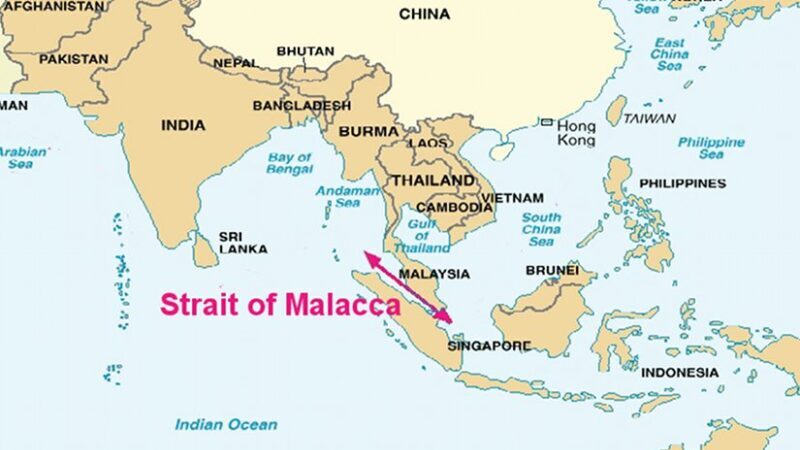
When Beijing recognized the dangers associated with excessive dependence on the Strait of Malacca — the so-called “Malacca Dilemma” — it did not wait for a complete blockade or major war before pursuing alternatives.
Instead, China gradually developed the Sino-Myanmar pipelines as part of a broader effort to reduce reliance on a single maritime corridor and strengthen long-term structural resilience.
From this perspective, discussions concerning Yemen’s potential role within alternative strategic corridors should not be dismissed as geopolitical fantasy or premature speculation.
Rather, they represent an attempt to anticipate transformations that may eventually become regional and international necessities.
Infrastructure As A Producer Of Stability
Perhaps the greatest misconception surrounding projects of this scale lies in the assumption that they can only emerge after the achievement of complete political stability.
Yet states are not restored through political arrangements alone, but also through the strategic functions that make their existence economically meaningful: infrastructure, ports, transit networks, energy systems, public revenue, and regional connectivity.
From this perspective, projects such as ASTRA should not be viewed solely as outcomes of stability, but potentially as contributors to its gradual production by generating local, regional, and international interests tied to preserving the corridor’s security and functionality.
By contrast, indefinitely postponing strategic initiatives until the emergence of a perfectly restored state risks institutionalizing paralysis itself.
Many major geo-economic transformations in history did not merely result from stability; they actively contributed to its production.
Within this framework, ASTRA could evolve into more than a pipeline corridor. It could become part of a broader architecture of economic integration, maritime resilience, energy security, and developmental stabilization extending across the Arabian Peninsula and the wider Indian Ocean sphere.
From Protecting Vulnerability To Engineering Resilience
Ultimately, the central strategic question is no longer whether projects such as ASTRA are entirely free from risk.
No strategic corridor in history ever was.
The more consequential question is whether the international system can indefinitely sustain such extreme dependence on dual maritime chokepoints whose disruption repeatedly threatens global energy markets, shipping flows, insurance costs, and supply-chain stability.
In that context, the long-term cost of remaining hostage to chronic maritime vulnerability may ultimately exceed the cost of constructing alternative systems of resilience.
And it is precisely here that the deeper significance of the ASTRA debate resides.
The issue is no longer merely how to defend Hormuz and Bab al-Mandeb.
It is how to gradually reduce their capacity to hold the global economy hostage in the first place.
