BRICS: Mantra The Way Forward – OpEd
By Patial RC
India and China having agreed to reduce border tensions is awayforward for the BRICS+. Egypt, Ethiopia, Iran and the UAE became BRICS members on January 1, 2024. Skepticism has been expressed over the years, about the BRICS (Brazil, Russia, India, China, and South Africa) initiative and especially when the interests of India, China the two immediate neighbours tend to have clashed on almost all issues on all platforms! Ladakh 2020 Standoff brought India and China the closest ever to war, since 1962.
In spite of a clear lack of any logic behind the coming together of these countries falling in different continents, dispersed geographically, ideologically and their economies in different stages of development came together, the BRICS has still sustained itself and is growing in numbers. There seems to be no common ground other than all emerging economies other than the fact that the purpose of BRICS was to form a front to influence global events and now BRICS+ with the present leadership of Putin under the Chinese influence sees itself as a geopolitical counterweight to the eastward expansion of the US led West. Each member of the BRICS also has their own reason to sustain this movement.
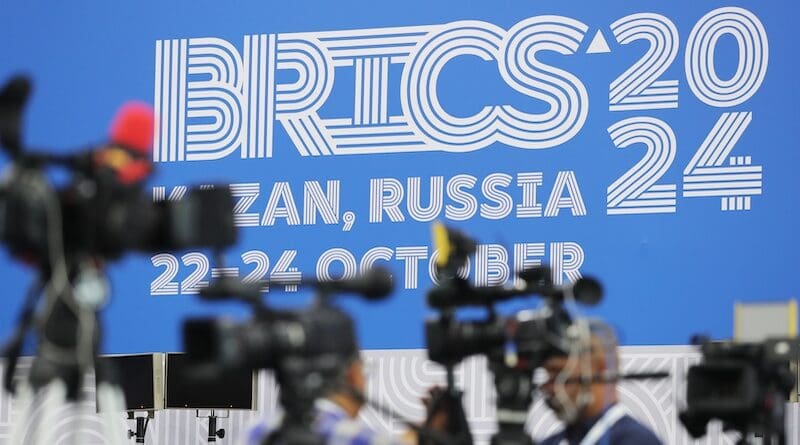
The 16th BRICS Kazan Summit (22–24 October 2024) in Russia, is the first since the BRICS’s expansion. The increasing number of applications to join the organization highlights BRICS’ appeal to Global South countries by offering a platform to work on equal terms. The trend also reflects a growing discontent with the Western-centric world order. Sri Lanka, Cuba, Malaysia, Belarus and Pakistan have also expressed the willingness or have applied to join BRICS. Turkey, a NATO member is also keen to join the BRICS group as it seeks to bolster its global influence! Russian Finance Minister has stated that the; “BRICS countries average growth rate in 2024-2025 stands at 4.4 percent whereas of the G7 countries is 1.7 percent. It is clear whose development Russian Finance Minister is more dynamic.” With the inclusion of Saudi Arabia, Iran, and the UAE, BRICS now boasts some of the world’s largest oil and gas producers.
China appears now to stand ready to work with other members to strive for the steady and sustained development of greater BRICS cooperation, open a new era for the Global South to seek strength through solidarity and jointly promote world peace and development. Hopefully, their statements match actions on ground!
India Advocates Global Reforms
The BRICS Summit in Kazan, Russia, marked a significant milestone in the evolution of the group, emerging as a pivotal player by its balanced national interests while promoting multilateralism, a feat that underscored its vision of an inclusive and multipolar world. At the Kazan summit, Prime Minister Narendra Modi reiterated the call for reforms in the United Nations Security Council (UNSC) and the International Monetary Fund (IMF). The idea is not just to seek greater representation for India and other BRICS members, but to create a more equitable system that better addresses the needs of emerging and developing economies. India has long sought a permanent seat in the UNSC being the world’s largest democracy with the largest global population.
Prime Minister Modi’s call for closer cooperation in areas such as digital infrastructure, green energy, and financial technology was well received, positioning India as a leader in these fields within the bloc. India also pushed for stronger multilateral frameworks within BRICS to tackle terrorism underscores its broader security objectives.
BRICS Mantra the Way Forward
BRICS represents more than just a coalition of emerging economies; it is a ray of hope for developing and underrepresented countries. BRICS offers an alternative to Western-dominated institutions like the UNSC, where aspirations of the developing economies have long been sidelined. By championing BRICS as a platform for the Global South, BRICS is positioning itself as a leader advocating for the interests of smaller nations, particularly those in Asia, Africa, and Latin America, which also suffer from exclusion in global governance.
The BRICS Currency was one of the most discussed proposals at the summit was the idea of a BRICS currency to reduce reliance on the US dollar to mitigate Dollar Dependency. Most nations have long been exposed to the vagaries of US monetary policy, particularly the fluctuations of the dollar. A BRICS currency could offer an alternative for settling trade transactions, thereby reducing the volatility that comes with dollar-based trade. A BRICS currency would also provide a tool to bypass Western sanctions and continue without being affected by external pressures.
India-China’s Strategic thaw if in place, then it would be safe to assume that BRICS will further accelerate the current process of multipolarity, making its prospects clearer to reform and innovate the inequities of the existing global order, striving for a system that is fair and equitable. With this development the US is scared of the BRICS+ potential threat to the US led Western economic and political hegemony especially China and Russia and India as a “potential partner” challenging the US hegemony in all respects. India still remains non-aligned. Wonder if the US like Pakistan will be unhappy with India and China having agreed to reduce border tensions! How True: “It may be dangerous to be America’s enemy, but to be America’s friend is fatal.” ― Henry Kissinger
BRICS promotes policies based solely on shared economic growth and not looking for strategic leadership. The BRICS geopolitical responses should be based on mutual trust and not coercion like the US and the West which colonized the world over a hundred years. The developing nations see a ray of hope for development while aligning with the BRICS.