
How AI-Powered Drones Are Shaping The Future Of Warfare – OpEd
By Altaf Moti
The landscape of modern warfare is undergoing a seismic shift, driven by advancements in artificial intelligence (AI) and drone technology. The integration of these technologies is not merely enhancing traditional military capabilities; it is fundamentally transforming the nature of conflict itself. As nations race to develop and deploy more sophisticated drone systems, the implications for military strategy, ethics, and global security are profound.
The Evolution of Drone Warfare
Drones, or unmanned aerial vehicles (UAVs), have been utilized in military operations for decades, primarily for surveillance and reconnaissance. However, recent conflicts, particularly in Ukraine and the Middle East, have showcased their offensive capabilities. The early weeks of the Russian invasion of Ukraine highlighted the effectiveness of Turkish-made Bayraktar TB2 drones, which played a crucial role in countering armored assaults. Similarly, Hamas employed drones to target Israeli defenses, demonstrating their versatility as offensive weapons.
As drone technology has evolved, so too has its application in warfare. Today’s drones are equipped with advanced sensors and AI algorithms that allow for real-time data processing and autonomous decision-making. This capability enables drones to execute complex missions with minimal human intervention, marking a significant departure from their original role as mere reconnaissance tools.
The Role of AI in Drone Warfare
AI is at the forefront of this transformation. By enhancing data processing capabilities, AI allows drones to analyze vast amounts of information quickly and make split-second decisions on the battlefield. This capability is particularly critical in high-stakes environments where traditional command-and-control structures may be compromised.
The integration of AI into drone systems has led to two major innovations: swarm intelligence and autonomous targeting. Swarm intelligence enables multiple drones to operate collaboratively, overwhelming enemy defenses through coordinated attacks. This tactic has been observed in various conflicts where swarms of drones have successfully penetrated sophisticated air defense systems.
Moreover, autonomous targeting systems are being developed that allow drones to identify and engage targets without human oversight. This raises ethical concerns about accountability and the potential for unintended consequences in combat scenarios. As nations continue to refine these technologies, the prospect of fully autonomous weapons—often referred to as “killer robots”—becomes increasingly realistic.
Current Applications and Developments
Recent developments in drone technology illustrate the rapid pace of innovation. For instance, companies like Helsing have introduced AI-powered attack drones capable of operating effectively in environments with electronic jamming—a common challenge in modern warfare. These drones can maintain target engagement even without continuous data connections, providing a significant tactical advantage.
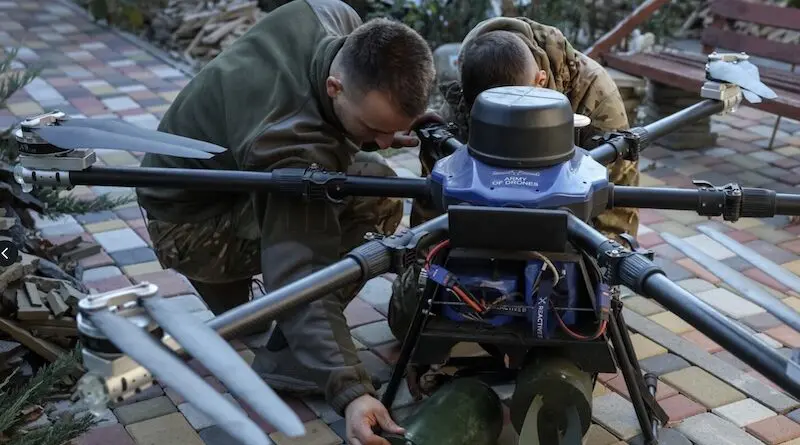
In Ukraine, the military has adapted its structure to incorporate drone warfare units across all branches. The introduction of first-person view (FPV) racing drones has enabled Ukrainian forces to conduct precision strikes against Russian tanks and troop formations. This shift highlights how drone technology can provide asymmetrical advantages in conflicts where one side may be outgunned by traditional artillery.
The use of AI-driven algorithms also enhances drones’ capabilities for intelligence gathering and reconnaissance. Drones can now autonomously navigate complex environments, identify patterns of life among enemy forces, and predict potential threats based on historical data analysis. This level of situational awareness is invaluable for modern militaries seeking to maintain an edge over adversaries.
The Strategic Implications
As drones become more sophisticated, their impact on military strategy is profound. The ability to deploy swarms of drones against enemy targets alters traditional notions of air power and ground warfare. Military planners must now consider how to defend against not just individual drone strikes but coordinated attacks involving hundreds or thousands of UAVs.
Furthermore, the cost-effectiveness of drone warfare presents a compelling argument for their increased use. Drones are generally cheaper to produce than manned aircraft and can be deployed in greater numbers without risking human lives. This economic advantage may encourage nations to invest heavily in drone technology as a primary component of their military arsenals.
The proliferation of drone technology also raises significant ethical questions regarding warfare conduct. The potential for autonomous weapons systems to operate without human oversight challenges existing international laws governing armed conflict. Advocacy groups have called for preemptive bans on fully autonomous weapons due to concerns about accountability and civilian casualties.
Countermeasures and Future Developments
As drone technology advances, so too do countermeasures designed to neutralize UAV threats. Nations are investing in electronic warfare capabilities that can jam or disrupt drone communications, rendering them ineffective during operations. Additionally, advancements in laser weaponry are being explored as potential solutions for intercepting swarming drones before they reach their targets.
Looking ahead, the future of drone warfare will likely see further integration with other technologies such as robotics and machine learning. The development of hybrid systems that combine ground-based robots with aerial drones could create multi-domain operational capabilities that enhance battlefield effectiveness.
Moreover, as countries like China and Russia ramp up their investments in drone technology, the global arms race surrounding UAVs will intensify. This competition will not only shape military strategies but also influence geopolitical dynamics as nations seek to assert dominance through technological superiority.
The intersection of AI and drone warfare represents one of the most significant transformations in military history. As these technologies continue to evolve, they will redefine how wars are fought and won. While offering unprecedented advantages on the battlefield, they also pose ethical dilemmas that require careful consideration by policymakers and military leaders alike.
The future of war is increasingly automated and reliant on artificial intelligence—a reality that demands new frameworks for regulation and accountability in armed conflict. As nations navigate this uncharted territory, the balance between leveraging technological advancements for security while safeguarding human rights will be critical in shaping the future landscape of warfare.
