
The Indian Navy In 2025: A Year Of Strength Across The Spectrum – Analysis
By Commodore (Dr.) Johnson Odakkal, I.N. (Retd.)
As the month of December settles in, bringing with it lights, celebrations, and a quiet pause before the new year, there is also a moment reserved across the nation for gratitude.
Amid the festivities, India turns its attention to the guardians of its seas, the Indian Navy. In 2025, their story has been nothing short of transformative. This year stands out as one where the Navy not only reinforced its combat readiness, but also deepened India’s strategic imprint across the Indo-Pacific, countering China’s expanding naval presence with confidence and cohesion. Be it the expansion of its fleet, maritime exercises, assistance to other navies, or even protection of national interests, the Indian Navy has shown a great zeal towards its commitment towards security and growth for all in the region.
Historical Background: The growth of the Indian Navy
Over the past decade, the Indian Navy has undergone a remarkable transformation. From a largely coastal defence force, it has evolved into a blue-water navy, capable of sustained operations across the Indian Ocean Region (IOR) and beyond. The introduction of indigenous platforms, the commissioning of advanced destroyers and submarines, and the operationalisation of the country’s first indigenous aircraft carrier, INS Vikrant, have all contributed to this growth. This trajectory reached a defining peak in 2025, a year that showcased India’s ability to not only build but also deploy a technologically advanced, combat-ready fleet with increasing global influence.
A Leap Toward Blue-Water Dominance
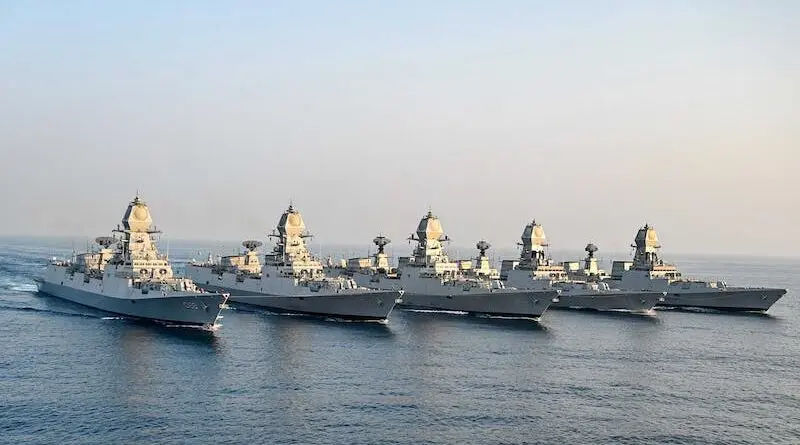
What began as a fleet of 130 ships and submarines at the start of the year expanded into 145 by November 2025, as the Navy surged toward its long-term goal of 155-160 ships and submarines by 2030. Over 75% of these inductions were indigenously built, underscoring the Navy’s steadfast commitment to the goal of ‘Aatmanirbhar Bharat’. The year’s highlight was the historic triple commissioning ceremony held on 15th January at the Naval Dockyard in Mumbai, wherein Prime Minister Narendra Modi inducted INS Surat (a Project 15B stealth destroyer), INS Nilgiri (the lead Project 17A stealth frigate), and INS Vaghsheer (the final Kalvari-class submarine). This unprecedented simultaneous commissioning of a destroyer, frigate, and submarine demonstrated India’s shipbuilding maturity and significantly enhanced ASW, air defence, and multi-domain capabilities in the IOR.
From January to November, 10 warships and one submarine, including offshore patrol vessels, ASW platforms like INS Mahe, and INS Nistar (an 80% indigenous Diving Support Vessel), joined the fleet. April further saw INS Surat successfully test-fire advanced indigenous air defence missiles. Additionally, the launch of 52 ongoing shipbuilding projects and Acceptance of Necessity for 69 more ships and six submarines consolidated India’s future force structure. At the Swavlamban 2025 event in November, the Navy reaffirmed its pivot toward disruptive technologies i.e., AI-enabled systems, unmanned platforms, high-power computing, and counter-UUV solutions, to prepare for next-gen maritime challenges.
Major Operations: Precision Strikes and Crisis Response
Operationally, 2025 was one of the most intense years for the Navy in recent memory. The high-tempo environment began with the aftermath of escalating China-Pakistan naval cooperation and peaked with Operation Sindoor in May, a decisive tri-service operation showcasing naval strength in the Arabian Sea, with the Navy playing a pivotal role through forward deployment of a carrier battle group. With over 35 warships, including INS Vikrant, the Indian Navy surged toward Karachi in a deterrent posture following hostile signals from Pakistan. Real-time intelligence sharing, secure communications, and coordinated air-sea operations validated India’s readiness, even as diplomatic channels ensured de-escalation.
Beyond conflict deterrence, the Navy’s humanitarian and crisis-response contributions were substantial. INS Vikrant and INS Deepak (Deepak-class fleet tanker) conducted a medical evacuation (MEDVAC) of injured crew members from the Panamanian bulk carrier MV Helian Star in March after it caught fire in the Arabian Sea. In June, INS Surat salvaged a Singaporean flagged container vessel MV Wan Hai 503 after it caught fire and suffered an explosion off the Kerala Coast. As a response, the Chinese Embassy in India expressed Gratitude towards the Indian Navy for the timely rescue of the crew onboard. Following the Pahalgam terror attack in July, heightened vigilance saw Indian warships deployed as far as Cyprus to counter Turkish manoeuvres near Karachi. Throughout the year, the Navy remained engaged in round-the-clock anti-piracy and maritime security operations, responding to over 35 distress calls, saving 520 lives, conducting more than 1,000 boardings, and escorting 367 merchant vessels carrying cargo worth $6.3 billion through high-threat zones in the Red Sea and Arabian Sea.
This spirit was further highlighted when the Indian Navy and Air Force conducted comprehensive Humanitarian Assistance and Disaster Relief (HADR) operations in Sri Lanka under “Operation Sagar Bandhu.” Following the severe flooding and widespread destruction caused by Cyclone Ditwah in late November 2025, India responded immediately, activating the operation in early December. Coordinated air and sea efforts saw Indian forces deliver essential relief supplies (including food, water, tents, and medical aid) to the worst-affected regions. The Indian government’s assured and timely support during the crisis reinforced the depth of bilateral ties, exemplified its commitment to the “Neighbourhood First” policy, and upheld the principle of “Security and Growth for All in the Region” (SAGAR).
Multilateral Exercises: Forging Indo-Pacific Alliances
The Naval calendar featured over 20 major multilateral exercises, cementing India’s partnerships across the Indo-Pacific. The year began with La Perouse 2025 (January 16-24), a major French-led exercise through the Malacca, Sunda, and Lombok Straits. Furthermore, India’s participation in TROPEX 2025 showcased carrier strike operations, UAV swarms, and live weapon firings across the IOR. Tiger Triumph 2025 in April strengthened India-US cooperation, particularly in HADR and unmanned support logistics.
As the year progressed, the Navy played a central role in Pacific Reach 2025 (one of the world’s largest submarine rescue drills) in the South China Sea, with INS Nistar demonstrating deep-sea operations at 650 metres. Malabar 2025, the flagship Quad exercise held in Guam in November, saw INS Sahyadri lead ASW and air defence drills, while Phase II in the Bay of Bengal expanded carrier strike interoperability.
Bilateral Engagements: Deepening Strategic Ties
Alongside multilateral drills, the Navy intensified bilateral engagements with ASEAN, Quad members, and European partners. In October, India conducted its first-ever dual carrier operations with the UK’s HMS Queen Elizabeth and INS Vikrant, followed by an IAF-Royal Navy air integration exercise. The fifth edition of Samudra Shakti with Indonesia off Visakhapatnam emphasised ASW cooperation, while JAINMEX with Japan strengthened maritime domain awareness and operational synergy. Engagements with Malaysia, Australia, and the United States further reinforced India’s role as a net security provider at a time when China attempted to expand its influence through submarine deliveries and base access in the IOR.
Technological and Space Integration: The ‘War God’ in Orbit
In 2025, the Indian Navy also deepened its integration with India’s space capabilities. On August 24, the IADT-01 test for Gaganyaan validated the Navy’s readiness for crew module recovery. The successful launch of GSAT-7R (CMS-03) on November 2nd marked a major milestone for the India Navy’s Intelligence, Surveillance and Reconnaissance (ISR) capabilities. The ISRO-Navy collaboration highlighted joint cooperation in the fields from seas to the stars. The GSAT-7R satellite is India’s most advanced naval communication satellite, offering jamming-resistant UHF/S/C/Ku-band connectivity for ships, submarines, aircraft, and UAVs. Investments in AI-driven swarms, Reaper UAV procurement, and counter-drone systems reflected a forward-leaning approach to emerging threats.
Humanitarian and Strategic Outreach
Beyond military achievements, 2025 was also marked by powerful gestures of national unity and outreach. Prime Minister Modi celebrated Diwali aboard INS Vikrant on October 20 (marking the first such visit by a serving Prime Minister) boosting morale and underlining India’s commitment to its indigenous carrier program. Recruitment drives continued steadily, with new entries under the 10+2 BTech scheme. The Navy’s response to national tragedies, especially the Pahalgam terror incident, highlighted its unwavering resolve and compassion.
Strategic and Geopolitical Review: A Force to Reckon With
By the close of 2025, the Indian Navy had firmly asserted itself as a dominant Indo-Pacific force. The combination of indigenous shipbuilding, space-enabled operations, strengthened alliances. This resulted in real-time crisis response shifting the strategic balance amid China’s submarine deliveries to Pakistan and economic influence in the IOR. The Navy’s protection of critical shipping lanes, especially during Red Sea disruptions, safeguarded billions in trade and reinforced India’s SAGAR doctrine. At the Naval Commanders’ Conference in October, Defence Minister Rajnath Singh praised Operation Sindoor’s precision and reiterated the need for aligning technological innovation with evolving hybrid threats. He described the Indian Navy’s role in the “IOR has become the center of contemporary geopolitics. It is no longer passive; it has become an area of competition and cooperation. The Indian Navy, through its multi-dimensional capabilities, has played a leadership role in the region.”
As India prepares to celebrate Navy Day on December 4, 2025 with a grand operational demonstration at Shangumugham Beach in Thiruvananthapuram on December 3, featuring MARCOS displays, MiG-29K flyovers, and live weapon demonstrations, the message is unmistakable: the Indian Navy of 2025 is not only cohesive and resilient, but strategically indispensable. With a pathway toward a 170-plus ship force by 2035 and continued investments in unmanned systems, AI, and space integration, India stands ready to defend its maritime frontiers and uphold a rules-based order across the Indo-Pacific. As India steps confidently into 2026, its Navy stands not just as a maritime force, but as the embodiment of national resilience, innovation, and global responsibility.
References
- Fanell, J. (2025, December 2). Delhi’s ambitious plan for naval power and strategic deterrence. https://www.gisreportsonline.com/r/growth-indian-naval-power
- Rao, S. (2025, January 17). India’s naval advancements will fuel its Indian Ocean ambitions. Focus on 5 key areas. https://theprint.in/opinion/indias-naval-advancements-will-fuel-its-indian-ocean-ambitions-focus-on-5-key-areas/2449798
- PIB. (2025, October 24). INS Vikrant: India’s First Indigenous Aircraft Carrier and a Landmark in Naval Capability. https://www.pib.gov.in/PressReleasePage.aspx?PRID=2182277®=3&lang=2#
- Pandit, V. (2025, January 16). Submarine, 2 warships commissioned in one go. The Hindu https://www.thehindu.com/news/national/three-naval-warships-commissioned-in-mumbai-pm-modi-attends-event/article69099605.ece
- DD News on Air. (2025, November 24). Indian Navy Commissions country’s first Indigenous Anti-Submarine Warfare Vessel ‘INS Mahe’ in Mumbai. https://www.newsonair.gov.in/indian-navy-commissions-ins-mahe-at-naval-dockyard-in-mumbai/#
- Economic Times. (2025, July 31). Project 18: India developing next-gen destroyer that can carry 144 missiles, including BrahMos, and track enemies 500 km away. https://m.economictimes.com/news/new-updates/project-18-india-developing-next-gen-destroyer-that-can-carry-144-missiles-including-brahmos-and-track-enemies-500-km-away/articleshow/123013487.cms#
- Economic Times. (2025, November 24). Mahe: All About Indian Navy’s newest anti-submarine warfare ship. https://m.economictimes.com/news/defence/ins-mahe-all-about-indian-navys-newest-anti-submarine-warfare-asset/articleshow/125533976.cms#
- Business Standard. (2025, November 4). Indian Navy adding new indigenous vessel every 40 days: Admiral Tripathi. https://www.business-standard.com/external-affairs-defence-security/news/indian-navy-adding-new-indigenous-vessel-every-40-days-admiral-tripathi-125110401151_1.html
- Modi, D. (2025, July 9). As China Eyes Sea Supremacy By 2049, India Sails Toward Self-Reliant Navy By 2047. https://www.news18.com/india/as-china-eyes-sea-supremacy-by-2049-india-sails-toward-self-reliant-navy-by-2047-ws-dkl-9430095.html
- Kulkarni, S. (2025, November 30). Operation Sindoor demonstrated effectiveness of Navy’s constant readiness paradigm, carrier group constrained Pakistan navy: Admiral Dinesh Tripathi. https://indianexpress.com/article/cities/pune/operation-sindoor-navy-pakistan-navy-admiral-dinesh-tripathi-10394673
- The Hindu. (2025, March 22). Indian Navy carries out critical medical evacuation of merchant vessel crew off Goa. https://www.thehindu.com/news/national/indian-navy-carries-out-critical-medical-evacuation-of-merchant-vessel-crew-off-goa-coast/article69359288.ece#
- The Hindustan Times. (2025, June 10). ‘Gratitude to Indian Navy’: China on rescue of crew aboard cargo ship which caught fire off Kerala coast. https://www.hindustantimes.com/india-news/gratitude-to-indian-navy-chinese-embassy-on-rescue-of-crew-aboard-cargo-ship-which-caught-fire-off-kerala-coast-101749545108858.html#
- First Post. (2025, November 22). 520 lives saved, 367 vessels escorted: At UN, India highlights Navy’s role in tackling piracy, securing sea lanes. https://www.firstpost.com/world/520-lives-saved-367-vessels-escorted-at-un-india-highlights-navys-role-in-tackling-piracy-securing-sea-lanes-13953135.html
- Menon, A. (2025, October 13). Royal Navy and Indian Navy conduct first ever combined carrier operations.
- The Hindu. (2025, October 15). IAF conducts joint exercise with U.K.’s carrier strike group in Indian Ocean. https://www.thehindu.com/news/national/iaf-conducts-joint-exercise-with-uks-carrier-strike-group-in-indian-ocean/article70165516.ece#
- PIB. (2025, October 15). INDIAN NAVY HOSTS FIFTH EDITION OF BILATERAL EXERCISE ‘SAMUDRA SHAKTI’ – 2025 WITH INDONESIAN NAVY AT VISAKHAPATNAM https://www.pib.gov.in/PressReleasePage.aspx?PRID=2179326®=3&lang=2#
- PIB. (2025, November 2). INDIAN NAVY TO BOLSTER SPACE-BASED COMMUNICATION WITH INDIGENOUS GSAT-7R SATELLITE. https://www.pib.gov.in/PressReleasePage.aspx?PRID=2185397®=3&lang=2#
- ISRO. (2025, August 24). ISRO accomplishes first Integrated Air Drop Test for Gaganyaan Missions successfull https://www.isro.gov.in/Integrated_Air_Drop_Test_for_Gaganyaan_Missions.html
- Dutta, A. N. (2025, June 7). Navy to commission up to 10 warships by December, led by first ASW Shallow-Water Craft ‘Arnala.’ The Indian Express. https://indianexpress.com/article/india/indian-navy-commission-10-warships-december-arnala-10053433/
- DD News on Air. (2025, December 2). Indian Army Deploys Contingent to Sri Lanka Under Operation Sagar Bandhu. https://www.newsonair.gov.in/indian-army-deploys-contingent-to-sri-lanka-under-operation-sagar-bandhu/#
- Singh, M. (2025, July 7). 17 warships, nine submarines await approval. https://www.newindianexpress.com/nation/2025/Jul/07/17-warships-nine-submarines-await-approval
- French Embassy in New Delhi. (2025, January). Multinational exercise LA PEROUSE 25.
- PIB. (2025, April 12). EXERCISE TIGER TRIUMPH 2025 CULMINATES WITH DISTINGUISHED VISITORS’ DAY AT KAKINADA, ANDHRA PRADESH. https://www.pib.gov.in/PressReleasePage.aspx?PRID=2121234®=3&lang=2
- Peri, U. (2025, April 2). India-US HADR exercise Tiger Triumph 2025 begins. https://www.newindianexpress.com/states/andhra-pradesh/2025/Apr/02/india-us-hadr-exercise-tiger-triumph-2025-begins
- PIB. (2025, September 15). INDIAN NAVAL SHIP NISTAR ENTERS CHANGI NAVAL BASE, SINGAPORE TO PARTICIPATE IN EXERCISE PACIFIC REACH 2025. https://www.pib.gov.in/PressReleasePage.aspx?PRID=2166790®=3&lang=2
- Prime Minister of India. (2025, October 20). PM celebrates Diwali on board the INS Vikrant. https://www.pmindia.gov.in/en/news_updates/pm-celebrates-diwali-on-board-the-ins-vikrant
- Atri, P. (2024, October 19). Protecting India’s Economic Lifelines: Navy’s Critical Role in Safeguarding Sea Trade. https://sputniknews.in/20241019/protecting-indias-economic-lifelines-navys-critical-role-in-safeguarding-sea-trade-8292563.html
- Sharma, S. (2025, September 30). Unified, decisive: Rajnath Singh on tri-services’ success in Op Sindoor. https://www.indiatoday.in/india/story/defence-minister-rajnath-singh-hails-tri-services-success-operation-sindoor-2795684-2025-09-30
- PIB. (2025, November 8). CURTAIN RAISER – INDIAN NAVY TO CELEBRATE NAVY DAY 2025 WITH GRAND OPERATIONAL DEMONSTRATION AT THIRUVANANTHAPURAM. https://www.pib.gov.in/PressReleasePage.aspx?PRID=2187809®=3&lang=2
- PIB. (2025, October 23). Operation Sindoor sent a global message that India is ever ready to respond to every challenge: Raksha Mantri at Naval Commanders’ Conference. https://www.pib.gov.in/PressReleasePage.aspx?PRID=2181897®=3&lang=2
- Explainers, F. (2025, December 1). Cyclone Ditwah: Inside India’s Operation Sagar Bandhu to aid flood-ravaged Sri Lanka. Firstpost. https://www.firstpost.com/explainers/cyclone-ditwah-india-operation-sagar-bandhu-aid-flood-ravaged-sri-lanka-13955521.html
- Singhal, A. (2025, December 1). PM talks to Lankan President, offers support under Op Sagar Bandhu after cyclone. India Today. https://www.indiatoday.in/india/story/pm-modi-holds-talks-with-sri-lankan-president-assures-full-support-under-op-sagar-bandhu-amid-cyclone-ditwah-2829015-2025-12-01
