Zelenskyy Outgunned But Not Out – OpEd
By Patial RC
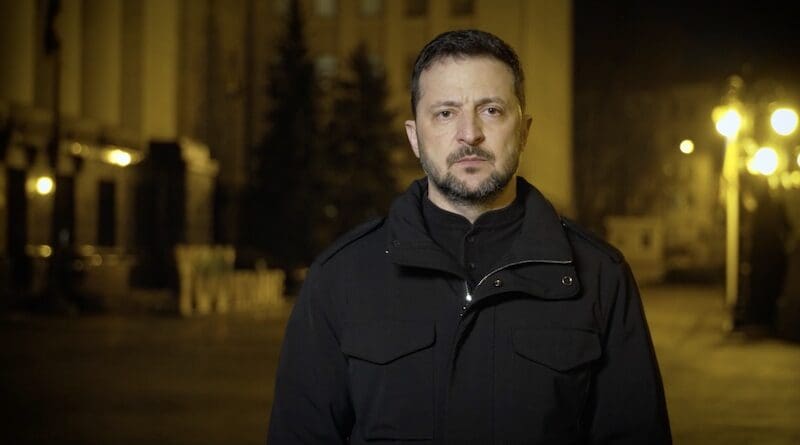
“Zelensky, the steadfast leader and fighter, stands strong with Ukrainians Resilience, Not Yet Outgunned, and Far From Out of the Reckoning.”
Ukraine’s President, Zelensky praised the conduct of Operation “Spiderweb.” It was a meticulously planned and executed Ukrainian drone offensive that struck deep into Russian territory on June 1, 2025. The operation targeted five major Russian airbases—Belaya (4,000km from Ukraine), Dyagilevo, Ivanovo Severny, Olenya, Ukrainka and Amur (over 8,000km from Ukraine) resulting in the destruction or disabling of approximately 41 military aircraft, including a significant portion of Russia’s strategic bomber fleet.
“Our people operated across several Russian regions – in three different time zones. And the people who assisted us were withdrawn from Russian territory before the operation, they are now safe,” the president said, without disclosing whether the agents were Ukrainian or Russian. Reigniting the legendary Greek mythological move using a wooden horse to destroy Troy’s unbreachable walls calling this as Russia’s ‘Trojan Horse’ moment. Ukraine’s security services launched one of the most audacious drone operations in modern military history across 4,000 kilometers of hostile territory.
Planning and Execution:
Planning and Execution: The operation was the culmination of over 18 monthshistory acrossraine’s Security Service (SBU), with direct oversight of President Zelensky. Ukrainian agents moved drones and explosives deep inside Russia, concealed within mobile structures mounted on trucks. These drones were launched remotely, catching Russian defenses off-guard. With the trucks positioned near Russian bases, the roof panels of the containers were lifted off by a remotely activated mechanism, allowing the drones to fly out and begin their attack. The drones had first-person view, or FPV, technology that allowed them to be operated remotely, probably from Ukrainian territory.
Targets and Impact: The strikes focused on Russia’s long-range aviation assets. Volodymyr Zelensky, said 117 drones were used in the operation, with a corresponding number of drone operators involved. He claimed 34% of “the strategic cruise missile carriers stationed at airbases were hit”. Ukraine’s SBU said the strikes damaged 41 planes used against Ukraine, though the full extent of the damage remained unclear.Among those it claimed to have hit were A-50 surveillance planes, the supersonic Tu-160 and Tu-22 bombers, and the massive Tu-95s, which were developed to carry nuclear bombs and now launch cruise missiles.
The operation significantly degraded Russia’s strategic air capabilities, Op “Spiderweb” can be compared its surprise and impact to the Pearl Harbour attack.
The Russian defence ministry confirmed that several of its military aircraft “caught fire” in the attack in the regions of Murmansk and Irkutsk. It added that there were no casualties and that several “participants” had been arrested.
Strategic Implications: The success of Operation “Spiderweb” underscores Ukraine’s evolving military tactics and its ability to conduct deep strikes into Russian territory. It also highlights vulnerabilities in Russia’s air defense systems and may influence future engagements in the ongoing conflict. This operation represents a significant moment in the Russia-Ukrainian War, demonstrating Ukraine’s resilience and strategic ingenuity in the face of ongoing aggression.
Crimea bridge linking Russia hit underwater
Ukraine has detonated a massive underwater blast targeting the key 12-mile-long Kerch bridge – a prestige project of the Russian president, Vladimir Putin road and rail bridge connecting the Russian-occupied Crimean peninsula to Russia, damaging its underwater supports. Road traffic on the bridge had been temporarily suspended for about four hours.
“Spiderweb” Revealed Vulnerability of Nations
Ukrainians revealed a vulnerability that should give every nation in the world sleepless nights. If the Ukrainians could sneak drones so close to major air bases in a police state such as Russia, what is to prevent the Chinese from doing the same with US air bases? Or the Pakistanis with Indian air bases?
Operation Spiderweb attack shows, yet again, that the Ukrainians are proving far more resilient and adaptable fighters than anyone had anticipated before the start of Russia’s full-scale invasion more than three years ago.
Kautilya places threats into four categories.
“The most serious one arises from internal originators and internal abettors and is like ‘the fear from a lurking snake’. Second to this is the purely external threat, both originated and abetted by foreigners. Third comes the internally originated but externally abetted threat, followed by the externally originated, internally abetted threat.
Lessons for India: Threats Exist
Non-state actors or rogue elements may still attempt drone or sleeper-cell-based attacks. Small drone attacks near border areas or urban centers are possible, like the 2021 Jammu airbase incident. Sleeper cells could coordinate with tech-savvy foreign handlers to stage attacks if not intercepted. Radicalized elements within Indian borders, particularly in border states or areas with historical tensions (e.g. J&K, Kerala, parts of UP), can act as enablers.
India, with a sizable minority population 200 million, the vast majority are law-abiding, patriotic citizens (Muslims, including those with potential cross-border affiliations), may be more vulnerable to infiltration or sleeper-cell operations than Pakistan, where the population is more ethnically/religiously homogeneous.
Pakistan could leverage sleeper cells more easily in India than vice versa, due to this complex sociopolitical landscape. India’s open society and demographic diversity can create opportunities for infiltration if exploited by a hostile actor like Pakistan.
Any attack deep inside India, especially by Pakistani-linked actors, would risk serious escalation. India has a “Cold Start” military doctrine for rapid retaliation. Pakistan’s leadership understands this. This is strategically valid to consider—and it’s something Indian security agencies have to remain deeply aware of.