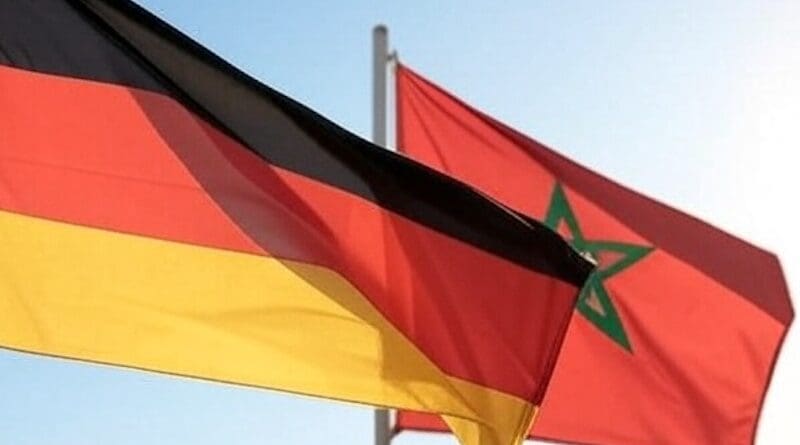
Morocco And Germany Are Quietly Crafting A Strategic Alliance – OpEd
As the global order undergoes profound reconfigurations, the diplomatic spotlight often misses some of the quieter, yet strategically significant realignments. One such case is unfolding between Morocco and Germany, two countries that are increasingly positioning themselves as pragmatic allies in a world of rising fragmentation. The recent phone call between Germany’s newly appointed Foreign Minister, Johann David Wadephul, and his Moroccan counterpart, Nasser Bourita, was not merely a formality. It was a signal—intentional and timely—of a deeper realignment underway.
The message from both sides was clear: the bilateral relationship is strong, future-oriented, and increasingly strategic. This comes after years of recalibration, most notably with the 2022 Rabat Joint Declaration, which laid the groundwork for a structured Strategic Dialogue between the two governments. The upcoming session of this dialogue, set to take place once again in Rabat, is more than a diplomatic ritual—it is the engine of a maturing partnership that combines shared interests with converging global outlooks.
Strategic Depth in a Fragmented Region
Germany views Morocco as a reliable partner in a turbulent regional environment marked by political instability in the Sahel, fragility in the Maghreb, and mounting migration pressures. Rabat offers Berlin something increasingly rare in its southern neighborhood: predictability, institutional stability, and geopolitical weight. At a time when the European Union is reassessing its southern partnerships, Morocco’s proactive diplomacy and reform-driven domestic agenda stand out.
Conversely, Germany provides Morocco with a crucial interlocutor within the EU’s decision-making core and a potential anchor for long-term investment, industrial cooperation, and multilateral alignment. This is not merely about bilateral trade or diplomacy—it is about positioning Morocco within the architecture of European strategic thinking, especially on issues such as energy security, climate transition, and migration management.
Green Hydrogen and the Politics of Energy Transition
One of the most promising dimensions of this partnership lies in the field of energy and climate cooperation. Morocco has emerged as a regional leader in renewables, especially in solar and wind infrastructure, and is rapidly scaling up its ambitions around green hydrogen production. Germany, looking to diversify its energy sources and reduce dependency on fossil fuels and geopolitically sensitive regions, sees Morocco as a credible, nearby, and scalable solution.
This is where the relationship transcends development aid and moves into co-investment and co-production. The potential for job creation, technological exchange, and industrial transformation is significant—both for Morocco’s economic future and for Germany’s decarbonization goals. In a multipolar energy landscape, Berlin and Rabat are aligning interests where geopolitics and climate policy intersect.
The Logic of Trusted Partnerships
In their conversation, both Wadephul and Bourita also emphasized the need for closer coordination on regional and international issues of strategic concern. These include instability in the Sahel, migration flows, counterterrorism cooperation, and the broader Africa-Europe agenda. Morocco’s unique positioning—African, Arab, Atlantic, and Mediterranean—gives it an outsized diplomatic reach. Germany, seeking more effective engagement with the African continent beyond the traditional aid paradigm, finds in Morocco a gateway, a partner, and a co-strategist.
What makes this relationship increasingly relevant is not its historical depth, but its strategic maturity. It is no longer based on asymmetry or conditionality but on shared responsibility and mutual value creation. This model of cooperation—focused on shared risks, joint planning, and long-term interests—may well offer a template for future EU-North Africa relations.
A Bilateral Relationship with Multilateral Impact
The Morocco-Germany dynamic is not an isolated story. It is a case study in how middle powers can proactively recalibrate their alliances, diversify their partnerships, and assert their agency in a shifting world order. As global institutions strain and traditional alliances are tested, it is these kinds of adaptive, quietly strategic relationships that may shape the contours of the next global chapter.
In a moment when diplomacy is often reactive, Rabat and Berlin are choosing to be deliberately forward-looking. Their emerging alliance is not built on nostalgia or ideological alignment, but on a realistic reading of interdependence, shared interests, and strategic geography.
And that, in today’s world, may be the most promising kind of diplomacy there is.

Like what you read?
Please consider supporting Eurasia Review. Thank you for your consideration!