South Korea In Crisis: How Political Turmoil Threatens Its Global Standing – OpEd
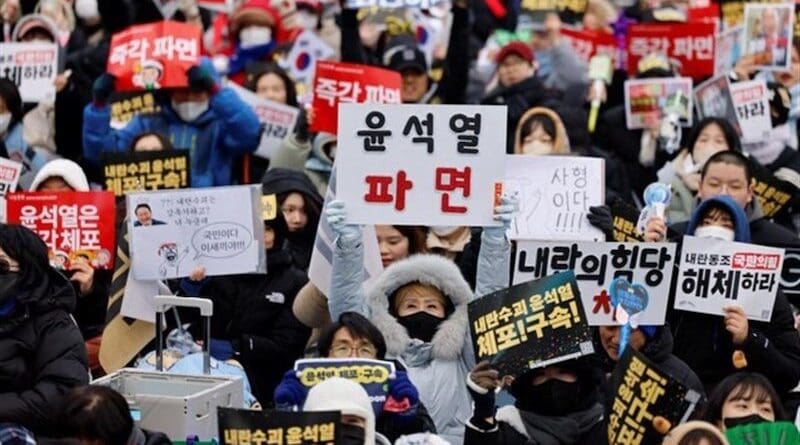
In December 2024 South Korea was faced with a major political crisis after the removal of President Yoon Suk Yeol. His impeachment charges of abuse power of and violation of the constitutional provisions on the separation of powers threw the country into political turmoil and impacted the country’s domestic and foreign affairs.
As one of the United States’ key Asian allies, South Korea’s political instability raises questions about the future of the South Korea-U.S. alliance, regional security, and policy effectiveness. Since North Korea’s nuclear threat and the rise of China are major issues in East Asia any turbulence in Seoul is not without consequences. This essay discusses the impact of political turmoil on the diplomatic relations of South Korea, the difficulties in the South Korea – United States relationship, and the general impact on the region.
President Yoon’s impeachment has left South Korea with a lapse of leadership that impacts the country’s capacity to deal with the US properly. With a government temporarily in power while the Constitutional Court considers Yoon’s future there is no strong leadership to bolster Seoul’s diplomatic position. Previous studies indicate that stability in governance is a necessary condition for effective foreign policy. Nonetheless given the circumstances in South Korea Washington may not be willing to commit long long-term strategic partnerships because of the possibility of changes political in Seoul.
The relations between South Korea and the United States is also affected by the fact that Yoon has been impeached. Investment sentiment turned negative and the markets tapered off as a result of political uncertainties. The Bank of Korea at its meeting in January 2025 discussed possible rate cuts given the heightened economic risks following political uncertainties. This financial instability may influence South Korea’s position in trade negotiations and economic relations with the U.S.
Furthermore, the level of political uncertainty in South Korea raises questions about the country’s capability to honor its military treaties and support security partnerships. Nevertheless, Seoul which is split between the two major political parties may not be in a position to make clear-cut foreign policy decisions a situation that may hinder the United States from increasing its security commitments. As the Indo-Pacific region remains a priority for American policy, Washington sees South Korea as a key partner in countering the North Korean threat and preserving regional stability.
One of the biggest issues in the preservation of the Korea South – United States alliance is the loss of trust. President Yoon’s administration has recently strengthened military relations with the United States, notably through the 2023 Washington Declaration, which reaffirmed their joint commitment to deterring North Korea. But his impeachment has everyone left guessing as to who will continue with these policies or if there will be a review of the relations with Washington.
Another issue is the political friction within South Korea. The far-right nationalist groups have come out to support Yoon while the opposition has called for a of change tact in foreign policy especially regarding China and North Korea. The drama it makes difficult to work out what is happening diplomatically as the different parts of South Korea want completely different foreign policy strategies. This instability may deter Washington from investing in long-term strategic partnerships because of the possibility of sudden policy changes.
Furthermore, the impeachment crisis has paved the way for North Korea to take advantage of the political weakness of South Korea. This early 2025 intelligence report indicated that there was an increase in the number of North Korean missile launches and had Seoul think that Pyongyang would take advantage of the political confusion to increase the provocation. The U.S. has expressed worries over the South Korean government, saying that it is not capable of tackling the security risks due to political instability. If Seoul is preoccupied with internal political disputes, its deterrence against North Korea may be diminished, prompting the United States to reconsider its defense commitments in the region. The effects of political risk in South Korea are not only limited to its relationship with the United States. The lack of clarity on government measures has led to FDI downbeat by multinational corporations which are not willing to commit to long-term projects. The Korea Trade Investment and Promotion Agency (KOTRA) data shows foreign investment inflows decreased by 7% in the last quarter of 2024 due to political risks in South Korea.
In the security sector, the relationship between South Korea, Japan, and the United States may also be influenced. The historic Camp David Summit in 2023 provided a platform for the enhancement of security cooperation among the three countries. However, with Seoul’s leadership uncertain, the progress achieved through these agreements may be jeopardized. Japan is wary of the political risks in South Korea and may choose to focus on its relationship with the United States, potentially at the expense of ties with Seoul.
Furthermore, following the domestic issues may limit South Korea’s response to regional conflicts that are not connected to the Korean Peninsula. The South China Sea is another disputed region with China claiming sovereignty over the waters. South Korea has always adopted a position of freedom supporting navigation operations led by the US Navy. However, with a politically frail administration, Seoul may adopt a more cautious position on the issue which may affect its relations with the United States and encourage Chinese expansionism in the region.
In conclusion, President Yoon Yeol Suk’s impeachment has created political instability in South Korea, affecting the stability of domestic policies as well as foreign and security relations. The lack of strong leadership undermines its diplomatic position with the United States, while uncertain economic conditions and diminished investor confidence complicate trade, military, and other agreements. This crisis also provides opportunities for North Korea and China to exploit South Korea’s weakened potentially state-shifting regional dynamics. To preserve alliances and strategic partnerships South Korea must restore political stability and demonstrate a consistent foreign policy to safeguard its national interests and regional security.
The opinions expressed in this article are the author’s own.
References
Kim, J. (2023). Geopolitics of the Korean Peninsula: Security, Economy, and Diplomacy in a Changing World. Routledge.
Lee, H. (2023). The U.S.–South Korea Alliance in the Indo-Pacific Era: Security, Trade, and Political Uncertainty. Palgrave Macmillan.
Park, S. (2023). North Korea’s Strategy and East Asian Security: Implications for South Korea and Its Allies. Springer.