The Maritime Turn In Indian Strategy: Restraint On Land, Expansion At Sea, And The Emerging Stability Dilemma – OpEd
The growing emphasis on maritime power in Indian strategic thinking is often presented as a natural evolution of a rising regional actor seeking a broader Indo-Pacific role. Yet from a South Asian stability perspective, particularly Pakistan’s security environment, this maritime shift cannot be separated from the structural pressures generated by the India-Pakistan nuclear dyad. As highlighted in recent International Security scholarship on the “cost of restraint,” India’s inability to achieve decisive conventional outcomes on land is not reducing competition; it is displacing it into new domains. The maritime sphere is becoming the primary beneficiary of this displacement. This is not a neutral transformation. It reflects an asymmetrical redistribution of capabilities that risks expanding instability rather than containing it.
India’s self-described doctrine of strategic restraint vis-à-vis Pakistan has often been presented as a stabilizing feature of South Asia’s nuclear environment. In practice, however, this restraint is neither absolute nor consistent; it is better understood as conditional behaviour shaped and constrained by nuclear deterrence dynamics. Episodes such as the crises of 1999, 2001–02, 2008, 2016, 2019, and 2025 demonstrate that escalation has been limited not by restraint alone, but by the persistent risk of nuclear escalation.
At the same time, restraint has not necessarily reduced India’s coercive options; rather, it has contributed to their reconfiguration. With large-scale conventional war increasingly constrained on land under nuclear shadow, India has gradually expanded its strategic toolkit into the maritime domain, where operational space is broader and escalation thresholds are more ambiguous.
This shift does not amount to genuine de-escalation. Instead, it reflects a geographic and domain-based relocation of coercive pressure, where competitive advantage can be pursued in less clearly defined escalation environments without crossing established land-based thresholds.
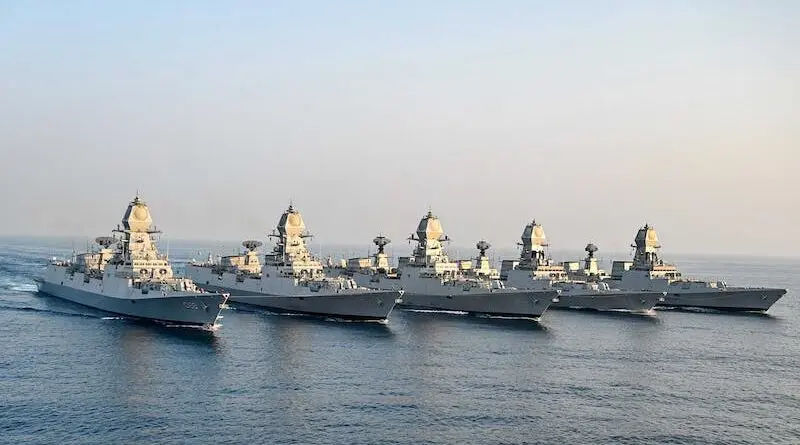
India’s naval modernization, carrier aviation, nuclear-powered submarines, long-range maritime surveillance, and expanded presence in the Indian Ocean, is often justified in terms of China’s regional rise. However, in South Asia’s interconnected security environment, maritime capability development inevitably affects the India-Pakistan balance largely.
The Indian Ocean is not a neutral arena. It is increasingly an extension of South Asia’s strategic rivalry, albeit in a less transparent and less regulated form than the land border. This raises three concerns for Pakistan. First, maritime asymmetry expands India’s coercive signaling capacity without reciprocal vulnerability at comparable levels. Second, the absence of clearly defined naval confidence-building measures increases the risk of misperception in crisis scenarios. Third, the integration of advanced surveillance and submarine capabilities compresses Pakistan’s strategic decision space at sea. In this sense, maritime expansion does not sit outside the India-Pakistan rivalry, it intensifies it under different conditions.
A key argument in contemporary strategic literature is that nuclear weapons do not eliminate rivalry; they restructure it. In South Asia, this restructuring has produced a persistent pattern: conventional war is constrained, sub-conventional competition persists, and military modernization shifts into alternative domains.
The Indian maritime shift is a textbook case of this dynamic. India’s inability to escalate freely on land under nuclear conditions creates incentives to seek compensatory domains of dominance. Sea power becomes a vehicle for restoring strategic initiative.
However, this compensation logic is inherently destabilizing. It does not resolve the underlying security dilemma; it relocates it. The risk is that competition becomes geographically dispersed while remaining strategically unified, making it harder to manage through existing crisis mechanisms.
One of the more complex implications of maritime militarization is its interaction with nuclear deterrence itself. Both India and Pakistan are strengthening the sea-based nuclear capabilities to ensure second-strike capability. In principle, this enhances deterrence stability by ensuring retaliation capability even under extreme scenarios.
Yet, the maritime domain introduces new layers of ambiguity. Dual-use platforms, extended patrol areas, and the integration of advanced sensing and tracking systems complicate threat assessment. In a crisis, distinguishing between conventional naval movement and strategic nuclear signaling becomes increasingly difficult.
This ambiguity does not necessarily increase the likelihood of deliberate escalation, but it does increase the risk of misinterpretation, particularly in fast-moving crisis environments where decision timelines are compressed.
A central concern from the Pakistani strategic outlook is that regional stability cannot be sustained through asymmetry expansion in new domains. Stability in South Asia has traditionally depended on a rough equilibrium of deterrence at the strategic level, even if conventional asymmetries exist.
Maritime modernization risks disturbing this balance by introducing a domain where asymmetry is more pronounced, less visible, and less regulated. Unlike the land frontier, where escalation pathways are well understood despite their risks, the maritime environment lacks mature crisis management architecture between India and Pakistan. This creates a situation in which stability becomes more fragile even as formal deterrence remains intact.
The narrative of Indian strategic restraint has often been associated with regional stability. However, when examined through the lens of its structural consequences, restraint appears less as a stabilizing doctrine and more as a constraint that redistributes competition across domains.
The maritime turn in Indian strategy illustrates this clearly. Nuclear deterrence has reduced the likelihood of full-scale war on land, but it has simultaneously encouraged the expansion of competition into the Indian Ocean, where asymmetries are widening and regulatory frameworks remain underdeveloped.
The result is not a stable equilibrium, but a reconfigured rivalry: one that is less visible than land confrontation, but potentially more complex in its escalation dynamics.
In this evolving environment, the challenge for South Asia is not simply to preserve deterrence stability on land, but to prevent the maritime domain from becoming the next arena of unchecked strategic accumulation. Without deliberate mechanisms for restraint at sea, the region risks replacing one managed instability with another, less predictable, more dispersed, and harder to control.