
Hybrid Conflict Along The Durand Line: Militancy, Coercion, And Economic Pressure – Analysis
By Suraj Yadav and Dr. Manish Kumar Yadav
Introduction
While much of the world watches the standoff between the U.S.A, Israel, and Iran in the Middle East, there is another war in the making in the near neighbourhood. Cross-border attacks, militant infiltrations, and counterstrikes are increasingly common along the Durand Line.
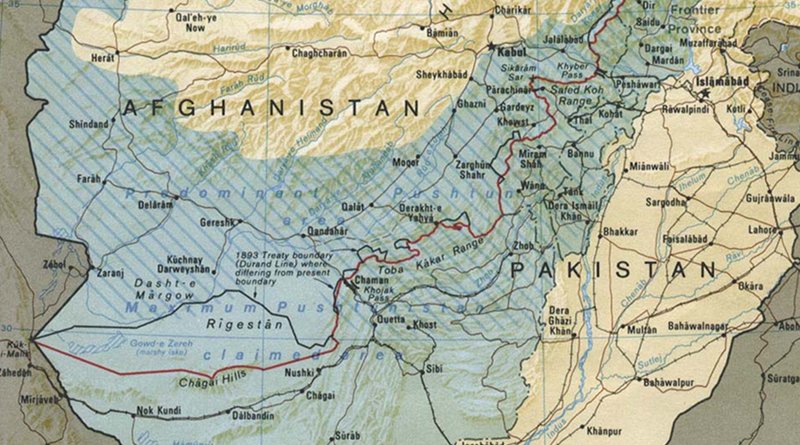
Yet the Pakistan-Afghanistan conflict receives little international attention. The Durand line (Colonial Border), drawn in 1893 by Afghan Emir Abdur Rahman Khan and Sir Mortimer Durand, has long been shaped by imperial rivalry. During the nineteenth century’s “Great Game” between the British and the Russian Empire, the region, also known as the “Graveyard of Empires,” served as a buffer zone for British India, and the Durand Line formalised this geopolitical frontier.
Relations between Islamabad and Kabul have largely deteriorated due to militant groups operating from Afghan territory. One of those groups, the Tehreek-e-Taliban Pakistan (TTP), has allegedly carried out approximately 600 attacks on Pakistani troops in 2025.
Over 30 million Pashtuns live on both sides of the border, complicating efforts to check and prevent militant movement.
This article argues that the Pakistan-Afghanistan border is increasingly evolving into a zone of hybrid conflict driven by the resurgence of the TTP, Pakistan’s growing reliance on cross-border military coercion, and the use of economic pressure to compel the Taliban government to act against havens of Terrorists.
The Resurgence of TTP Militancy Along Pakistan’s Western Frontier
The Tehreek-e-Taliban Pakistan (TTP) has become the most prominent security threat along Pakistan’s western frontier. Pakistan has blamed Afghanistan for harbouring the TTP, Jamaat ul Ahrar, a splinter group of the TTP, and other militant groups such as the Balochistan Liberation Army (BLA), also referred to as “Fitna al Hindustan,” and the Islamic State Khorasan Province (ISKP), although the Islamic Emirate of Afghanistan denies those claims.
With the Taliban’s return to power in August 2021, the TTP regrouped and expanded. Islamabad is also concerned about potential collaboration between the TTP and other militant organisations active in the region, mentioned above.
The TTP has consistently stated that it would cease its attacks if Pakistan surrendered control over the former tribal areas and reversed its decision to merge the Federally Administered Tribal Areas (FATA) into Khyber Pakhtunkhwa; a position that Pakistan rejects. Moreover, Islamabad has attempted to negotiate with the TTP on multiple occasions, but these efforts have repeatedly collapsed.
The scale of the security challenge facing Pakistan has grown. Between June and September 2025, militant infiltration from Afghanistan into Pakistan increased significantly. Islamabad, on the other hand, has responded by conducting aerial attacks on militant positions inside Afghanistan, and with requests to the Taliban government to target TTP training camps inside Afghanistan. However, Pakistan’s approach to addressing this issue is constrained by rapidly shifting geopolitical dynamics in the region. Consequently, Islamabad’s ability to use military force and diplomatic pressure against the Taliban government to mitigate TTP safe havens in Afghanistan is being challenged.
Rising Pakistan-Taliban Tensions and the Breakdown of Border Stability
Since August 2021, the relative stability of the Af-Pak border has decreased dramatically. From Pakistan’s perspective, the return of the Taliban to power in Afghanistan created a haven for militant groups operating against Pakistan. Conversely, the Taliban viewed Pakistan’s military actions in Afghanistan as an infringement upon Afghanistan’s sovereignty.
Islamabad’s hard-line policy toward Kabul became evident in the region in December 2025, when, during a regional conference held under the auspices of the Tehran Format. Pakistan called for greater international pressure to be applied to the Taliban regarding cross-border terrorist activities. While Pakistan received partial support from some attending nations, the call for collective action did not result in a joint communiqué. Furthermore, many regional actors like P R China. Uzbekistan, Iran, India, and Qatar are increasingly seeking bilateral engagements with the Taliban to promote strategic and economic interests, thereby isolating Pakistan in its efforts to highlight militant sanctuaries in Afghanistan.
Afghanistan’s reluctance to act against the TTP stems also from ideological affinity, Pashtun tribal ties, and an aversion to external influence on its internal decision-making centred on Rehbari Shura (Leadership Council). Strategic considerations may also play a role, as severing ties with the TTP could destabilise the Taliban internally.
The TTP further exacerbates the situation by making demands that directly contradict Pakistan’s sovereignty as a nation-state. As earlier stated, its opposition to the merger of FATA with Khyber Pakhtunkhwa, and its demand for the release of its jailed members as a precondition for peaceful negotiations, is a case in point.
Islamabad has also accused Kabul of permitting militant groups on Afghan soil that target Pakistan. The Taliban led government of Afghanistan has refuted these claims, stating it will not allow any group to utilise Afghan territory to attack neighbouring countries.
The continued incursions of militants into Pakistan and declining diplomatic relations have prompted Islamabad to use coercive methods, including cross-border military fire and economic sanctions. The Durand Line has thus become an active fault line in South Asia’s evolving security environment.
Cross-Border Airstrikes and Pakistan’s Strategy of Coercive Signalling
Pakistan’s increased reliance upon cross-border airstrikes represents a larger trend toward coercive signalling within Islamabad’s Afghanistan policy. Amid rising TTP attacks and Kabul’s perceived inaction against militant safe havens, Islamabad has used cross-border strikes to demonstrate its resolve.
This trend became evident in December 2024, when Pakistan launched cross-border military strikes in Afghanistan’s Khost and Paktika provinces in response to a militant attack that killed 16 Pakistani soldiers. Islamabad said the operation was a targeted strike against TTP positions utilising Afghan territory. The Afghan Taliban government condemned the attack as an infringement on Afghan sovereignty. As tensions escalated, the TTP abducted several Pakistani civilian employees of the Atomic Energy Department, highlighting the volatile nature of the conflict. The pattern continued through late 2025 and early 2026, when Pakistan carried out further cross-border strikes and warned that it would act unilaterally against militant sanctuaries inside Afghanistan if Kabul failed to address the TTP threat.
The strikes reflect a shift toward proactive counter-terrorism operations. Pakistan’s cross-border strikes increasingly resemble extraterritorial counter-terrorism operations conducted by states such as Turkey against Kurdish militants in Iraq and Syria.
Pakistan’s cross-border strikes also serve as strategic signalling aimed at pressuring Afghanistan to limit militant activity, though such actions may further escalate tensions. As long as militant violence persists and trust between Islamabad and Kabul deteriorates, cross-border military coercion will remain a significant component of Pakistan’s strategy toward Afghanistan. This dynamic reflects the clear and present danger of TTP for Pakistan and the limits of traditional diplomacy in addressing it.
Economic Pressure and the Decline of Pakistan-Afghanistan Trade
In 2021, Pakistan’s exports to Afghanistan stood at USD 1025.5 million. In recent years, however, bilateral trade patterns have fluctuated. Pakistan’s exports to Afghanistan reached approximately USD 1.644 billion in 2024. Still, they declined to about USD 1.261 billion in 2025, reflecting growing political tensions and repeated border disruptions, with some sectors of Pakistan-Afghanistan trade reportedly declining by nearly 56 per cent during prolonged border closures.
Historically, Afghanistan has been reliant on Pakistan for pharmaceutical supplies. Given Afghanistan’s limited domestic production of medicines, the country relies on Pakistan for more than 60 per cent of its medicines. The Taliban’s ban on Pakistani medicines demonstrates how insurgency-driven tension is constraining Pakistan’s exports and diminishing Pakistan’s ability to utilise trade leverage with Afghanistan.
On the other hand, amidst deteriorating ties with the Taliban-led government, Pakistan has become increasingly reliant on economic restrictions and regulatory measures as tools of pressure. In 2023, Islamabad prohibited the export of 212 items to Afghanistan and implemented a 10% processing fee on Afghanistan’s transit trade. The latter was designed to limit smuggling and curtail an estimated PKR 180 billion in annual losses generated from illicit re-exports.
These actions reflect Pakistan’s increasing reliance on trade restrictions to pressure Afghanistan. Restrictive trade policies have also taken the form of border closures and logistics disruption. For example, border closures have resulted in over 11,000 Afghan truckers being stranded for nearly a month at the strategic border crossings of Torkham & Chaman. These events illustrate the extent to which Pakistan has utilised trade sanctions, border closures, and restrictive trade policies as tools of strategic pressure on Afghanistan.
As a consequence of these trade restrictions along the Af-Pak border, the frontier economy and informal commercial networks have been negatively impacted. Afghanistan’s landlocked geography requires transit agreements with neighbouring states, particularly Pakistan and Iran, to access seaports such as Gwadar and Chabahar for international trade. Historically, most Afghan trade has passed through Pakistan, but transit volumes have sharply declined in recent years. Trade through Pakistan fell by nearly 66 per cent in 2024–2025 due to stricter anti-smuggling measures, import restrictions, and periodic border closures. At the same time, Afghanistan has increasingly relied on Iran’s Chabahar Port to diversify its trade routes and reduce dependence on Pakistan. Political tensions, restrictive policies, and structural constraints have further contributed to declining trade flows, highlighting how instability and fragmented economic policies are weakening Pakistan’s long-standing economic influence over Afghanistan.
Conclusion
The Af-Pak border is increasingly evolving into an arena of hybrid conflict shaped by militancy, cross-border coercion, and economic pressure. The persistent presence of the TTP within Afghanistan continues to be the primary driver of tension between Kabul and Islamabad. Pakistan’s increased reliance on aerial strikes and trade embargos against Afghanistan threatens to create a protracted and recurring crisis area across the Durand Line. Unless both governments address the core problems of terror havens and rebuild diplomatic trust, instability along the Durand Line will continue to shape South Asia’s evolving security environment.
About the authors:
- Suraj Yadav is a Geopolitical risk analyst specialising in International security and Defence policy. He holds an M.A. in Diplomacy, Law, and Business from O.P. Jindal Global University and has worked with the Centre for Land Warfare Studies (CLAWS) and the United Service Institution of India (USI).
- Dr. Manish Kumar Yadav is a former senior faculty member at the School of Law, Fairfield Institute of Management and Technology, GGSIP University, New Delhi, and has served as Associate Professor and Head at NHERI Asmara University, Eritrea. He is a V. K. Krishna Menon Memorial Gold Medal awardee, Associate Member of the Institute of Defence Studies and Analyses, and has served with UNV-UNDP in Malawi.


