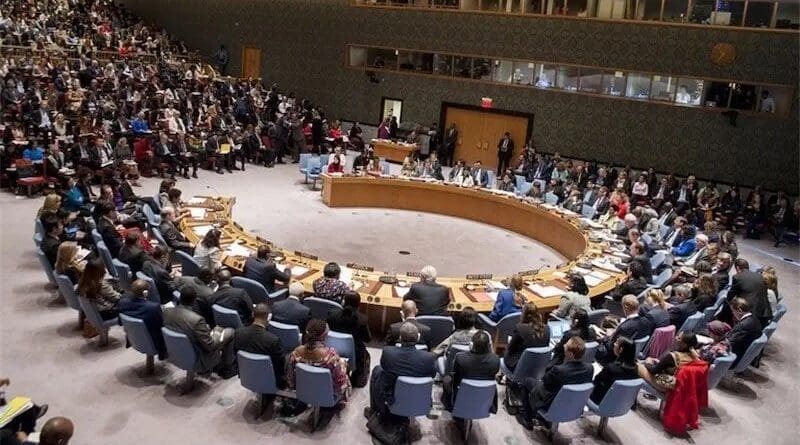
The United Nations Must Reform Its Veto Power Before The Rules-Based Order Collapses – OpEd
By Dr Jose Mario Bautista Maximiano
I have decided to provide an assertion that is not rooted in ideology, religion, or national interest. My argument arises from something more fundamental: Natural Law and universal human reason. Across cultures, civilizations, and political systems, people generally recognize certain moral truths, that every person possesses an intrinsic worth tied simply to their humanity—which transcends class, race, gender, or abilities—that no one can flourish in isolation, that power should be accountable, and that justice should not depend on whether one is strong or weak.
These fundamental principles belong not to any one nation but to humanity itself. If the United Nations is to remain credible, its institutions must reflect these universal standards.
The United Nations was created after World War II to ensure that international disputes would be governed by law rather than force. Yet eighty years later, the institution faces a growing crisis of legitimacy. The problem is not that international law lacks principles. The problem is that those principles are often applied selectively.
When powerful states can ignore legal rulings, block accountability, or shield allies through the veto power, people around the world begin to wonder whether international law is truly law—or merely a suggestion for the weak.
The consequences are not abstract
Consider the 2016 arbitral ruling under the United Nations Convention on the Law of the Sea (UNCLOS), which rejected the legal basis of China’s Nine-Dash Line claim in the South China Sea. The ruling was celebrated as a victory for international law. Yet years later, Filipino fishermen continue to report harassment and restricted access to traditional fishing grounds. For them, the issue is not legal theory but food on the table, fuel for their boats, and the survival of their families.
Consider Gaza, where repeated cycles of warfare have produced immense civilian suffering while the international community remains deeply divided over accountability and enforcement. Whether one focuses on Israeli security concerns or Palestinian humanitarian suffering, the same question emerges: What happens when international institutions appear unable to act consistently during humanitarian crises?
Consider the war in Ukraine. The United Nations has repeatedly condemned violations of international law, yet the Security Council remains constrained because one of its permanent members is directly involved in the conflict. The world watches a system designed to preserve peace struggle to respond when one of its most powerful members becomes a party to the dispute.
These cases differ in history and context, but they reveal the same structural weakness. When legal rules cannot be enforced against the powerful, faith in the rules-based order begins to erode. Citizens of smaller nations naturally ask: If international law cannot protect us when it matters most, what exactly is it protecting?
At the center of this crisis lies the Security Council veto. Created in 1945 to secure the participation of the great powers, the veto has increasingly become a mechanism of paralysis. A single permanent member can block collective action even when overwhelming international concern exists.
Some reformers argue for expanding permanent membership to include African nations, major developing countries, or even the Holy See as a moral voice for humanity. Such reforms would improve representation. Africa, home to nearly one-fifth of the world’s population, deserves a stronger presence in global governance. The Global South should likewise have a greater voice in decisions that profoundly affect its future.
Yet representation alone will not solve the problem. Expanding the circle of privilege does not eliminate privilege. The deeper question is whether any nation should possess the authority to indefinitely block action when fundamental human dignity and the common good are at stake.
The United Nations should therefore adopt a Humanity Clause.
Under this reform, a Security Council veto could be overridden when a supermajority—perhaps two-thirds of the General Assembly—determines that a humanitarian catastrophe, mass atrocity, or grave violation of international law is occurring. Such a mechanism would preserve the Security Council while recognizing a basic moral principle accessible to all peoples through reason, that no state’s geopolitical interests should permanently outweigh the protection of human life.
A second reform is equally necessary. International legal rulings must carry consequences.
The United Nations should establish an Enforcement Trigger Clause. Under this rule, when a recognized international tribunal issues a final ruling and a state refuses compliance after a reasonable review period, predetermined diplomatic or economic measures would automatically take effect. The objective is not punishment for its own sake but the preservation of legal credibility. Laws without enforcement gradually become recommendations.
The ultimate question is simple. Should international law apply equally to all nations, or only to those unable to resist it?
Natural Law and universal human reason point toward the same answer. Justice loses its meaning when it depends on power. A truly rules-based international order requires more than eloquent declarations. It requires institutions capable of binding power to responsibility.
The United Nations remains humanity’s most ambitious attempt to replace force with law. But if the law is seen as optional for the strong and obligatory only for the weak, the moral foundation of that project will continue to erode. Reform is therefore not only a political necessity but also a moral imperative for anyone who believes that human dignity, justice, and the common good should belong equally to all nations and peoples.