
Behind Iran’s Longstanding Ambition To Destroy Israel – Analysis
By Yossi Mansharof
Introduction
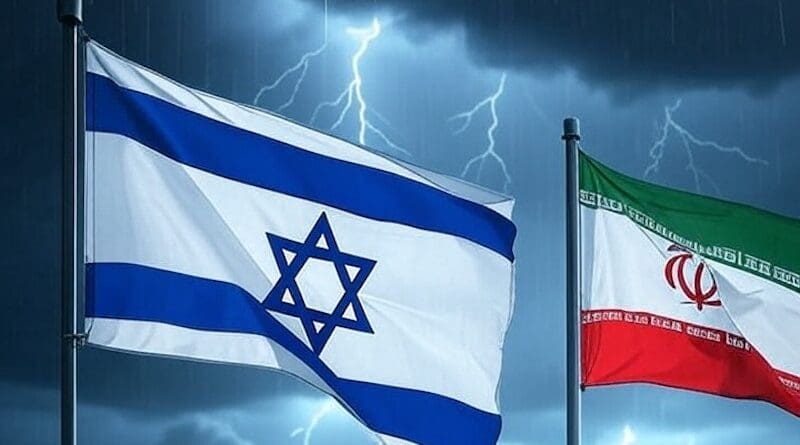
Since its inception, the Islamic Republic of Iran has inscribed the ambition to eliminate Israel on its banner, advancing both diplomatic and military pathways toward this objective. In 2015, Ali Khamenei articulated a concrete timeline for the first time, declaring that Israel had at most twenty-five years of existence remaining, effectively setting a target for 2040.[1] This vision has since been accompanied by parallel efforts. Diplomatically, Iran has promoted the idea of a referendum among those who lived in Israel and Palestine prior to 1948—Jews, Christians, and Muslims—despite the expectation that the Muslim majority at the time would predetermine the outcome. Militarily, senior Iranian official Hossein Amir-Abdollahian revealed in 2018 that Iran was advancing an operational plan to realize this objective. Speaking at the Exhibition[2] in Tehran on February 27, 2018, he confirmed the plan’s existence while declining to disclose its details.[3]
Documents seized by the Israeli Defense Forces (IDF) in Gaza during the Iron Swords War (October 2023-January 2026) revealed coordination between Hamas, Hezbollah, and Tehran regarding the October 7 attack. Yahya Sinwar, however, appeared to have initiated the operation without waiting for final coordination among the parties.[4] Following the October 7 massacre attack, Islamic Revolutionary Guard Corps (IRGC) Commander Hossein Salami (December 1, 2023); later eliminated in the June 2025 war between Israel and Iran) and Mahdi Mohammadi (November 1, 2025), an advisor to Parliament Speaker Mohammad Bagher Ghalibaf, called for an enhanced and lesson-learned massacre, involving all elements of the Axis of Resistance, in order to destroy Israel.[5] Even after the elimination of Khamenei in the opening phase of the current war, the regime’s spokesmen have remained committed to the objective of eradicating Israel. This enduring ambition was clearly reflected during the Quds Day events on March 13, 2026 when official rhetoric continued to emphasize the annihilation of Israel.”[6]

Iran does not share a geographical border with Israel and has no territorial dispute with it. Opposition within Iranian society to this ambition and the extensive financial support provided to Hamas and Hezbollah has been expressed in the slogan heard during protests since 2009: “Not Gaza, not Lebanon, I will sacrifice my life for Iran.” The regime critic and intellectual Sadegh Zibakalam has also voiced the anger of many opponents of the regime regarding the vast resources allocated to this goal. In numerous interviews, he has asked defiantly: “Who assigned the Iranian regime the task of destroying Israel?,” noting that no territorial dispute exists between the two countries.[7]
An analysis of the motives behind Iran’s aspiration to eliminate Israel reveals a complex web of political theology, historical memory, and geopolitical strategy. This is not a territorial dispute but an existential confrontation rooted in the ideological principles of the Islamic Revolution. Iran’s ambition to eliminate Israel stems from several mutually reinforcing motives: ideological antisemitism rooted in the thought of the Islamic Republic’s founders; an anti-imperialist doctrine that frames Israel as a U.S. outpost; geopolitical calculations aimed at exporting the Islamic Revolution and expanding Iranian influence in the Muslim world; a theological-legal perception of Palestine as Islamic waqf land; and historical narratives of revenge linked to the revolutionary struggle against the Pahlavi regime. Together, these elements create an ideological framework in which the elimination of Israel is perceived not merely as a strategic objective but as a historical and religious mission.
The Ideological Foundations of Antisemitism: From the Schools of Khomeini and Khamenei
At the root of this hostility lies an antisemitic motif drawn from the thought of the regime’s founder, Ruhollah Khomeini. In his work The Islamic Government (1970), in which he presented his political doctrine of the guardianship of the Islamic jurist, Khomeini portrayed Jews as cunning and resourceful actors seeking to distort the content of the Qur’an and uproot Islam because they oppose its very essence. He described the Jews as adversaries who have fought Islam since its emergence and warned that they aspire to dominate the world and oppose, together with the West, the ambition of Islam to spread to the four corners of the earth. According to Khomeini, Jews initiated propaganda against Islam in order to undermine its most important element—its character as a comprehensive and eternal system of law guiding the governance of the state and society.[8]
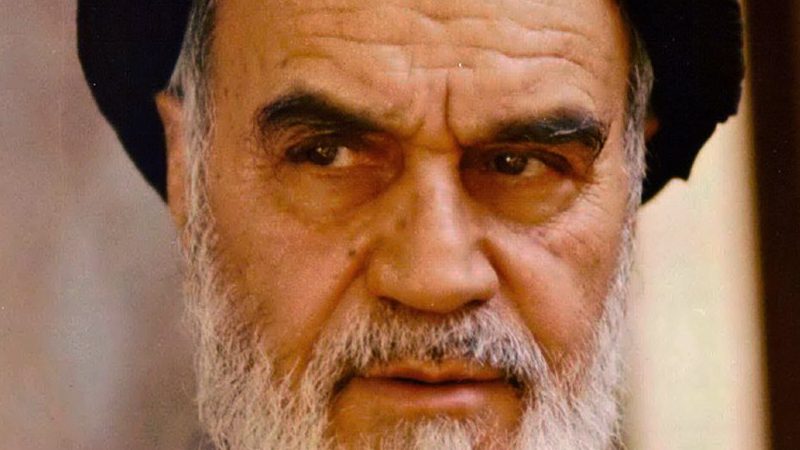
This perception became particularly prominent during Khamenei’s leadership. Although Khamenei claimed, in a speech in November 2019, that his regime did not oppose Jews but rather Zionism,[9] the obsessive manner in which the regime under his leadership promoted antisemitism is significant. He denied the Holocaust and turned Iran into one of the most prominent Holocaust-denying regimes, while describing Israel as a “cancerous tumor that will certainly be uprooted,”[10] in language characteristic of classic antisemitic discourse. Cultural and educational materials circulated in Iran depicted Jews as pursuing global domination.
Under Khamenei’s leadership, the Islamic regime promoted antisemitic content through the hosting of international Holocaust deniers, in television series broadcasts by the state media, and in a variety of cultural productions. Some textbooks within the education system portray Jews as conspirators against Muhammad and the Muslims, and even present their alleged control of the media as a factor damaging the cultural identity of non-Western societies. These books also frequently link Jews to the Freemasons, directly invoking the longstanding antisemitic myth of a conspiracy between Jews and that European fraternal movement—a theme widely circulated in antisemitic propaganda since the late nineteenth century as evidence of a supposed “global Jewish takeover.”[11]
In direct connection with this antisemitic narrative cultivated under Khamenei, one may also note the poster published by his office for Quds Day in 2020, under the provocative title “The Final Solution,” depicting the Temple Mount conquered by the so-called Axis of Resistance.[12]

The Anti-Imperialist Dimension
To the antisemitic layer, a distinct anti-imperialist dimension is added. The regime in Tehran views Israel as the LittleSatan, a forward outpost of Western imperialism led by the United States, the Great Satan, designed to dominate the Muslim world and plunder its resources. Khomeini framed Israel as the vanguard of imperialism and warned that its ultimate goal was the takeover of the entire Middle East “from the Nile to the Euphrates.”[13]
The roots of the regime’s anti-imperialist orientation lie partly in the influence of Ali Shari’ati—one of the prominent theorists of the Islamic Revolution—on Khomeini in the 1970s. Khomeini adopted Shari’ati’s terms opppressors (mostakberan) and oppressed (mostazafan), which are derived from Marxist terminology. However, while Shari’ati treated these concepts as socioeconomic categories—the rich versus the poor—Khomeini gave them a theological-political interpretation. In his view, even a wealthy country such as Iran could be considered mostazafan if it was oppressed by the West, as he believed Iran had been under the Pahlavi monarchy. Conversely, even a poor individual could be deemed mostakber if they supported Western values, as he believed was the case with intellectuals and workers who continued to adhere to liberal or Western ideals.
During his struggle against Mohammad Reza Shah, Khomeini used these terms to grant the local political struggle against the shah a global dimension, framing it as part of a broader confrontation with American and Zionist imperialism. After the revolution, Khomeini designated Iran to serve as the vanguard of the oppressed and to export its revolution to the world of the oppressed so that they could overcome the arrogant ones. Accordingly, on July 18, 1988, he stated that “our war is a war of faith and therefore recognizes no borders,” and his followers anchored the project of exporting the revolution in the constitution of the Islamic Republic. The anti-imperialist component was intended to help Iran gradually become a global power, positioning itself as the leader of a bloc struggling against the West, led by the United States.
As Khomeini stated, “I hope that one party named the Party of the Oppressed will arise throughout the world, and these oppressed, who hold all the powers, will stand against the arrogant [August 19, 1979].” He argued, “We intend to break the great powers . . . .We must push this movement forward so that, with God’s help, not only in Iran but everywhere in the world, the oppressed will prevail over the arrogant [March 1, 1980].”[14]
In Khamenei’s anti-U.S. doctrine, the 1953 coup and the era of U.S. dominance in Iran during the rule of Mohammad Reza Shah serve as proof of the fundamental hostility of the United States toward Iran’s independence. In this view, the relationship between Iran and the United States constitutes an identity-based struggle that cannot be bridged unless one of the sides changes its essence. Opposition to the United States is therefore a cornerstone in the thought of both Khomeini and Khamenei, and a defining element in the ideological architecture of the regime.
As a derivative of this worldview, the ambition to eliminate Israel forms part of the broader struggle against the United States. In this view, Israel is a U.S. satellite and plays a central role in advancing U.S. ambitions in the Middle East, undermining the independence of Iran and other Muslim countries. In summary, according to Khamenei’s doctrine, Israel is a tool in the hands of the United States for promoting Western hegemony; therefore, its elimination is seen as a necessary condition for authentic Muslim sovereignty and for the establishment of a new regional order in which Iran serves as the central axis.
The Geopolitical Dimension
The vision of eliminating Israel allows the Iranian regime to communicate with Arab audiences in the Middle East over the heads of their rulers, thereby undermining them in the name of adherence to the ideal of Palestine. As early as August 1979, Khomeini called for a joint pan-Islamic struggle to eliminate Israel and established the last Friday of the month of Ramadan as Quds Day to express and promote this ambition. Adherence to the Palestinian cause became a litmus test, in the eyes of Khomeini, and later Khamenei, for assessing the legitimacy of Arab regimes. Those that retreated from this ideal were denounced as “servants of the Americans.” In this way, the vision of eliminating Israel served Iran as a tool for promoting its ambitions to export the Islamic Revolution and achieve regional hegemony.
The commitment to struggle against Israel helped Iran establish ties with Shiite communities in Lebanon, Iraq, Yemen, Bahrain, and Saudi Arabia and even enabled it to create and nurture networks of militias within them. At the same time, by wielding the Palestinian cause, Iran also forged connections with Sunni circles, thereby bridging the gap created by its position as a Shiite Persian minority in a region that is predominantly Arab and Sunni. For Iran, anti-Zionism functions as the “common language” of the Middle East. It allows the Shiite Persian minority to speak in terms of universal Islamic justice, thereby blunting Arab Sunni fears of the expansion of a new Persian empire. The struggle against Israel thus serves, or is intended to serve, as Iran’s “entry ticket” into the heart of the Arab consensus.
Accordingly, Saudi Arabia has in the past argued that Iranian involvement in the Palestinian issue is illegitimate, since it is fundamentally an Arab issue, and has accused Iran of exploiting it as a tool for subversion in the Arab world. In response, Iran emphasizes that the Palestinian cause is an Islamic issue. The Palestinian issue therefore stands as a central pillar of Iran’s regional policy. Khamenei has repeatedly emphasized over the years that it must remain the leading issue for the Muslim world, even during periods of major regional upheaval such as the Arab Spring and the rise of ISIS. Reflecting his deeply conspiratorial outlook, he has even claimed that the ISIS crisis was manufactured by the West in order to divert Muslim attention away from the Palestinian issue and thereby serve Israel.
Khamenei feared that countries in the region would become preoccupied with their own crises, whether through the fight against ISIS or through internal conflicts, thereby weakening their focus and mobilization in support of the Palestinian struggle.
The Religious-Legal Barrier
Alongside antisemitic, anti-imperialist, and geopolitical motives, Iranian discourse regarding Israel also relies on a theological-legal foundation. According to the perception promoted by Iran, the territory of Israel is considered waqf land, a religious endowment that cannot be permanently transferred or relinquished. At the core of this perception also lies Iranian opposition to Jewish sovereignty over the al-Aqsa Mosque, regarded as the first qibla of the Muslims. The leadership of the Islamic Republic adopted this interpretation to justify an uncompromising stance toward the very existence of Israel. If the territory is defined as an Islamic waqf, then any recognition of Jewish sovereignty over it is perceived as a violation of divine law.
The conflict is therefore presented not merely as a political or territorial dispute but as a religious struggle over sacred land belonging to the Islamic nation. Within this framework, Khomeini issued a fatwa calling for the elimination of Israel, elevating the struggle to a religious obligation. Several senior regime figures have further linked Israel’s destruction to the reappearance of the Hidden Imam, who, according to Shiite belief, is destined to emerge at the end of days. These figures include IRGC Quds Force Chief Esmail Qaani (statement made on December 2021), Deputy IRGC Commander Ali Fadavi (July 2017), [15] and Ayatollah Hossein Noori Hamedani (October 2023), [16] a senior pro-regime cleric based in Qom. Also prominent in this discourse is Mehdi Taeb (February 2019),[17] head of the Ammar Strategic Think Tank and a close associate of Mojtaba Khamenei, who reportedly advocated for the latter’s leadership. Within this worldview, the annihilation of Israel and the weakening of the West are viewed as essential catalysts for the Imam’s reappearance and the ultimate redemption of the Shiite world.
Historical Narratives and Revolutionary Memory
Another significant layer is the drive for revenge and the settling of historical accounts. Senior regime officials, led by Khamenei, view Israel as a full partner in the crimes of SAVAK, the secret police of the Pahlavi monarchy, which was established in 1956 with the assistance of the intelligence services of the United States, Britain, and Israel. In official Iranian discourse, it is often emphasized that the Israeli Mossad served as the teacher and guide of the Iranian torturers. As a result, the elimination of Israel is sometimes framed as an act of historical justice and as revenge for the suffering of regime opponents during the monarchical period.
Articles published on the Supreme Leader’s website in Iran portray Israel as having exported a culture of torture to Iran,[18] and therefore frame its elimination as a matter of historical justice for the revolutionaries. In this narrative, revenge for the blood spilled in the interrogation rooms of the 1970s merges with the present struggle, turning the war against Israel into a personal and moral obligation of the leadership of the Islamic Republic.
Hatred toward Israel and Jews also serves as an important component in shaping revolutionary Iranian identity, providing the regime with a common enemy around which it can rally support. The Iranian regime frequently attributes its economic and social failures to Israel and the United States. The presence of an external enemy helps consolidate its social base around the leadership and justify the authoritarian nature of the system. Without such an enemy, the regime would likely struggle to explain the persistence of economic, social, and political crises within the country. It offers the regime a convenient explanation for its failures in fulfilling promises made to the public. As Khomeini stated, the United States and Israel are the source of all our troubles, a narrative to which he has continued to adhere during his leadership.
Without sustained opposition to the United States and an uncompromising stance toward Israel, the regime would lose an important tool for justifying its own weaknesses. At the same time, opposition to the United States and the ambition to eliminate Israel enable the regime to present itself as the ideological antithesis of the Pahlavi monarchical regime.
Alongside this, followers of Khomeini established ties with Palestinian circles as early as the 1970s, receiving training and guidance in their camps in Lebanon and Syria as part of their struggle against the Pahlavi monarchy. Consequently, these early connections facilitated the promotion of the liberation of Palestine struggle after the Islamic Revolution’s ascent to power. Such ties were forged between Fatah circles and figures like Mohammad Montazeri (assassinated in 1981), the first commander of the Unit for Liberation Movements (the precursor to the Quds Force), and Yahya Rahim Safavi, who commanded the IRGC (1997–2007) and has served as Khamenei’s senior military advisor since 2007, among others.[19]
However, it is crucial to emphasize that Iranian support for the Palestinians was maintained only as long as it served Iranian interests. For instance, with Iranian backing and direction, Hezbollah and Assad’s military forces imposed a tight siege on the Palestinian Yarmouk refugee camp in Syria. This resulted in the deaths of hundreds of Palestinians due to starvation and lack of medical care. The objective was to impose collective punishment on the local population and Palestinian factions that had supported or joined the rebels. The siege led to mass starvation, harrowing scenes of extreme malnutrition, and the killing of hundreds through shelling and hunger.[20]
In this spirit, during their 2012 meeting—amidst Fatah-Hamas unity government talks— Khamenei warned Ismail Haniyeh against abandoning the path of resistance. He cautioned him that Hamas could lose its popularity and become ostracized by the peoples of the region, just as Arafat was due to his deviation from the path of struggle.[21] It is no wonder, then, that critics of the Iranian regime have accused it of becoming kaseh-ye daghtar az ash (a bowl hotter than the soup it contains).
Summary and Conclusions
The various motives underlying Iran’s actions toward Israel, antisemitic, anti-American, geopolitical, religious, and historical, create a complex web in which each layer reinforces the others. This framework makes the struggle against Israel a central component of the regime’s identity and its regional strategy. The religious-legal ideology, according to which Palestine is considered inviolable waqf land, frames the elimination of Israel as an inevitable theological goal in the eyes of the regime’s leadership.Alongside this, the anti-American and geopolitical dimensions allow Iran to recruit legitimacy within the region and strengthen its standing among Muslim countries and communities, while the antisemitic and historical elements reinforce a sense of vengeance and moral justice. Within this framework, the policy of eliminating Israel is not merely a security or political objective but the realization of a comprehensive ideological worldview that connects religion, politics, and history.
Against this background, it is difficult to assume that the new leader of the regime, Mojtaba Khamenei, will seek to deviate from the central principle in the regime’s thought—the vision of eliminating Israel—or present any retreat from it, even temporarily. Given the centrality of this vision in the regime’s ideology and strategy, it appears unlikely that Mojtaba will be able to promote any retreat from it during the first years of his rule, particularly in light of his limited experience within the regime’s complex decision-making institutions and the debt he owes to the IRGC circles that pushed for his appointment.[22] The only scenario in which Mojtaba could be expected to agree to a retreat would be in the face of a genuine existential threat and, even then, likely as part of an attempt to deceive the United States.
Under Mojtaba, or under any other leader, the Islamic Republic will first seek to restore its capabilities, with particular emphasis on the missile and nuclear programs, and to rebuild the Axis of Resistance. Subsequently, it will strive, at a time it deems appropriate, to renew efforts to advance the vision of eliminating Israel, thereby fulfilling what it sees as the legacy of Khomeini and Khamenei. It is difficult to expect any significant change in this policy from Iran’s leadership, whether under Mojtaba Khamenei or any other figure forged in the crucible of the Islamic Revolution, so long as it remains grounded in the ideology of the Islamic Revolution.
- About the author: Dr. Yossi Mansharof is an expert and researcher of Iran and Shiite political Islam at the Jerusalem-based Misgav Institute for National Security and Zionist Strategy and a lecturer in the School of Political Science at the University of Haifa, where he teaches in the Politics of the Middle East MA program.
- Source: This article was published at the Middle East Forum.
- “The 25-Year Destruction of Israel Tops International Media Headlines,” Tasnim (Iran), September 10, 2015, https://www.tasnimnews.ir/fa/news/1394/06/19/855367/نابودی-25-ساله-اسرائیل-در-صدر-رسانه-های-بین-المللی-تصاویر .
- Dedicated to the goal of Israel’s destruction, the exhibition culminated in a closing ceremony in Tehran on September 8, 2018. The presence of high-ranking figures—including then–Deputy Quds Force Commander Esmail Qaani, Hezbollah’s representative to Iran Abdullah Safi al-Din, Palestinian Ambassador Salah Zawawi, and Palestinian Islamic Jihad representative Abu Sharif—signaled that the exhibit’s focus was the elimination of Israel through military means (Afkar News, September 8, 2018). See “Int’l Anti-Israel Art Festival ‘Hourglass’ Wraps Up in Tehran,” Iran Front Page, September 9, 2018, https://ifpnews.com/intl-anti-israel-art-festival-hourglass-wraps-up-in-tehran/; “Iran to Host ‘Hourglass Festival’ to Count Down to Israel’s Destruction,” Jerusalem Post, February 28, 2018, https://www.jpost.com/Middle-East/Iran-to-host-Hourglass-Festival-to-count-down-to-Israels-destruction-543842.
- “Abdollahian: Iran Definitely Has a Plan to Achieve the Destruction of Israel Within Next 25 Years,” Asr-e Iran (Iran), February 27, 2018.
- Uri Rosset, “Hamas’ Strategy to Destroy Israel: From Theory Into Practice, As Seen in Captured Documents” The Meir Amit Intelligence and Terrorism Information Center, Glilot, Israel, March 13, 2025, https://www.terrorism-info.org.il/app/uploads/2025/03/E_051_25.pdf.
- “Israel’s Highly Risky Tactic in the Gaza War, According to IRGC Chief,” Khabar-on-line (Iran), December 1, 2023,https://www.khabaronline.ir/news/1843116/تاکتیک-بسیار-خطرناک-اسرائیل-در-جنگ-غزه-به-روایت-فرمانده-کل-سپاه.; “Strange Tweet by Qalibaf’s Aide Calling For an All-Out, Prolonged, and Extensive Battle: We Must Not Let the Enemy Dictate the Terms of The Conflict!,” Khabar-on-line (Iran), November 29, 2025, https://www.khabaronline.ir/news/2148674/توئیت-عجیب-دستیار-قالیباف-و-درخواست-ایجاد-نبرد-تمام-کننده-طولانی.
- “Khatami, Tehran’s Friday Prayer Leader: We Say Explicitly, Israel Must Be Destroyed,” Iran International, March 13, 2026, https://www.iranintl.com/202603133467?source=share-link.
- “Zibakalam: Who Assigned the Islamic Republic the Mission of Destroying Israel?,” Radio France Internale (Farsi section), April 11, 2015, https://www.rfi.fr/fa/زیباکلام-چه-کسی-رسالت-نابودی-اسرائیل-را-بردوش-جمهوری-اسلامی-گذاشته-20150411/ایران .
- Meir Litvak, “Iran and Israel: Ideological Enmity and Its Roots,” in Iyunim bi-Tkumat Yisrael: Studies in Zionism, the Yishuv, and the State of Israel, ed. David Menashri (Ben-Gurion University of the Negev Press, 2004), 372–374.
- “Ayatollah Khamenei: The Elimination of Israel Does Not Mean The Elimination of the Jews; We Will Assist the Palestinians Without Hesitation,” BBC News (Persian section), November 15, 2019, https://www.bbc.com/persian/iran-50421480.
- “The Supreme Leader: The Islamic World Will Witness The Destruction of The Zionist Cancerous Tumor,” al-Alam (Iran), February 22, 2024, https://fa.alalam.ir/news/6814673/رهبر-معظم-انقلاب-دنیای-اسلام-نابودی-غده-سرطانی-صهیونیسم-را-شاهد-خ.
- “Teaching Hate: Iran Textbooks Push Anti-Semitism, Say COVID Hyped to Harm Regime,” Times of Israel, February 11, 2021, https://www.timesofisrael.com/iran-textbooks-teach-anti-semitism-say-covid-hyped-up-to-harm-regime-adl-study/?utm_source=chatgpt.com;and “Iranian Textbooks Full of Antisemitic, Anti-American Content– ADL,” Jerusalem Post, February 11, 2021,https://www.jpost.com/middle-east/iranian-textbooks-full-of-antisemitic-anti-american-content-adl-658583.
- “Iran Releases Poster Showing Conquered Jerusalem As ‘Final Solution,’” I24NEWS, May 20, 2020, https://www.i24news.tv/en/news/middle-east/1589967211-iran-releases-poster-showing-conquered-jerusalem-as-final-solution.
- “Palestine From The Perspective Of Imam Khomeini,” IRNA (Iran), August 26, 2011, https://www.irna.ir/news/7133365/فلسطین-از-دیدگاه-امام-خمینی-ره.
- Ruhollah Khomeini, speech on International Qods Day, August 1979, in Ṣaḥīfeh-ye Imām, vol. 9 (Tehran: Institute for Compilation and Publication of Imam Khomeini’s Works, 2008), 280–82, accessed via official archive; English translation available at Abdorrahman Boroumand Center archive; and Ruhollah Khomeini, “Message for the Iranian New Year, March 21, 1980,” in Islam and Revolution: Writings and Declarations of Imam Khomeini, trans. Hamid Algar (Berkeley: Mizan Press, 1981), 286–89; reprinted at MERIP archive, “We Shall Confront the World with Our Ideology”.
- “Fadavi: The Destruction of The Zionist Regime Will Prepare the Ground for the Reappearance of The Mahdi,” Borna News (Iran), July 21, 2017.
- “The Most Important Preparation for the Reappearance is the Effort to Destroy Israel,” Mehr (Iran), October 24, 2023, https://www.mehrnews.com/news/5919756/مهمترین-زمینه-سازی-ظهور-تلاش-برای-نابودی-اسراییل-است.
- “Ammar Strategic Headquarters Chief: ‘The Zionist Regime Must Be Destroyed to Fulfill the Conditions for the Appearance of The Hidden Imam,’” Eghtesad News (Iran), February 9, 2019 https://www.eghtesadnews.com/بخش-سایر-رسانه-ها-61/267236-برای-رسیدن-به-ظهور-امام-زمان-باید-رژیم-صهیونیستی-از-بین-برود-در-کمتر-از-دقیقه-می-توانیم-این-رژیم-را-بگیریم.
- “SAVAK: The Shah’s American Slaughterhouse,” The Official Website of Ali Khamenei’s Office (Iran), March 13, 2025.
- Yossi Mansharof, Iran and the Shiite Communities of the Persian Gulf: Transnational Shiite Pro-Iranian Networks, 1963–1989,” (PhD diss., University of Haifa, 2019), in Hebrew.
- Syria: Squeezing the Life Out of Yarmouk: War Crimes Against Besieged Civilians (Amnesty International, London, U.K., March 10, 2014), https://www.amnesty.org/en/documents/mde24/008/2014/en/.
- “Khamenei Urges Hamas Not to Give Up Fighting Israel,” Times of Israel, February 12, 2012, https://www.timesofisrael.com/khamenei-urges-hamas-not-to-give-up-fighting-israel/.
- For the IRGC’s role in promoting Mojataba Khamenei’s nomination, see “Deep Dive: The Selection of Iran’s Third Supreme Leader,” Amwaj Media, March 9, 2026, https://amwaj.media/en/article/deep-dive-the-selection-of-irans-third-supreme-leader.

