
Satellite Images Suggest North Korea Upgrading Ports for New Larger Destroyers – Analysis
By RFA
By Noh Jung Min
North Korea is expanding shipyards in two key port cities, satellite imagery analyzed by Radio Free Asia has revealed, an indication that experts say falls in line with a five-year plan announced earlier this year to modernize the country’s navy.
Though the North Korean navy is one of the largest in the region, most of its fleet is made up of ships constructed in the Cold War era. The new five-year plan includes orders from the country’s leader Kim Jong Un to build two new destroyers per year, the state-run Korea Central News Agency, or KCNA, reported.
The upgraded shipyards in the coastal cities of Nampo and Chongjin appear to be the navy’s attempt at satisfying Kim’s quota, Bruce Songhak Chung, a senior researcher at the Seoul-based Korea Institute for Security Strategy, told RFA,
“If North Korea proceeds with its plans to build additional destroyers and deploy them in both the East Sea and the West Sea, the ships could pose a significant military threat,” said Chung, using the Korean terms for the waters east and west of the Korean peninsula.
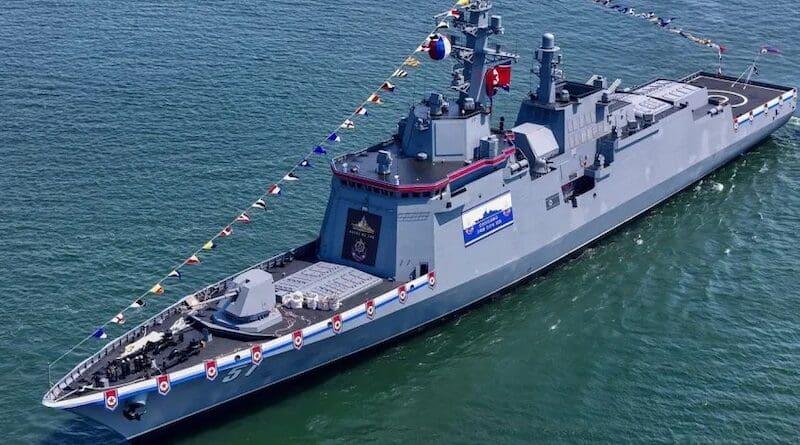
North Korea has already built – but has not yet commissioned – two new 5,000-ton destroyers, the Choe Hyon and the Kang Kon, named after historical military figures. Another two destroyers are believed to be under construction in the shipyards.
In March, after inspecting the Choe Hyon, Kim said it represented a “radical change” in maritime defense, something Pyongyang has not achieved in “half a century,” KCNA reported.
New ships
In Chongjin, in the country’s northeast, the imagery shows evidence that a new ship is being built – A large blue building measuring 300 meters (980 feet) by 77 meters (250 feet) is clearly visible alongside a gantry crane. Chung said this could be a destroyer, which, when completed, would be the fourth in the North Korean fleet. The third is believed to be currently under construction in Nampo.
Chung also noted further evidence – the imagery shows that in the south of the shipyard, large-scale excavation and foundation work have been advancing rapidly in recent months, with up to 6 acres (2.4 hectares) of new land developed.
Temporary worker barracks near the construction site are also visible, as is a new rail track for transporting completed sections of ship to be transported outside for assembly into a complete hull.
“This infrastructure expansion at Chongjin shipyard is seen as groundwork for the construction of the fourth destroyer, in accordance with Kim Jong Un’s orders,” Chung said.
Though the imagery clearly shows that a ship is under construction in Chongjin, it is too early to say that it is a destroyer, Joseph S. Bermudez Jr., a senior fellow for imagery analysis at the Washington-based Center for Strategic and International Studies, told RFA.
“We see some developments at Chongjin. Speculation ranges wide — whether it is going to be a large commercial vessel, whether it’s going to be another destroyer or whether it’s going to be a new larger class destroyer. We don’t have enough information yet,” Bermudez said.
Twin destroyers
On June 4, Kim Jong Un inspected the Kang Kon during a navigation test and ordered that both the Kang Kon and the Choe Hyon be commissioned as soon as possible, KCNA reported.
The two ships are 5,000-ton guided missile destroyers. The Kang Kon drew international attention when it failed to launch on May 21, 2025.
Kim also expressed his ambition to build larger 10,000-ton destroyers in an announcement made ahead of Chinese President Xi Jinping’s visit on June 8.
According to Bermudez, the shipyard in Nampo, on Korea’s western coast, about 50 kilometers (31 miles) from Pyongyang, began an expansion and a modernization effort toward the end of 2024, and that has led some analysts to speculate that North Korea is planning to build the 10,000-ton ships there.
The Choe Hyon, meanwhile, was visible in the images of the Nampo shipyard.
On June 12, the approximately 144-meter (472-foot) long destroyer can be seen docked at the pier. To its left, construction of what would be North Korea’s third destroyer appears to be actively underway inside a large covered building measuring 170 meters (560 feet) by 33 meters (110 feet) with a dark green roof. Floating cranes, a floating dock and work vessels have been deployed in the water in front of the building to assist with hull block assembly, indicating work is likely in full swing.
North Korea has set a political target of completing the third destroyer by the Workers’ Party Foundation anniversary in October, but based on the satellite images, it is estimated to be only 30-40% complete. Chung said that means it will likely not be finished by the deadline.
Ambitious, but unrealistic
Chung said North Korea’s plan to have 10 new destroyers after five years is ambitious but very unlikely.
“So you’re going to need a lot of personnel who are well trained,” Bermudez said. “You’re going to need a lot of equipment and you’re going to need weapons systems and electronics and bringing that all together at that quantity that quickly will be a challenge.”
He added that the weapon systems and electronics will depend heavily on what Russia and China decide to share with North Korea. North Korea’s newest destroyers feature a Pantsir air defense system from Russia.
“It’s likely — better than a 50 percent chance — that Russia is providing technology and experience to the North Korean shipbuilders,” he said. “How much they’re contributing as far as equipment goes, we just can’t tell at this point. They’re probably providing guidance, at a minimum.”

