
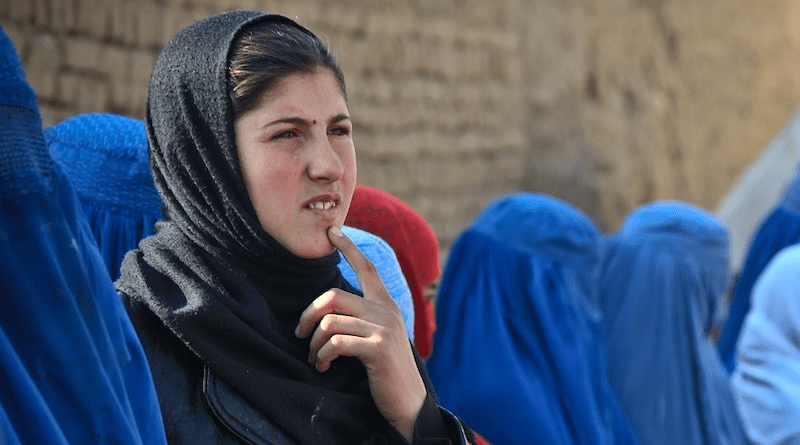
Canada’s Gender-Responsive Humanitarian Diplomacy In The Taliban-Controlled Afghanistan (2021-2026) – Analysis
Key Takeaways:
- Canada’s Feminist International Assistance Policy (FIAP) exhibits a structural policy-practice gap in Taliban-controlled Afghanistan, where ambitious gender-equality commitments clash with counter-terrorism legislation (e.g., Bill C-41), diplomatic non-recognition, and humanitarian access requirements, resulting in depoliticized aid delivery and collapsing gender-transformative programming.
- Multiple interconnected domains reinforce the gap: restrictive counter-terrorism rules created bureaucratic paralysis (zero development authorizations in 2024 despite applications); humanitarian partners systematically reframe gender objectives into basic-needs language to gain Taliban acquiescence; multilateral legal efforts (CEDAW interstate case, ICC gender-persecution warrants) advance accountability without recognition; and refugee resettlement backlogs leave vulnerable Afghans stranded.
- The study proposes “accountability-without-recognition” as an emergent but limited paradigm for feminist humanitarian diplomacy under non-recognized repressive regimes, arguing that legal and diplomatic innovations have strengthened international accountability mechanisms while failing to deliver meaningful improvements in the daily lives and rights of Afghan women and girls.
How do liberal democratic states operationalize feminist foreign policy commitments when the governing authority they must work through is both unrecognized and engaged in systematic, state-directed gender persecution? This question has become one of the most consequential unresolved problems in feminist international relations and humanitarian diplomacy studies, not because feminist foreign policy is new, but because the conditions now testing it expose limits in how the relationship between normative commitment, institutional design, and field-level impact is understood. When a state declares gender equality the organizing principle of its international assistance, and the women it aims to support then lose meaningful influence over their own households, falling from 90 percent to 32 percent in a single year, the gap between declaration and outcome demands explanation at a structural level, not an administrative one (UN Women, UNAMA, IOM, 2024).
Existing literature approaches the disjuncture between feminist foreign policy rhetoric and operational reality through two dominant frameworks. The first treats the gap as an implementation problem, attributable to insufficient resources or bureaucratic inertia, correctable through better management and clearer indicators. The second treats it as a coherence problem, attributable to the embedding of feminist commitments inside neoliberal development frameworks that instrumentalize gender equality as a driver of economic growth rather than as a challenge to patriarchal power (Tiessen & Rao, 2025; Esquivel & Sweetman, 2016). Both rest on the assumption that the gap is, in principle, closeable through improved design and political will. Neither accounts for contexts in which the gap is produced not by design failure but by the simultaneous, irreconcilable collision of feminist normative objectives with counter-terrorism governance, humanitarian operational necessity, and the diplomatic non-recognition of the regime whose conduct the policy is designed to challenge.
Despite extensive scholarly investigation into feminist foreign policy, humanitarian diplomacy, and the international response to the Taliban’s return to power, this critical limitation persists: no study has analyzed Canada’s gender-responsive humanitarian engagement in Taliban-controlled Afghanistan as a unified, multi-domain structural phenomenon, tracing the causal connections among its legislative architecture, operational field adaptations, multilateral legal strategy, conceptual contestation over international criminal law categories, and refugee resettlement failures within a single integrated theoretical framework. The consequence is a fragmented literature that treats the FIAP, Bill C-41, the CEDAW interstate dispute, the gender apartheid debate, and the Tajikistan backlog as separate policy problems with separate solutions, when the evidence shows they are interlocking components of a single configuration that reproduces the policy-practice gap across all domains simultaneously. The 2023 Auditor General found that Global Affairs Canada (GAC) cannot demonstrate empirical linkage between its FIAP programs and measurable progress on gender equality (Office of the Auditor General of Canada, 2023). The Aid for Afghanistan Coalition documented that Bill C-41 granted zero development authorizations in all of 2024 despite fourteen applications (Public Safety Canada, 2025). The Knowledge Platform Security and Rule of Law found that Canadian-funded partners systematically reframe gender equality objectives into basic-needs vocabulary to secure Taliban acquiescence (KPSRL, 2025). The Harvard Human Rights Journal confirmed that the September 2024 CEDAW interstate dispute is the first invocation of Article 29 in forty-five years of treaty history (Harvard Human Rights Journal, 2025). Each finding appears in a separate literature; none connects them as dimensions of the same problem.
This limitation is acute in Afghanistan, where the Taliban’s governance system, more than seventy decrees excluding women from education, employment, public presence, and legal identity (Right to Learn Afghanistan, 2024), both exemplifies and intensifies tensions identified in the broader feminist foreign policy literature. This gap also reflects disciplinary boundaries that have separated feminist IR academic works from critical security studies, humanitarian diplomacy theory from international legal pluralism, and policy analysis from the ground-level operational realities that implementing partners navigate daily. Afghanistan is not merely a difficult case for feminist foreign policy implementation. It is a critical case that reveals what feminist foreign policy actually is when it operates at the limit of its institutional design, confronting a regime whose foundational purpose is the elimination of the conditions that policy exists to protect.
In response, this study examines Canada’s gender-responsive humanitarian diplomacy in Taliban-controlled Afghanistan from August 2021 to the present, integrating four theoretical layers, Critical Feminist International Relations, Humanitarian Diplomacy and Principled Pragmatism, International Legal Pluralism and the Non-Recognition Doctrine, and Securitization and Counter-Terrorism Governance, into a single framework applied through process-tracing, thematic analysis, and critical discourse analysis across six empirical domains. The article demonstrates that Canada’s policy-practice gap is a structural condition rather than an implementation deficit, theorizes the accountability-without-recognition model as an emergent paradigm for feminist humanitarian diplomacy under non-recognized repressive regimes, and establishes the subnational compromise as a distinct and analytically under-theorized mode of aid delivery that systematically depoliticizes the feminist content it is designed to protect. In doing so, the study addresses a gap that comparative or single-domain research designs, which trade analytical depth for breadth, cannot close.
The Structural Policy-Practice Gap
Canada’s FIAP, launched June 9, 2017, set two binding targets for fiscal year 2021 to 2022: at least 15 percent of bilateral assistance would designate gender equality as its principal objective, and at least 80 percent would integrate it as a significant objective, for a combined 95 percent threshold (Global Affairs Canada, 2017). GAC reported 99 percent compliance by the deadline year, positioning Canada as the OECD-DAC donor committing the greatest share of bilateral official development assistance to gender equality in 2021 (Global Affairs Canada, 2022; Policy Magazine, 2023). Applying Layer One, this figure conceals more than it reveals. In fiscal year 2018 to 2019, while 95 percent of assistance nominally integrated gender equality, only 6.2 percent designated it as the principal objective, far below the 15 percent target (Reality of Aid, 2021; Cooperation Canada, 2022). The policy counts programs where gender is a secondary mention identically to programs built around gender transformation, which Cooperation Canada warned creates incentives for gender-washing (Cooperation Canada, 2022). Deputy Prime Minister Chrystia Freeland’s framing of the policy as both “the right thing to do and the smart way to reduce poverty” (Global Affairs Canada, 2022) captures the instrumentalist logic that critical feminist scholars identify as Western-centric and neoliberal (Tiessen & Rao, 2025; Paterson & Scala, 2020). Deputy Minister Christopher MacLennan’s testimony that GAC does “not always control the denominator,” since COVID-19 and the invasion of Ukraine shifted the composition of Canada’s portfolio (House of Commons Standing Committee on Public Accounts, 2023), confirms that Canada’s feminist commitments are structurally subordinate to broader foreign policy priorities. In Afghanistan, circumstances have never permitted otherwise.
The 2023 Auditor General report, tabling Report 4 on International Assistance in Support of Gender Equality, found GAC unable to demonstrate how roughly $3.5 billion in annual bilateral assistance contributed to improved outcomes for women and girls (Office of the Auditor General of Canada, 2023). Twenty-four of twenty-six monitoring indicators measured outputs rather than outcomes; annual reports captured outputs for only about half of GAC-funded projects; and GAC met neither the 15 percent gender-targeted threshold, peaking at 14 percent in 2019 to 2020, nor its 50 percent sub-Saharan Africa allocation target (Office of the Auditor General of Canada, 2023; House of Commons Standing Committee on Public Accounts, 2023). Auditor General Karen Hogan testified that GAC “was unable to demonstrate how Canada’s Feminist International Assistance Policy contributed to improving gender equality in low- and middle-income countries” (House of Commons Standing Committee on Public Accounts, 2023).
The crisis long predates August 2021. Its structural origins lie in the February 2020 Doha Agreement, which committed Western forces to a staged withdrawal in exchange for Taliban assurances on regional security, without binding protections for Afghan women, representation of Afghan civil society, or accountability for prior rights gains (American Journal of International Law, 2020). The Georgetown Institute for Women, Peace and Security documented that the Taliban’s seizure of Kabul ended more than twenty years of incremental progress in women’s education, labor force participation, and political representation (Georgetown Institute for Women, Peace and Security, 2026). Since the Taliban’s return, the UN Human Rights Council documented more than fifty decrees curtailing women’s rights, including the 2024 Law on the Promotion of Virtue and the Prevention of Vice, which institutionalized these prohibitions at the statutory level (UN Human Rights Council, 2025). Canada condemned these developments through a joint ministerial statement on August 14, 2022, characterizing them as the “steady deterioration” of hard-won human rights (Global Affairs Canada, 2022), yet condemnation did not translate into a revised operational strategy adequate to the scale of what had occurred. Humanitarian financing follows a clear pattern of mobilization followed by retrenchment. The 2022 UN appeal, the largest single-country appeal in UN history at $4.44 billion, received only 54.5 percent of required funding (UN News, 2022; Security Council Report, 2022); by 2024, requirements of $3.06 billion drew only 47 to 53 percent, a confirmed gap of at least $1.43 billion (UN OCHA, 2024; ReliefWeb, 2025). Canada’s own humanitarian disbursements fell from $149.49 million in fiscal year 2021 to 2022 to $44.70 million by 2023 to 2024, a decline of 70.1 percent (Global Affairs Canada Statistical Reports, 2022, 2023, 2024). Of the 22.4 million people reached in the 2024 response, 67 percent received food aid alone, while only 3.1 million, against a target of 7.6 million, received multi-sector support (ReliefWeb, 2025). Of those reached, only a fraction received multi-sector support, as gender-transformative programming was compressed by Taliban interference in beneficiary selection, staff recruitment, and program design, which UN OCHA confirmed required “time-consuming negotiations and workarounds” that delayed registration and implementation (UN OCHA, 2023). The ICRC’s Patrick Hamilton testified that operating under these conditions requires direct engagement with Taliban authorities to secure access (House of Commons Special Committee on Afghanistan, 2022), and the Princeton University Afghanistan Policy Lab found that Taliban interference in aid delivery itself reduces donors’ political will to fund proportionate to need, because the perception that the Taliban benefits materially and reputationally from international assistance undermines the case for sustained financing (Princeton University, 2023). UN Women and UNAMA’s 2024 consultations with 774 women across all 34 provinces recorded that women’s self-reported influence over household decisions fell from 90 to 32 percent between January 2023 and January 2024, and community-level influence from 17 to 1 percent (UN Women, UNAMA, IOM, 2024). Afghan women consulted were twice as likely to prioritize gender equality over economic or humanitarian assistance (UN Women, UNAMA, IOM, 2024). The evidence supports a precise conclusion: the policy-practice gap is a structural condition produced by the simultaneous operation of an instrumentalist framework incapable of transformative function under persecution, an evidentiary infrastructure GAC itself cannot supply, and financing that collapsed as need intensified.
The Legislative Paradox of Bill C-41
In autumn 2021, World Vision Canada had two shipping containers of ready-to-use therapeutic food prepared for Afghanistan, enough to treat approximately 1,800 severely malnourished children. The shipment never left, not for lack of need, but because Canada’s own Criminal Code made delivery legally dangerous (The New Humanitarian, 2022). The Taliban has been listed as a terrorist entity under Canada’s Criminal Code since 2013, and under subsection 83.03(b), providing property or financial services benefiting a listed group is an indictable offence carrying up to ten years’ imprisonment (Senate of Canada, 2022). This made routine transactions, paying rent, clearing customs, covering salary taxes, legally ambiguous, stopping rather than merely slowing Canadian operations. Amy Avis of the Canadian Red Cross testified that “critical programming that includes the provision of midwives in remote areas is no longer being provided…shipments of aid remain paused, and supplies sit ageing in warehouses” (Senate of Canada, 2022); Canada was the only one of fourteen CARE International chapters unable to operate in Afghanistan, and Martin Fischer of World Vision Canada put it plainly: “We can’t do anything” (The New Humanitarian, 2022). The Mennonite Central Committee reported that a local partner’s director took out personal loans to keep staff paid while Canadian funding was frozen (The New Humanitarian, 2022). The United States issued a general license authorizing humanitarian activity six weeks after Kabul fell; the UK, Australia, and New Zealand followed within months. Senator Mobina Jaffer noted that Canada was “the only G7 country that has not found a way to resume aid for life-saving activities in Afghanistan” (Senate of Canada, 2023). Applying Layer Four, once the Taliban was designated a security threat, Canada’s legal architecture treated all contact with Taliban territory as a terrorism-financing risk, suspending ordinary humanitarian decision-making (Buzan, Wæver, & de Wilde, 1998); the humanitarian sector was not excluded from this securitization, it was captured by it.
Bill C-41 received Royal Assent on June 23, 2023, nearly twenty months after Kabul’s fall, passing 299 to 25 (Parliament of Canada, 2023). It created two tracks: a self-executing humanitarian exception under subsection 83.03(4) for life-saving assistance, and a discretionary authorization regime for development, education, and rights-based programming requiring ministerial application and a two-stage security review (Public Safety Canada, 2024). This bifurcation is analytically revealing: life-saving aid receives automatic protection, while the transformative gender equality programming the FIAP mandates requires security clearance. The Conservative Party supported the bill as better than the status quo while urging fast-track assessments for established organizations such as the Red Cross and Doctors Without Borders (Senate of Canada, 2023). The NDP went further, arguing during debate that “the premise of this bill, which involves getting the permission of a government…goes against the humanitarian principles of neutrality, independence and impartiality” (House of Commons, 2023). This is not a procedural objection; when a humanitarian organization must receive government clearance to deliver aid, its perceived neutrality in the field is compromised, and the Taliban, or any armed actor, comes to see Canadian NGOs as operating with government permission, which carries its own security risks. The NDP also noted the bill’s geographic scope extended the authorization requirement to Gaza, Syria, and other terrorist-designated territories, potentially criminalizing foreign aid mobilization across a far wider range of contexts than Afghanistan alone. The Aid for Afghanistan Coalition, representing CARE Canada, World Vision, Islamic Relief, the Canadian Red Cross, and the Canadian Foodgrains Bank, identified five structural problems: risk-shifting of the geographic “substantial control” assessment to individual NGO staff who lack the intelligence capacity to make it responsibly; a discretionary, revocable authorization creating sustained legal uncertainty; vague criteria on undefined links to terrorist financing enabling denial by speculation rather than evidence; beneficiary-screening requirements that violate the impartiality principle of delivering aid solely on the basis of need; and data-sharing requirements creating privacy exposure for aid workers (Canadian Bar Association, 2022; Canadian Charity Law Blog, 2024).
The authorization regime was not launched until June 19, 2024, nearly a year after Royal Assent, and as of December 2024 not a single application had been approved (ICLMG, 2024). The 2024 Annual Report confirmed twelve applications received and zero granted that year, with two finally approved in 2025 (Public Safety Canada, 2025). For roughly eighteen months, every Canadian organization seeking to deliver education, livelihoods, or gender-rights programming remained in bureaucratic suspension. MP Heather McPherson confirmed four years after passage that the system remains a bureaucratic obstruction (McPherson, 2025). Bill C-41 did not resolve the counter-terrorism dilemma; it restructured it, replacing criminal paralysis with bureaucratic paralysis, functioning as what Duffield calls a technology of securitized development governance that extends state security logic into civilian humanitarian space (Duffield, 2007). The Canadian Bar Association observed that restrictive interpretation of subsection 83.03(b) “has a profound impact on the most vulnerable people in Afghanistan, including the women and girls that Canada’s Feminist International Assistance Policy purports to champion” (Canadian Bar Association, 2022).
Subnational Compromise and the Depoliticization of Gender
Where legislative and policy architecture set the outer constraints, the daily operational reality is governed by what researchers term the Humanitarian Aid Plus Plus model: donor funds route through pooled multilateral trust funds to sustain healthcare, education, and livelihood support while maintaining formal non-recognition of Taliban authorities (Afghanistan Analysts Network, 2022; Global Affairs Canada, 2022). Canada committed $118 million to the World Bank’s Afghanistan Resilience Trust Fund (ARTF) from 2020 to 2026, disbursed exclusively through UN agencies and NGO partners with no funds entering Taliban control; total World Bank support through this mechanism exceeded $1.7 billion, reaching more than 25 million Afghans (Open Government Portal, 2024; World Bank, 2024). The UNDP’s Special Trust Fund operates under similarly strict terms barring Taliban influence over beneficiary selection (MPTF UNDP, 2025). The ICRC’s healthcare agreements route payments directly to hospital staff salaries rather than through ministry accounts, verified by an independent German-Dutch monitoring company (House of Commons Special Committee on Afghanistan, 2022); as ICRC’s Patrick Hamilton testified, “we are very conscious of the need to avoid trespassing over the various sets of counter-terror legislation that exist…under the present circumstances, we must engage with the de facto authorities to ensure access to the people the ICRC is seeking to assist and protect” (House of Commons Special Committee on Afghanistan, 2022). The December 2024 ARTF financial status report recorded $144.28 million in donor contributions for that calendar year and a cash balance of $445.48 million, confirming that the architecture remains operational despite sustained shortfalls (ARTF Financial Status Report, 2025). This bypass architecture is not costless: the Afghanistan Analysts Network and the Danish government both found that operating entirely outside Taliban administrative systems raises costs and questions the sustainability of results, and the World Bank’s CASA-1000 regional electricity project resumed only in a “ring-fenced manner,” with all payments managed outside Afghanistan, illustrating how far the bypass architecture must extend even for infrastructure work (Afghanistan Analysts Network, 2022; Danish Ministry of Foreign Affairs, 2023; World Bank, 2024).
The financial bypass does not resolve the political problem of programming in territory where explicit gender-equality commitments trigger obstruction. That problem is managed through systematic reframing: vocational literacy becomes household livelihood resilience, midwifery training becomes safe maternal healthcare, protection from gender-based violence becomes family safety (KPSRL, 2025; Crisis Group, 2025; UNAMA, 2025). This reframing responds to a concrete enforcement apparatus: the Ministry for the Propagation of Virtue and Prevention of Vice (MPVPV) fields approximately 3,300 male inspectors across 28 of 34 provinces, and its July 2024 governing law codifies 35 articles of restriction (UNAMA, 2025; 8am Media, 2024). Applying Layer Two, principled pragmatism here intersects directly with Layer One’s depoliticization critique: services continue, but the feminist political content is stripped to sustain them.
Local flexibility exists but is fragile. In certain provinces, local officials have permitted temporary exceptions to male-guardian requirements for female health workers and allowed women to continue in agricultural and healthcare roles where their labor is practically necessary; UNESCO-supported community classrooms reached more than 361,000 children, over 200,000 of them girls, by 2023, and trained more than 1,000 women facilitators who reached 55,000 Afghans in rural areas by 2024 (All Multidisciplinary Journal, 2025; Crisis Group, 2025). Women-only markets have been established in major cities, and women’s shops have gradually re-emerged in Kabul bazaars despite initial displacement orders, while informal community Shura councils continue to function as dispute resolution mechanisms where formal judicial access has been closed to women (Crisis Group, 2025; Danish Ministry of Foreign Affairs, 2023). But UNAMA’s survey data show these gains reversing in real time: between September and December 2024 alone, the share of organizations reporting women unable to reach their offices rose from 21 to 46 percent, those reporting women unable to travel to field locations rose from 20 to 43 percent, MPVPV enforcement visits reached 46 percent of surveyed organizations, and staff anxiety about movement and dress-code enforcement rose from 36 to 54 percent (UNAMA, 2025), evidence of a system tightening incrementally rather than stabilizing. This capacity is further eroded by brain drain: more than 1.6 million Afghans fled between 2021 and 2023, including hundreds of lecturers, doctors, and civil society professionals, and UNESCO found 31 percent of Afghan private universities at risk of closure and a 28 percent income loss for private higher education institutions immediately following the ban on women in higher education (UNESCO, 2024). Crisis Group found that the departure of educated families compounds this collapse, since households with the resources to migrate are precisely those most likely to have educated daughters whose futures have been foreclosed (Crisis Group, 2025). A parallel global shift toward gender mainstreaming has coincided with declining targeted, high-density funding for the women’s rights organizations best positioned to deliver rights-based services locally, even as their institutional survival depends on exactly that kind of direct financing (Lowy Institute, 2024). The subnational compromise is therefore not a temporary tactic; it is a structural feature of humanitarian diplomacy under non-recognized repressive regimes in which survival-oriented aid substitutes for rights-based empowerment as the operational price of continued access.
The Multilateral Legal Turn as Alternative Diplomacy
When direct political engagement with a governing authority is structurally foreclosed, states retaining normative human rights commitments face a choice: disengage entirely, or find alternative modalities of action that preserve accountability without conferring legitimacy. Canada chose the second path. As of mid-2025, only Russia had extended formal diplomatic recognition to the Taliban, while eleven countries, including China, Iran, Qatar, and the UAE, had posted ambassadors in Kabul (IISS, 2024). Canada occupies a more restrictive position than most: it is one of only two UN member states, alongside Tajikistan, that formally classify the Taliban as a terrorist organization (Times of Central Asia, 2025). Prime Minister Trudeau stated in August 2021 that Canada “will not recognize the Islamic Emirate as the legitimate government of Afghanistan” (Reuters, 2021), a position that has not shifted even as the International Institute for Strategic Studies documents “creeping normalization” elsewhere in the international system (IISS, 2024).
On September 25, 2024, Canada joined Australia, Germany, and the Netherlands in initiating formal proceedings against Afghanistan under CEDAW Article 29, described by the Harvard Human Rights Journal as “a monumental statement” and the treaty’s first invocation of that clause in forty-five years (Harvard Human Rights Journal, 2025). Afghanistan ratified CEDAW in 2003 without reservation to Article 29, and under the International Law Commission’s Draft Articles on State Responsibility a de facto government’s conduct is imputable to the state (Open Society Justice Initiative, 2024). The initiative rests on erga omnes partes standing, which allows any state party to invoke state responsibility before the ICJ on the basis of a collective treaty interest regardless of individual injury, a doctrine anchored by The Gambia v. Myanmar (2019) (Harvard Human Rights Journal, 2025; Donoho, 2025). Twenty-six states formally supported the joint statement, which declared the action “without prejudice to our firm position that we do not politically recognize the Taliban de facto authorities as the legitimate representation of the Afghan population” (Global Affairs Canada, 2024). Scholars dispute the caveat’s coherence: the NYU Journal of International Law and Politics reads it as withholding only political recognition (NYU JILP, 2025), while Opinio Juris argues the case implies legal recognition by necessity (Opinio Juris, 2025); the Open Society Justice Initiative rebuts this by citing United States v. Iran (1980) and The Gambia v. Myanmar as precedent for litigating against unrecognized governments (Open Society Justice Initiative, 2024). Functionally, the caveat performs boundary-maintenance, signaling that legal accountability does not constitute normalization.
Three parallel developments reinforce this architecture. In October 2024, the Court of Justice of the European Union ruled that Taliban measures against Afghan women constitute persecution under EU asylum law, such that “the mere fact of being a woman of Afghan nationality under the Taliban regime is sufficient grounds for considering her eligible for refugee status” (ASIL, 2024). In June 2025, the UN CEDAW Committee’s first comprehensive review of Afghanistan since 2021 heard Committee Expert Bandana Rana state that Afghan women and girls had suffered “an unprecedented and systematic obliteration of their rights,” while former Afghan parliamentarian Shukria Barakzai urged the Committee to “recognise gender apartheid as a grave violation of the Convention; hold the de facto authorities accountable for systematic discrimination; and to support Afghan women inside and outside of the country” (OHCHR, 2025). On July 8, 2025, ICC Pre-Trial Chamber II issued arrest warrants for Taliban Supreme Leader Haibatullah Akhundzada and Chief Justice Abdul Hakim Haqqani for the crime against humanity of gender persecution under Rome Statute Article 7(1)(h), finding reasonable grounds that the two leaders ordered, induced, or solicited persecution on gender grounds covering the period from August 15, 2021 onward (ICC, 2025). ICC Prosecutor Karim Khan stated that “these applications recognise that Afghan women and girls as well as the LGBTQI+ community are facing an unprecedented, unconscionable and ongoing persecution by the Taliban” (UN News, 2025). Canada’s commitment extends beyond rhetoric: a $1 million contribution to the ICC Office of the Prosecutor’s Advanced Technology and Specialized Capacity Trust Fund and an increase in seconded police investigators from 3 to 10 directly supported the investigation producing these warrants, with the ICC’s 2025 Annual Report confirming the fund “allowed the Office to recruit specialised expertise, develop policies at the macro and operational levels and conduct substantive training” for the Afghanistan investigation (ReliefWeb, 2022; ICC, 2025).
This accountability-without-recognition model rests on four elements: erga omnes partes standing, the without-prejudice caveat, simultaneous deployment across the ICJ, ICC, and treaty-body venues, and operational investment in investigative capacity. What it cannot yet demonstrate is impact on the lives of women inside Afghanistan: ICJ proceedings face multi-year timelines and produce no enforcement mechanism, and ICC warrants apply to individuals who show no indication of traveling to jurisdictions where arrest is possible. The architecture is real; its distance from the women who need it most is also real.
The Gender Apartheid Conceptual Contestation
The word apartheid carries historical weight most political terms do not, entering international legal consciousness through South African racial segregation and codified as a crime against humanity tied to racial domination. Afghan and Iranian women’s rights activists launched the End Gender Apartheid Campaign in March 2023, arguing that Taliban governance is not merely discriminatory in the familiar sense but institutionalized, state-designed, and aimed at total erasure, and therefore requires legal recognition beyond existing categories (End Gender Apartheid, 2025; PGA, 2024). As campaign lawyer Gissou Nia explained, “gender apartheid currently only has power as a descriptive term. Under international law, the crime of apartheid only applies to racial hierarchies, not hierarchies based on gender” (Global Citizen, 2023). Campaign leader Metra Mehran stated that “women in Afghanistan are basically dehumanized, which means they don’t have access to education, they are not allowed to work, they don’t have freedom of movement, they don’t have access to services” (Vital Voices, 2023). The campaign observes that gender persecution, while legally established and applied in the ICC’s July 2025 arrest warrants, has produced only two attempted ICC prosecutions in nearly twenty-one years, with only one proceeding to trial (Global Citizen, 2023). Its proposed definition covers “inhumane acts committed in the context of an institutionalized regime of systematic oppression and domination by one gender group over any other” (End Gender Apartheid, 2025); the critical difference from persecution is the phrase “institutionalized regime,” since persecution addresses what is done to individuals while apartheid addresses the system designed to produce and sustain that domination. As South African jurist Bonita Meyersfeld, who has built alliances with Afghan activists through her expertise in dismantling racial apartheid, put it: “gender apartheid is a governing system. Afghan women are not just facing discrimination; they are being legally and politically erased…it’s a systemic and codified strategy of control” (Malala Fund, 2025).
The primary vehicle for codification is the UN Convention on the Prevention and Punishment of Crimes Against Humanity. On November 22, 2024, the General Assembly’s Sixth Committee adopted Resolution 79/122 by consensus, establishing a negotiation pathway with preparatory sessions in 2026 and a diplomatic conference across 2028 and 2029, co-sponsored by ninety-nine states spanning all regional groups (Forbes, 2024; Just Security, 2024). Several delegations have proposed expanding the draft treaty’s definition of crimes against humanity to include gender apartheid, alongside proposed additions such as ecocide, while a countervailing bloc urges caution and adherence to the Rome Statute as the appropriate reference point (UN Sixth Committee, 2026). Russia has obstructed the process procedurally, with the Czech Republic stating the Sixth Committee had been “held hostage” by Russia’s “bad faith” consensus tactics before Russia dissociated from the resolution without breaking it, and China’s sovereignty-first posture, resisting human rights conditionality that could apply to its own domestic practices, compounds this resistance (Just Security, 2024). Applying Layer Three, this geopolitical dynamic defines the ceiling of what treaty-based normative entrepreneurship can achieve: a convention opening for signature in 2029 requires broad ratification to be operationally meaningful, and a definition that major powers refuse to ratify becomes a symbolic instrument rather than an enforceable legal standard.
Within Canada, the Senate adopted a motion recognizing gender apartheid on June 11, 2024, with Senator Salma Ataullahjan arguing that “by its silence, this government is complicit in the erasure of Afghan women and girls” (National Magazine, 2025; Senate of Canada, 2023). The House of Commons did not follow; Parliamentary Secretary Rob Oliphant maintained that gender apartheid lacks definition in international law, directing resources instead toward the Rome Statute framework (Government of Canada, 2024). This divergence reflects genuine strategic disagreement rather than a lack of will: the Senate prioritizes the normative, agenda-setting function of naming the phenomenon precisely, while the executive prioritizes existing enforcement machinery, operationalized through the same ICC funding and investigator deployment that produced the July 2025 arrest warrants (ReliefWeb, 2022; ICC, 2025). The evidence does not resolve in favor of one strategy; the strongest position sustains both simultaneously, building long-term normative architecture through treaty negotiation while pursuing near-term accountability through existing mechanisms.
Transit Vulnerabilities and Refugee Resettlement Backlogs
Between August 2021 and October 2024, Canada welcomed over 54,700 Afghan nationals through special immigration programs, committing $2.37 billion over eleven years, placing it second only to the United States in absolute resettlement numbers and meeting its formal commitment of 40,000 arrivals by October 2023, ahead of schedule (IRCC, 2023; Public Safety Canada, 2025). The three program streams, 18,000 spaces for former government partners, 5,000 for family reunification, and a humanitarian stream prioritizing women leaders, LGBTQI+ individuals, human rights defenders, journalists, and persecuted minorities including Hazaras, were designed around the populations most at risk from Taliban governance (Public Safety Canada, 2025). Yet the aggregate conceals design failures. Every stream required applications to route through organizations with pre-existing government agreements, excluding vulnerable individuals without such access, and none targeted individuals still inside Afghanistan who lacked resources to reach a third country first. Neela Hassan documented applications disappearing into what one Canadian lawyer called “a black hole,” and a private sponsorship pilot for 3,000 individuals reached capacity within its first hour, leaving thousands of eligible applicants without options (Hassan, 2024). Hassan concluded that Canada’s policies are “ambiguous and disconnected from reality on the ground, which not only makes the migration process irregular and unpredictable for Afghan refugees but also leaves them in a liminal legal limbo, making them vulnerable to violence, exploitation, and abuse” (Hassan, 2024).
The UAE transit partnership, announced May 2023, shows what functioning transit-state cooperation looks like: Canada resettled up to 1,000 Afghans evacuated to the UAE, with roughly 1,500 total arrivals by mid-2023 (Canada.ca, 2023). Tajikistan presents the structural inverse. Approximately 3,000 sponsored Afghan refugees remain stranded there as of mid-2025, delayed by six-to-twelve-month CSIS screening timelines and the December 2023 closure of special measures programs (Go Canada Services, 2025; CBC News, 2025). Tajikistan’s posture has hardened due to alignment with Russia, which has recognized the Taliban as Afghanistan’s legitimate government; resource strain from hosting over 10,000 refugees concentrated in its poorer, rural southern region bordering Afghanistan; and a permissive international environment modeled on U.S. deportation practices (CBC News, 2025), producing sweeping immigration raids, formal deportation orders, and documented physical abuse of Afghan nationals by Tajik security forces. The UNHCR found that deportations of male breadwinners triggered family separations, with wives and children following deported husbands back to Afghanistan, and that voluntary repatriation rose to 66 individuals in 2024, more than double the 29 who returned in 2023, with some refugees citing the closure of Canada’s sponsorship program as a direct reason for returning (UNHCR, 2025). IRCC stated it was “deeply concerned about reports” of deportations and was working with IOM and UNHCR to protect Afghans destined for Canada, while Global Affairs Canada confirmed it was monitoring conditions in Tajikistan, Pakistan, and Iran (CBC News, 2025). Monitoring and concern are not the same as protection.
The case of Bibi Khatoon Yaqoubi, fifty-seven, illustrates the human cost. Beaten publicly by Taliban authorities on August 15, 2024, leaving her with two fractured legs and a fractured hand, she recounted: “The Taliban pulled me out of the car and beat me. I was unconscious and ended up in the hospital… When I regained consciousness, I realized my arms and legs were broken” (CBC News, 2025). She fled to Tajikistan in December 2024 with a confirmed Canadian sponsorship arranged by her son, and as of August 2025 remained stranded in the backlog. Her son stated: “Of course I’m afraid, she is not where she is supposed to be… If she goes back to Afghanistan, I don’t know what will happen with the Taliban there” (CBC News, 2025).
This is a coherence deficit: the normative commitment is genuine, but the operational architecture designed to deliver it fails under pressure. Arbitrary program caps reflect sizing for administrative manageability rather than protection need; the absence of any safe passage guarantee for refugees holding confirmed sponsorships in hostile transit states means the commitment is not backed by the diplomatic infrastructure needed to make it meaningful, mirroring at the domestic level the same risk-shifting dynamic documented for Bill C-41 and humanitarian NGOs. Canada’s resettlement of 54,700 Afghans is a genuine humanitarian achievement, but commitment without architecture to sustain it under pressure is not protection when protection is most urgently needed.
Conclusion
This study argues that Canada’s humanitarian diplomacy toward Taliban-controlled Afghanistan is characterized by an accountability-without-recognition model that combines legal innovation with persistent operational constraints. The analysis demonstrates that Canada’s legal and diplomatic initiatives have strengthened international accountability mechanisms while remaining only partially connected to improvements in the everyday conditions of Afghan women and girls. The coexistence of legal progress and declining humanitarian effectiveness reflects not temporary policy shortcomings but a broader structural contradiction embedded within the interaction of feminist foreign policy, humanitarian governance, and counter-terrorism regulation.
The study further demonstrates that legislative barriers, operational adaptation, multilateral legal engagement, refugee protection challenges, and accountability mechanisms should not be understood as independent policy domains. Rather, they represent interconnected dimensions of a single governance system in which humanitarian access, legal accountability, and feminist objectives are simultaneously pursued yet frequently undermine one another. Addressing any single component in isolation is therefore unlikely to produce durable policy change.
The findings indicate that strengthening Canada’s gender-responsive humanitarian diplomacy requires coordinated reforms across multiple domains. Counter-terrorism authorization procedures should be redesigned to facilitate gender-responsive development programming while maintaining appropriate security safeguards. Refugee protection mechanisms require more effective operational pathways to ensure that resettlement commitments translate into safe and timely protection. Finally, sustained support for Afghan women’s organizations should be prioritized to preserve locally led gender-responsive programming alongside broader humanitarian assistance.
In the last words, this analysis contributes to the literature by conceptualizing accountability-without-recognition as an emerging model of feminist humanitarian diplomacy while demonstrating its inherent structural limitations. The Afghan case illustrates that legal accountability, humanitarian effectiveness, and feminist transformation cannot be treated as separate policy objectives. Instead, they must be understood as mutually dependent components of humanitarian diplomacy operating within conditions of contested sovereignty and protracted conflict.
References
- 8am Media. (2024, August 24). Taliban’s Law for the Propagation of Virtue and the Prevention of Vice: Citizens face collective humiliation and dehumanization. https://8am.media/eng/talibans-law-for-the-propagation-of-virtue-and-the-prevention-of-vice-citizens-face-collective-humiliation-and-dehumanization/
- American Journal of International Law. (2020). United States signs agreement with the Taliban, but prospects for its full implementation remain uncertain. https://www.cambridge.org/core/journals/american-journal-of-international-law/article/united-states-signs-agreement-with-the-taliban-but-prospects-for-its-full-implementation-remain-uncertain/DFCC3FA5EE12A575373BF5177C184220
- Afghanistan Analysts Network. (2022, July 5). Donors’ dilemma: How to provide aid to a country whose government you do not recognise. https://www.afghanistan-analysts.org/en/reports/international-engagement/donors-dilemma-how-to-provide-aid-to-a-country-whose-government-you-do-not-recognise/
- All Multidisciplinary Journal. (2025). [Community-based education access in Afghanistan].
- ARTF Financial Status Report. (2025, January 10). Afghanistan Resilience Trust Fund (ARTF) Financial Status Report – December 2024. https://policycommons.net/artifacts/19371193/administrators-report-on-the-financial-status/20271730/
- ASIL. (2024, October 21). EU Court recognizes Taliban’s discriminatory measures against Afghan women as acts of persecution. https://asil.org/ilib/eu-court-recognizes-talibans-discriminatory-measures-against-afghan-women-acts-persecution/
- Beach, D., & Pedersen, R. B. (2013). *Process-tracing methods: Foundations and guidelines*. University of Michigan Press.
- Braun, V., & Clarke, V. (2006). Using thematic analysis in psychology. *Qualitative Research in Psychology*, 3(2), 77-101.
- Buzan, B., Wæver, O., & de Wilde, J. (1998). *Security: A new framework for analysis*. Lynne Rienner Publishers.
- Canada.ca. (2023, May 26). Canada welcomes Afghans through new humanitarian partnership. https://www.canada.ca/en/immigration-refugees-citizenship/news/2023/05/canada-welcomes-afghans-through-new-humanitarian-partnership.html
- Canadian Bar Association. (2022, March 8). Bill C-41, An Act to amend the Criminal Code and to make consequential amendments to other Acts. https://www.ourcommons.ca/Content/Committee/441/JUST/Brief/BR12404883/br-external/TheCanadianBarAssociation-e.pdf
- Canadian Charity Law Blog. (2024, June 19). Authorization regime and information on humanitarian exception for activities in areas of terrorist group controlled areas. https://www.canadiancharitylaw.ca/blog/authorization-regime-and-information-on-humanitarian-exception-for-activities-in-areas-of-terrorist-group-controlled-areas/
- CBC News. (2025, August 10). Afghan Canadian fears mother may be sent back into Taliban’s hands after they nearly killed her. https://www.cbc.ca/news/canada/taliban-mother-canada-1.7604161
- Coalition of Canadian Humanitarian Organizations. (2023). Brief on Bill C-41: House of Commons Standing Committee on Justice and Human Rights. https://www.ourcommons.ca/Content/Committee/441/JUST/Brief/BR12342990/br-external/Jointly1-e.pdf
- Cooperation Canada. (2022). Holding the line on gender equality. https://cooperation.ca/wp-content/uploads/2026/03/FIAP-full-report_Final-EN.pdf
- Crisis Group. (2025, December 17). A precarious lifeline? Women-led business in Afghanistan. https://www.crisisgroup.org/rpt/asia-pacific/afghanistan/352-precarious-lifeline-women-led-business-afghanistan
- Danish Ministry of Foreign Affairs. (2023). Special Trust Fund for Afghanistan, 2023. https://um.dk/media/ipqf1een/special-trust-fund-for-afghanistan-2023.pdf
- Donoho, K. A. (2025). Blazing a trail for the enhanced enforcement of women’s rights: Erga omnes partes standing. *Cornell Law Review*. https://publications.lawschool.cornell.edu/lawreview/wp-content/uploads/sites/2/2025/05/Donoho-note-final.pdf
- Duffield, M. (2007). *Development, security and unending war: Governing the world of peoples*. Polity Press.
- Eckstein, H. (1975). Case study and theory in political science. In F. I. Greenstein & N. W. Polsby (Eds.), *Handbook of political science* (Vol. 7). Addison-Wesley.
- Ejil:Talk!. (2024, October 16). Representation of Afghanistan before the International Court of Justice. https://www.ejiltalk.org/representation-of-afghanistan-before-the-international-court-of-justice/
- End Gender Apartheid. (2025). End Gender Apartheid Campaign. https://endgenderapartheid.today/
- Esquivel, V., & Sweetman, C. (2016). Gender and the Sustainable Development Goals. *Gender & Development*. https://www.tandfonline.com/doi/full/10.1080/14616742.2026.2639032
- ESIL. (2018). The doctrine(s) of non-recognition. European Society of International Law. https://esil-sedi.eu/wp-content/uploads/2018/04/Agora-3-Milano.pdf
- Forbes. (2024, December 23). UN General Assembly to close impunity gap for crimes against humanity. https://www.forbes.com/sites/ewelinaochab/2024/12/23/un-general-assembly-to-close-impunity-gap-for-crimes-against-humanity/
- Foucault, M. (1991). Governmentality. In G. Burchell, C. Gordon, & P. Miller (Eds.), *The Foucault effect: Studies in governmentality* (pp. 87-104). University of Chicago Press.
- Georgetown Institute for Women, Peace and Security. (2026). Afghanistan conflict tracker. https://giwps.georgetown.edu/conflict-tracker/country/afghanistan/
- Global Affairs Canada. (2017). Canada’s Feminist International Assistance Policy. Government of Canada. https://pmc.ncbi.nlm.nih.gov/articles/PMC7586002/
- Global Affairs Canada. (2022). G7 Foreign Ministers’ statement on the situation of women and girls in Afghanistan. https://www.canada.ca/en/global-affairs/news/2022/05/g7-foreign-ministers-statement-on-the-situation-of-women-and-girls-in-afghanistan.html
- Global Affairs Canada. (2024). Canada’s International Assistance Report 2022-2023. Government of Canada. https://publications.gc.ca/collections/collection_2024/amc-gac/FR2-28-2023-1-eng.pdf
- Global Affairs Canada. (2024, September 26). Joint statement regarding the Convention on the Elimination of All Forms of Discrimination Against Women. https://www.international.gc.ca/world-monde/international_relations-relations_internationales/un-onu/statements-declarations/2024-09-26-women-femme.aspx?lang=eng
- Global Affairs Canada Statistical Reports. (2022, 2023, 2024). Statistical Report on International Assistance. https://international.canada.ca/en/global-affairs/corporate/reports/international-assistance-data/statistical-report-2022-2023
- Global Citizen. (2023, October 10). Iranian and Afghan women are calling for gender apartheid to be a crime. Here’s what to know. https://www.globalcitizen.org/en/content/iranian-afghan-women-gender-apartheid-campaign/
- Go Canada Services. (2025, August 7). Canada Immigration Updates August 2025: Afghan Refugee Crisis. https://gocanadaservices.ca/canada-immigration-updates-biometrics-for-citizenship-afghan-refugee-crisis-immigrant-unemployment/
- Government of Canada. (2024). Government response to Petition 441-02386. Signed by Rob Oliphant. House of Commons. https://www.ourcommons.ca/petitions/EN/Petition/Details?Petition=441-02386
- Harvard Human Rights Journal. (2025). Gender equality and state responsibility: Enforcing CEDAW through the International Court of Justice. *Harvard Human Rights Journal*, 38, 287-324. https://journals.law.harvard.edu/hrj/wp-content/uploads/sites/83/2025/05/06_HLH_38_1_Sweeney287-324.pdf
- Hassan, N. (2024). A half-open door: A case study of Canada’s special immigration programs for Afghan nationals. Canadian Association for Refugee and Forced Migration Studies. https://carfms.org/wp-content/uploads/2024/05/Neela-Hassan_A-Half-open-Door-A-Case-Study-of-Canadas-Special-Immigration-Programs-for-Afghan-Nationals.pdf
- House of Commons. (2023, June 9). Debates (Hansard) No. 210 – Criminal Code. https://www.ourcommons.ca/DocumentViewer/en/12516743
- House of Commons Special Committee on Afghanistan. (2022). Honouring Canada’s legacy in Afghanistan: Responding to the humanitarian crisis and helping people reach safety. https://www.ourcommons.ca/Content/Committee/441/AFGH/Reports/RP11826943/afghrp01/afghrp01-e.pdf
- House of Commons Standing Committee on Public Accounts. (2023). [Testimony on the 2023 Auditor General Report].
- ICC. (2025, July 8). Situation in Afghanistan: ICC Pre-Trial Chamber II issues arrest warrants for Haibatullah Akhundzada and Abdul Hakim Haqqani. https://www.icc-cpi.int/news/situation-afghanistan-icc-pre-trial-chamber-ii-issues-arrest-warrants-haibatullah-akhundzada
- ICLMG. (2024, December 13). What we’ve been up to in 2024. https://iclmg.ca/june-dec-2024/
- ICRW. (2026, January 22). Defining feminist foreign policy: An analysis of the 2025 report. https://www.icrw.org/defining-feminist-foreign-policy-an-analysis-of-the-2025-report/
- IISS. (2024, December 12). Towards the reintegration of Afghanistan into the international community. https://www.iiss.org/publications/armed-conflict-survey/2024/towards-the-reintegration-of-afghanistan-into-the-international-community/
- IRCC. (2023, October 30). Canada meets commitment to welcome 40,000 vulnerable Afghans. https://www.canada.ca/en/immigration-refugees-citizenship/news/2023/10/canada-meets-commitment-to-welcome-40000-vulnerable-afghans.html
- Just Security. (2024, December 2). Key UN Committee clears path for crimes against humanity treaty negotiations. https://www.justsecurity.org/105305/cah-treaty-negotiations-passes-sixth-committee/
- KPSRL. (2025). A reality check of Dutch feminist foreign policy in Afghanistan and South Sudan. Knowledge Platform Security & Rule of Law. https://kpsrl.org/sites/kpsrl/files/2025-06/A-Reality-Check-of-Dutch-Feminist-Foreign-Policy-in-Afghanistan-and-South-Sudan.pdf
- Lake, H. (2025). Erased from public life: The push to recognize gender apartheid in Afghanistan. *National Magazine*. https://nationalmagazine.ca/fr-ca/articles/law/in-depth/2025/erased-from-public-life
- Lowy Institute. (2024). Mainstreamed, sidelined: Global funding for gender equality. Lowy Institute for International Policy. https://www.lowyinstitute.org/publications/mainstreamed-sidelined-global-funding-gender-equality
- Malala Fund. (2025, April 29). Ending gender apartheid: Afghan women are leading. The world must follow. https://malala.org/news-and-voices/ending-gender-apartheid-afghan-women-are-leading-the-world-must-follow
- Manjoo, R. (2026). Justice and accountability for the women and girls of Afghanistan. International Association of Democratic Lawyers. https://iadllaw.org/2026/03/justice-and-accountability-for-the-women-and-girls-of-afghanistan-professor-rashida-manjoo/
- McPherson, H. (2025). NDP statement on the fourth anniversary of the fall of Kabul. Canada’s New Democratic Party. https://heathermcpherson.ndp.ca/news/heather-mcpherson-ndp-statement-fourth-anniversary-fall-kabul
- MPTF UNDP. (2025, April 8). Special Trust Fund for Afghanistan terms of reference (Revised). https://mptf.undp.org/sites/default/files/documents/2025-10/revised_stfa_tor_2025.04.08_ver_6.0.pdf
- National Magazine. (2025). Erased from public life. https://nationalmagazine.ca/fr-ca/articles/law/in-depth/2025/erased-from-public-life
- NATO COE-DAT. (2023, May 17). Gender in terrorism and counter-terrorism: Unravelling masculinities, the impact of climate change and cyber security. https://www.coedat.nato.int/publication/workshop_reports/15-GENDER_IN_TERRORISM_COUNTERTERRORISM_REPORT(2023).pdf
- NYU Journal of International Law and Politics. (2025, September 22). The Taliban at the ICJ: Representation of de facto authorities. https://nyujilp.org/wp-content/uploads/2025/09/11-Stark_Commentary_Formatted.pdf
- Office of the Auditor General of Canada. (2023). Report on the Feminist International Assistance Policy. https://www.tandfonline.com/doi/full/10.1080/10130950.2025.2591260
- OHCHR. (2025, June 24). Experts of the Committee on the Elimination of Discrimination against Women commend the voices of Afghan women and girls demanding justice. https://www.ohchr.org/en/meeting-summaries/2025/06/experts-committee-elimination-discrimination-against-women-commend-voices
- Open Government Portal. (2024). Funding to the Afghanistan Reconstruction Trust Fund 2020-2024. https://search.open.canada.ca/grants/record/dfatd-maecd%2C064-2024-2025-Q2-00436%2Ccurrent
- Open Society Justice Initiative. (2024, November 18). Bringing a case before the International Court of Justice for the rights of Afghan women and girls. https://www.justiceinitiative.org/uploads/56046440-580b-4c0f-ac14-7f503331427c/afghan-women-cedaw-icj-briefing-20241118.pdf
- Opinio Juris. (2025, April 10). Judge them by their actions, not their words: Legal and political recognition of governments and the prospective CEDAW case against Afghanistan before the ICJ. https://opiniojuris.org/2025/04/10/judge-them-by-their-actions-not-their-words-legal-and-political-recognition-of-governments-and-the-prospective-cedaw-case-against-afghanistan-before-the-icj/
- Oxford Public International Law. (2026, May 23). Non-recognition. https://opil.ouplaw.com/display/10.1093/law:epil/9780199231690/law-9780199231690-e1073
- Paterson, S., & Scala, F. (2020). Neoliberal understanding of equality. *International Studies Review*.
- Parliament of Canada. (2023). C-41 (44-1) – LEGISinfo. https://www.parl.ca/legisinfo/en/bill/44-1/c-41
- Parliamentarians for Global Action. (2024). The campaign to codify gender apartheid. https://www.pgaction.org/ilhr/gender-apartheid.html
- Policy Magazine. (2023). [Canada’s OECD-DAC gender assistance ranking].
- Princeton University. (2023). [Afghanistan Policy Lab report on donor political will].
- Public Safety Canada. (2023, March 9). Government introduces legislation to support humanitarian aid to vulnerable Afghans. https://www.canada.ca/en/public-safety-canada/news/2023/03/government-introduces-legislation-to-support-humanitarian-aid-to-vulnerable-afghans.html
- Public Safety Canada. (2024, June 19). Authorization regime and humanitarian exception for activities in terrorist group controlled areas. https://www.publicsafety.gc.ca/cnt/ntnl-scrt/cntr-trrrsm/hmntrn-xcptn/index-en.aspx
- Public Safety Canada. (2025, February 27). Overview of the Afghan Resettlement Initiative. https://www.publicsafety.gc.ca/cnt/trnsprnc/brfng-mtrls/prlmntry-bndrs/20250305/17-en.aspx?wbdisable=true
- Public Safety Canada. (2025, June 23). 2024 Annual Report of the Minister of Public Safety concerning Criminal Code sections 83.031 to 83.0391. https://www.publicsafety.gc.ca/cnt/rsrcs/pblctns/2024-nnl-prt-crmnl-cd-sctns-83/index-en.aspx
- Reality of Aid. (2021). [Canadian gender-targeted ODA analysis].
- ReliefWeb. (2022, May 26). Canada provides funding to International Criminal Court to strengthen accountability for conflict-related sexual violence. https://reliefweb.int/report/world/canada-provides-funding-international-criminal-court-strengthen-accountability-conflict-related-sexual-violence
- ReliefWeb. (2025). [2024 Afghanistan humanitarian response end-year gap analysis].
- Reuters. (2021, August 17). Canada will not recognize Taliban as Afghan gov’t — PM Trudeau. https://www.reuters.com/world/asia-pacific/canada-will-not-recognize-taliban-afghan-govt-pm-trudeau-2021-08-17/
- Reus-Smit, C. (2008). [Constructivism in international relations theory].
- Right to Learn Afghanistan. (2024, April 1). Gender apartheid and international justice. https://righttolearn.ca/gender-apartheid/
- Security Council Report. (2022). [Monthly forecast on Afghanistan humanitarian funding].
- Senate of Canada. (2022, December). Interim report on Canada’s restrictions on humanitarian aid to Afghanistan. https://sencanada.ca/content/sen/committee/441/RIDR/reports/2022-12-14_RIDR_Report_FINAL_e.pdf
- Senate of Canada. (2023, June 15). Debates, Issue 135 – Criminal Code (Bill C-41). https://sencanada.ca/en/content/sen/chamber/441/debates/135db_2023-06-15-e
- Senate of Canada. (2023, September 19). Senator Salma Ataullahjan topic intervention 627208-25. https://sencanada.ca/en/senators/ataullahjan-salma/interventions/627208/25
- Sweeney, C. (2025). Gender equality and state responsibility: Enforcing CEDAW through the ICJ. *Harvard Human Rights Journal*, 38, 287-324. https://journals.law.harvard.edu/hrj/wp-content/uploads/sites/83/2025/05/06_HLH_38_1_Sweeney287-324.pdf
- Sweeney, C., et al. (2024). Canada’s feminist foreign policy agenda as governance feminism. *International Studies Review*, 27(1). https://academic.oup.com/isr/article/27/1/viaf007/8109153
- The New Humanitarian. (2022, July 6). A year after Taliban return, Canadian anti-terror law still bars NGOs. https://www.thenewhumanitarian.org/analysis/2022/07/06/Afghanistan-anti-terrorism-Taliban-aid-and-law
- Thomson, J. (2022). The growth of feminist (?) foreign policy. *E-International Relations*.
- Tiessen, R. (2019). Feminist International Assistance Policy. *PMC Articles*. https://pmc.ncbi.nlm.nih.gov/articles/PMC7586002/
- Tiessen, R., & Rao, S. (2025). Built on shaky ground: Reflections on Canada’s Feminist International Assistance Policy. *Journal of Gender Studies*. https://www.tandfonline.com/doi/full/10.1080/10130950.2025.2591260
- Times of Central Asia. (2025, May 20). Recognition of the Islamic Emirate of Afghanistan: Between law, diplomacy, and pragmatism. https://timesca.com/recognition-of-the-islamic-emirate-of-afghanistan-between-law-diplomacy-and-pragmatism/
- Turunen, S. (2024). *The principled pragmatists: Humanitarian diplomatic practices at the United Nations* [PhD dissertation]. Sikt. https://nva.sikt.no/registration/0198f22afcd2-ac7aed5c-22c1-4891-a13f-e55bad7ca93d
- UN Human Rights Council. (2025). [Report on the situation of human rights in Afghanistan].
- UN News. (2022). [2022 Afghanistan Humanitarian Response Plan appeal].
- UN News. (2025, January 23). Afghanistan: ICC seeks arrest warrants for Taliban leaders over gender-based persecution. https://news.un.org/en/story/2025/01/1159366
- UN OCHA. (2023). Afghanistan Humanitarian Response Plan 2023.
- UN OCHA. (2024). [2024 Afghanistan Humanitarian Needs and Response Plan].
- UNAMA. (2025, April 10). Report on the implementation, enforcement and impact of the Law on the Propagation of Virtue and the Prevention of Vice. https://unama.unmissions.org/sites/default/files/unama_pvpv_report_10_april_2025_english.pdf
- UNESCO. (2024). Costs of continued suspension of women’s access to higher education and work in Afghanistan. https://articles.unesco.org/sites/default/files/medias/fichiers/2024/09/01.Costs%20of_Suspension_of_Women_Higher_Education_and_Work_in_Afghanistan_brief.pdf
- UNHCR. (2025, May 28). Annual Results Report – 2024 Tajikistan. https://www.unhcr.org/sites/default/files/2025-06/Tajikistan%20ARR%202024.pdf
- UN Sixth Committee. (2026). Crimes against humanity – Eightieth session. https://www.un.org/en/ga/sixth/80/cah.shtml
- UN Women. (2024, October 9). Counter-terrorism and preventing violent extremism. https://www.unwomen.org/en/what-we-do/peace-and-security/preventing-violent-extremism
- UN Women, UNAMA, IOM. (2024). Summary report of country-wide women’s consultations. https://afghanistan.iom.int/sites/g/files/tmzbdl1071/files/inline-files/situation-of-afghan-women-september-2023.pdf
- UNRISD. (2025). Feminist foreign and development policies. United Nations Research Institute for Social Development. https://cdn.unrisd.org/assets/library/papers/pdf-files/2025/wp-2025-04-ffdp.pdf
- Wendt, A. (1999). *Social theory of international politics*. Cambridge University Press.
- World Bank. (2024, September 26). World Bank & Afghanistan Resilience Trust Fund (ARTF) support for the people of Afghanistan. https://www.worldbank.org/en/country/afghanistan/brief/world-bank-afghanistan-resilience-trust-fund-artf-support-for-the-people-of-afghanistan
