(UC)UAVs In Turkish Airspace: A Low-Intensity Probe Along The Black Sea Axis? – OpEd
Two recent unmanned aerial vehicle (UAV/UCAV) incidents in Turkish airspace call for a more careful reading than explanations based solely on technical malfunction or coincidence.
The first involved an unidentified UAV/UCAV entering Turkish airspace and being neutralized by a NATO/national tasking F-16 in accordance with the rules of engagement. Taken on its own, this incident can be assessed as a routine and closed defensive response, demonstrating that Turkey’s detect–identify–decide–engage chain functions effectively against airspace violations.
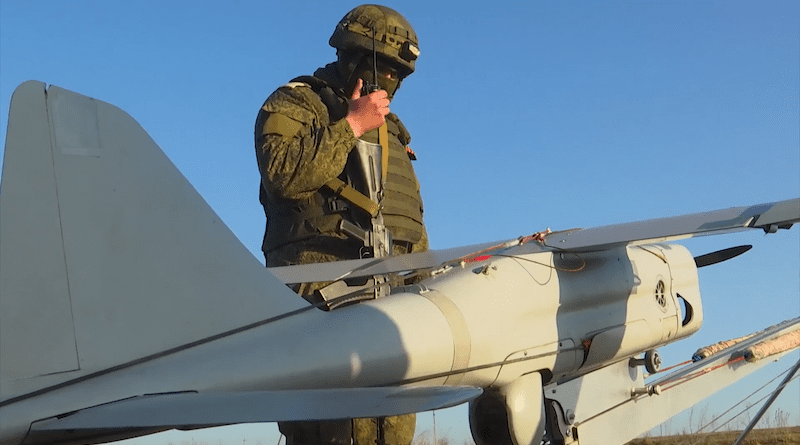
However, the subsequent discovery of a Russian-made Orlan-10 UAV in İzmit alters the overall picture.
The Orlan-10 is not a basic reconnaissance platform. It is known for its electronic warfare and signals intelligence capabilities, including the ability to assess radar coverage and air defense reactions. Its appearance so close to Istanbul and to critical industrial and logistical infrastructure weakens the plausibility of a simple “loss of control” explanation. When timing and geography are considered together, the incident takes on the character of a multi-layered probe rather than an accident. Several scenarios merit consideration:
1. Technical failure / loss of navigation.
Possible in conflict environments, yet the Orlan-10’s operational range and typical mission profile make this explanation less convincing. The Orlan-10 is a reconnaissance and EW UAV with up to ~16 h endurance and a range well beyond short local flights.¹
2. Testing air defense capacity.
This appears the strongest possibility. Turkey’s radar coverage, reaction time, engagement thresholds, and the real-time distinction between NATO and national taskings may have been indirectly tested. This would constitute a low-intensity strategic “pulse check” rather than an overt attack—measuring how deeply penetration is possible without escalation.²
3. Generating tension in the Black Sea.
At a time when the land front of the Ukraine war has reached a relative stalemate, some actors may find renewed pressure in the Black Sea strategically useful. Under the Montreux Convention, Turkey controls passage through the Bosphorus and Dardanelles and thus plays a key role in regional security dynamics.³
4. Probing the hybrid air defense architecture.
Independently of specific systems like the S-400, Turkey’s integration of NATO systems, national radar-command structures, and newly fielded indigenous air defense elements may be undergoing technical assessment and observation.⁴
What Does the Overall Picture Suggest?
There is no indication of a direct attack on Turkey. Rather, Turkey’s decision-making reflexes, the coherence between political signaling and military capability, and its crisis thresholds may be under observation from the field. The critical issue is therefore not the immediate perpetrator, but the strategic axis toward which Turkey may be nudged.
If such incidents remain isolated, they are manageable. If they become serial and diversified, however, they may form part of a broader process aimed at drawing Turkey into a Black Sea–centered geopolitical escalation.
What has occurred is neither a simple coincidence nor the opening move of a war. It is better understood as a controlled contact with Turkey’s strategic nerve endings. Each response provided to such contacts helps shape the framework of the next move.
For Turkey, the decisive factor is less the threat itself than how the response is recorded in strategic memory. The challenge is not to choose sides, but to recognize attempts at being drawn into a fire—and to preserve strategic autonomy grounded firmly in national interests.
Footnotes
1. Orlan-10 reconnaissance/EW UAV capabilities: The Russian Orlan-10 is a reconnaissance and electronic warfare UAV with long endurance and modular payloads including cameras and EW gear, making it suitable for extended reconnaissance missions beyond simple navigation loss. See STC Orlan-10 (Wikipedia) — https://en.wikipedia.org/wiki/STC_Orlan-10
2. Air defense probing and “gray zone” aerial activities: Low-intensity and gray-zone probing via UAVs has been noted in military strategy analysis of hybrid conflict environments; the use of reconnaissance drones to test responses and reaction thresholds fits this pattern. General context on such dynamics can be found in strategic defense reports on Russian UAV deployments.
3. Montreux Convention and Black Sea security: The 1936 Montreux Convention Regarding the Regime of the Straits regulates passage through the Turkish Straits and remains a cornerstone of Black Sea security and Turkey’s role in it. See Montreux Convention Regarding the Regime of the Straits (Wikipedia) — https://en.wikipedia.org/wiki/Montreux_Convention_Regarding_the_Regime_of_the_Straits
4. Turkey’s hybrid air defense architecture: Turkey is actively developing a multi-layered integrated air defense system combining indigenous elements with broader networks; initiatives like the multi-layered Steel Domesystem reflect efforts to modernize and integrate detection and engagement capabilities across domains. See Steel Dome (Wikipedia) — https://en.wikipedia.org/wiki/Steel_Dome