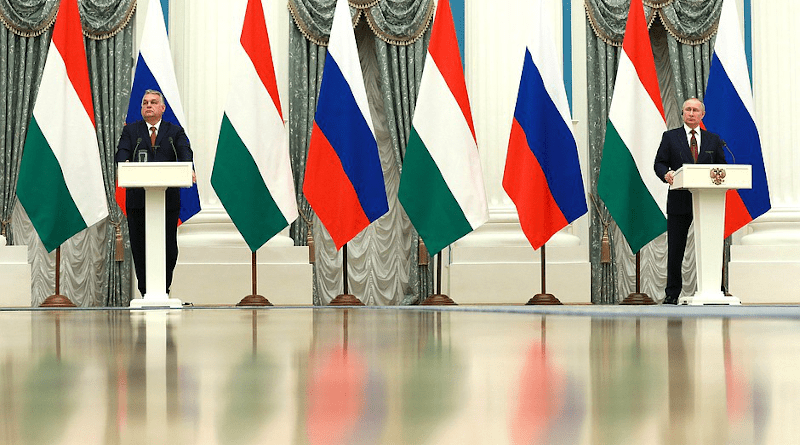
Putin’s Duma Candidates Could Lose For Same Reasons Orbán’s Did In Hungary – Analysis
By Paul Goble
Most international commentaries on Hungarian Prime Minister Viktor Orbán’s loss in the Hungarian parliamentary elections and his fall from power have focused on the consequences for European support for Ukraine’s continuing fight against the Russian invasion (see EDM, April 15). Russian analysts are focusing on that too, but some are worried that what happened in Hungary could happen in Russia’s September Duma elections, given parallels between Orbán’s Fidesz party and Russian President Vladimir Putin’s United Russia party. Both parties and the electoral systems of the two countries have experienced a decline in support (Kommersant; RBC, April 13). A few Russian commentators are even predicting an equally revolutionary change, with United Russia losses triggering a Russian Maidan and regime change, or at least a growing threat to Putin’s continued rule (Svobodnaya Pressa, April 15). Such notions are almost certainly overblown given the differences between the two countries. Russia is not a parliamentary system in which the country’s leader must have a majority in the legislature. The Kremlin leader has shown himself even more willing than Orbán to use falsification and brute force to maintain his rule. Despite that, the appearance of such worries is likely to shape Russian politics in the coming months (RBC, April 13).
Observers are focusing on how Orbán’s defeat will impact EU support for Ukraine in its fight against Russian aggression. For senior members of United Russia, however, there may be a more immediate threat, Russian analyst Sergey Aksyonov suggests (Svobodnaya Pressa, April 15). To make his case without landing himself in trouble with the Kremlin, Aksyonov summarized the arguments of Anatoliy Shariy, a Russian-speaking Ukrainian commentator who has often been accused of being pro-Kremlin (see EDM, August 4, 2020). In a reaction to the Hungarian elections, Shariy argued that Orbán’s defeat was the product of “a series of errors that bear a striking resemblance to the well-known blunders committed by Ukraine’s former ruling party in the run-up to the 2014 Maidan protests,” a parallel that he implies Russia’s current rulers should be aware of (Svobodnaya Pressa, April 15).
Shariy himself draws a direct comparison between the two Viktors—Orbán and President Viktor Yanukovich in Ukraine a decade ago. He points to “not only … the politicians’ physical stature but also … their political profiles.” He features Shariy’s comment that “Fidesz is essentially [Yanukovich’s] Party of Regions all over again,” with corrupt officials having entrenched themselves and feeling they need not answer to the people (Govorit Evropa, April 13). He continues, “Those who previously voted for Orbán’s party are now voting against it; they can no longer tolerate the local bosses who have become entrenched in power and, as a form of protest, are backing its opponent.” He justifies this by arguing that soon-to-be Hungarian Prime Minister Péter Magyar’s affiliation with the Tisza Party is “merely nominal”—all developments with potential Russian parallels.
Tisza’s new constitutional majority reflects this popular anger and “the specific features of the electoral system,” and Orbán introduced these features to serve his ruling Fidesz Party. They now, as the election has shown, have led to his party’s crushing defeat and his own ouster from power. Aksyonov, echoing Shariy’s argument, explains that Hungary’s majoritarian system amplifies electoral swings. One hundred six of the 199 parliamentary seats are elected in single-member constituencies, and any votes cast for a “winning candidate in excess of the minimum required threshold are not discarded, but added to the party list voting,” thus magnifying any victory. That is because “this mechanism grants a massive bonus to the leading party, enabling it to attain a constitutional majority (two-thirds of the seats) even without enjoying a commensurate level of support among the general population,” something very different from the rest of Europe and Russia (Svobodnaya Pressa, April 15).
There is a feature of the Hungarian electoral system that Russia does share, the two say. The government frequently redraws election districts to make it easier for incumbents to remain in power. Russia has regularly changed the boundaries using the “petal principle,” whereby a major city is carved up even more frequently than Orbán did in Hungary and then attached to a vast, neighboring rural district—an area where “loyalty to the authorities is traditionally higher, and opposition votes are effectively diluted,” Aksyonov, following Shariy, says. Russian incumbents from the ruling party remain confident they can remain in power indefinitely, especially as this system is “fine-tuned by domestic ‘inventors’ within the Central Election Commission and capped off with a dome of additional filers and options designed to provide a 100 percent guarantee of the desired outcome,” including more easily falsifiable multi-day voting (Svobodnaya Pressa, April 15).
Putin and his regime are counting on that arrangement to hold in the September Duma elections. Shariy asks what would happen if “this multilayered construct—designed to dispel any doubts regarding United Russia’s success—were to yield a completely different, indeed diametrically opposite, result” as it did in Hungary and earlier in Ukraine. In that event, the long-entrenched United Russia “princelings” “could well be soundly defeated—just as the Hungarians routed the ossified ‘Orbánites,’” Shariy and Aksyonov argue. “Everything the Presidential Administration has spent years building to prop up the ruling party would then turn against it.”
The two suggest this could have revolutionary consequences. Russia is not a parliamentary system, and a loss of United Russia seats in the Duma would not force Putin to leave office. United Russia would also be prepared to resort to even more falsification of the results to ensure its desired outcome. As Shariy implies, even if the party does so, that could backfire. If manipulating the reported vote becomes too obvious, that alone could trigger a popular uprising, something similar to the Maidan,or at least the protests of 2011–2012 when Putin returned to the presidency after Dmitry Medvedev. As a result, Putin’s system and Putin himself could suffer a greater defeat than the losses in the parliamentary votes might suggest, another parallel with Hungary.
Russia is obviously not Ukraine or Hungary. Its political culture is fundamentally different, but the fact that Yanukovich and Orbán lost power despite overwhelming organizational advantages is certain to be much on the minds not only of analysts, but of those in the Kremlin. This precedent raises the stakes of the upcoming legislative election and is likely to cause United Russia to take further measures to secure its position.
- This article was published at The Jamestown Foundation