French Voters Should Take Inspiration From De Gaulle – OpEd
By Arab News
By Mohamed Chebaro
Key Takeaways:
- Film Highlights De Gaulle’s Leadership and Moral Compass: The epic “La Bataille de Gaulle” portrays the French leader’s stubborn vision, resilience, and commitment to liberating and rebuilding France during WWII, offering a powerful reminder of principled leadership in times of crisis.
- Timely Warning Against Far-Right Rise in France: Released ahead of the next presidential election, the film contrasts De Gaulle’s legacy with Marine Le Pen’s candidacy, emphasizing concerns over her far-right agenda, criminal record, and divisive policies, while calling for a strong, trustworthy alternative candidate.
- Broader Message on Leadership and Hope: The movie underscores that hope is possible through courageous, visionary leadership, urging modern politicians to emulate De Gaulle’s qualities rather than compromise or embrace authoritarian populism.
I recently dedicated six hours of my time to watching “La Bataille de Gaulle,” an epic two-part war movie that carries, between its debatable narrative and scenes of conflict and heroism, reminders of what is missing in today’s France and many other countries. That is the importance of defending against fascism, while also having a leadership with a moral compass that stands up for its ideals in a world that could do with more selfless service for the benefit of state and society.
In an unbearable heat wave that struck Europe but especially France this summer, I took refuge in the cinema due to its cooling system. Many others did the same, choosing to watch “La Bataille de Gaulle” — a very long and poignant movie. One hopes that French viewers will take notice and remember the film when electing their next leader less than a year from now.
Marine Le Pen, a long-time aspirer to the Elysee Palace, after her father Jean-Marie, has been positioning herself as a patriot and an avid defender of the realm, despite her colorful record. Never mind her far-right populist agenda — she has also been found guilty of involvement in an embezzlement scam in public office. An appeal court has just cleared her to run for the highest office in the nation, despite her criminal record and the fact she may have to wear an electronic tag on her ankle. Her candidacy, let alone potential victory, could have Charles de Gaulle turning in his grave after all that he did to help liberate his occupied country and secure its independence and sovereignty in the Second World War.
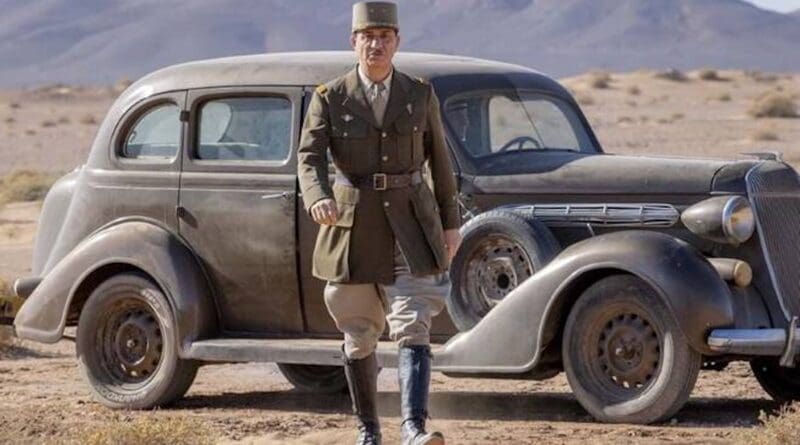
The captivating film depicts the great French leader’s role in the critical years of the early 1940s, when he was an exiled general with a romantic vision of his country after it had just capitulated to Nazi Germany. It reflects on the bravery of a mid-career general who saw beyond the immediate reality of defeat. In its 350-plus minutes, the film enthusiastically engages with the passion, leadership and gravitas of this former French president, which many leaders of today ought to emulate.
In addition to a surprising physical resemblance, Simon Abkarian, a French-born Armenian actor who grew up in Lebanon and later moved to Los Angeles, brings out the firm and stubborn De Gaulle, who hung on to the correctness of his vision even when he was not all that sure of it himself. The film is also enlivened by some comic qualities, such as through Abkarian’s unbending poise, permanent straight face and mustachioed stiff upper lip. One can only wonder how the complex relationship with Winston Churchill went, when he was his closest ally, challenger and, at times, controller all at the same time.
From a cinematic point of view, the film rests heavily on a parallel story to the depiction of De Gaulle: a powerful portrait of the early French Resistance activist Fernand Bonnier de La Chapelle. De La Chapelle was only 20 years old when he assassinated Vichy government Admiral of the Fleet Francois Darlan in Algiers after Darlan, widely seen as a Nazi collaborator, signed a controversial deal with US Gen. Dwight Eisenhower.
In today’s volatile and highly dangerous world, the film offers a reminder that hope is possible and leaders could emerge to ferry us to calmer waters. In this world, when Europe and France’s brush with the far right is gaining momentum and a quasi-fascist ethos is becoming mainstream, “La Bataille de Gaulle” shows us that, with the right leadership qualities, politicians can transcend adversities and find solutions to the ills that handicap the political system. They should not hesitate to rise with stubbornness and arrogance, as well as with genius, as De Gaulle did to turn the fate of France.
The timing of the movie’s release could not be better, coming just months before Emmanual Macron’s embattled presidency is due to lapse and amid the absence of a credible and trusted candidate to take on Le Pen, the leader of National Rally, who is campaigning on a program of EU reform, economic protectionism and antimigrant French nationalism.
Like many modern-day populists, the rich, patriotic vocabulary of Le Pen papers over deeply rooted, divisive policies such as the “national preference” that favors the so-called native population. Her economic patriotism hides entrenched euroskepticism, while highlighting the issue of assimilation as a conduit to express anti-Islam views. However, Le Pen has whitewashed the long tradition of her father’s party’s extreme antisemitic rhetoric, which aided its rise.
It is not clear yet who is likely to stand against Le Pen to try and save France. There is still time to find a candidate who is stubborn, arrogant and has signs of genius to keep voters away from the far right. The mission of that candidate will be daunting, just as it was during the time France was under occupation. But one thing that is for sure is that De Gaulle would not have voted for a convicted criminal to lead his nation.
France needs a leader who is ready for battle, not someone who is embattled and compromised before they even start.
- Mohamed Chebaro is a British-Lebanese journalist with more than 25 years of experience covering war, terrorism, defense, current affairs and diplomacy.