
Japan’s Enduring Defence Pivot Under Kishida – Analysis
By Ayumi Teraoka
Japan is a ‘small-c’ conservative country. Japanese politics and society are usually slow to change in response to global trends. This is not always a bad thing — Japan has seemingly escaped the steep political polarisation and the rise of the far right vexing democracies elsewhere. Often underappreciated, however, is that once Japan changes in response to the external environment, the shift tends to stick for the same reason, with little likelihood of reverting.
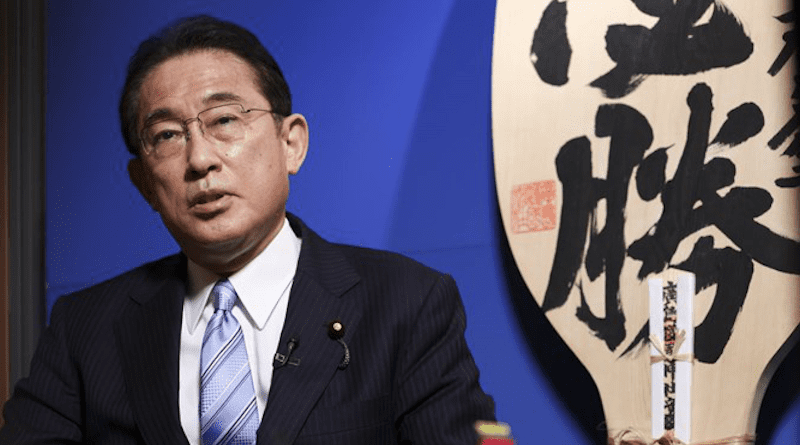
The last three years of former prime minister Fumio Kishida’s administration underscored a durable shift in Japan’s strategic posture. Kishida doubled down on the national security and foreign policy direction of his predecessors, especially the late former prime minister Shinzo Abe.
Sometimes called the ‘Abe Doctrine’, Japan’s new strategy primarily consists of three tenets — strengthening ties with the United States and other likeminded partners, loosening restrictions on the use of military power as a means of statecraft and proactively defending the rules-based international order. With China on its doorstep, Japan no longer hides in the shadow of the US–Japan alliance and engages actively in regional and global security, marking a departure from Japan’s post-World War II strategy.
That Kishida accelerated these efforts should come as no surprise. He led Japan amid wars in Ukraine and Gaza, growing ties between Beijing, Moscow and Pyongyang and heightened tensionsin the Taiwan Strait. Domestically, Kishida won the prime ministership in October 2021 by gaining support from the still-politically powerful Abe, who was convinced Kishida would continue his agenda. Having served as Abe’s foreign minister from 2012 to 2017, Kishida was also personally invested in foreign policy.
In continuing to implement Japan’s new strategy, Kishida took advantage of his liberal image as a politician, which likely tamed public backlash, as well as leadership changes in partner countries.
Through his ‘shuttle diplomacy’ with South Korean President Yoon Suk-yeol, Kishida improved Japan’s relationship with South Korea. Their bilateral intelligence-sharing agreement was normalised and export controls to South Korea were eased. These US allies also began new bilateraland trilateral cooperation in quantum technology, artificial intelligence and economic security.
Building off of Abe’s stable and positive ties with former Philippine president Rodrigo Duterte, the advent of much more pro-US leader Ferdinand Marcos Jr in Manila also allowed the Kishida government to upgrade Japan–Philippine ties. Japan provided coastal surveillance radars for the Philippine Navy as part of Japan’s new Official Security Assistance program and signed Japan’s third reciprocal access agreement to enable better logistical coordination between the two forces.
Russia’s invasion of Ukraine allowed Kishida to adjust his predecessor’s Russia policy. Abe’s repeated attempts to steer Russian President Vladimir Putin away from China had gone nowhere. Russia’s invasion of Ukraine and the emergence of the ‘no-limits’ Sino–Russian friendship underscored Tokyo’s limited leverage over Moscow.
Unlike Abe, who wavered after Russia’s takeover of Crimea in 2014, Kishida promptly joined the multilateral sanctions regime, deepening Japan’s partnership with NATO. His regular attendance at NATO summits and invitation of Ukrainian President Volodymyr Zelensky to the G7 Summit in Hiroshima in May 2023 were the most visible efforts. In December 2023, Kishida’s administration also eased the ban on weapons exports to help replenish US Patriot missiles to support Ukraine.
Domestically, Kishida also advanced major agendas on security in ways his predecessors could not. In May 2022, he passed the far-reaching Economic Security Promotion Act to navigate the new era of US–China competition. In December 2022, he announced Japan’s plan to acquire stand-off strike capabilities and drastically increase its defence-related budget to 2 per cent of GDP.
Starting in 2025, Japan will also acquire 400 Tomahawk cruise missiles, allowing the Japan Self-Defense Forces to hit enemies from further afield. This is a remarkable shift in the US–Japan alliance, where Japan traditionally focused on being the ‘shield’ while relying on the US military’s ‘spear’. This decision has prompted official dialogues about modernising and upgrading coordination between the two forces’ command and control systems.
Underpinning these strategic investments is both Japanese policymakers’ desire to strengthen deterrence against Beijing and a shift in Japan’s public discourse. International security experts and former defence planners now regularly appear on popular television shows to explain military operations. A slew of introductory books on military affairs are displayed prominently at bookstores in Tokyo. Having confronted Chinese maritime expansion since 2008, the public overwhelmingly considers China a threat, and also supports upgrading the US–Japan alliance and increasing Japan’s defence budget.
Kishida’s leadership began to falter following Abe’s assassination in July 2022. Having lost Abe’s backing and lacking a strong personal political base, Kishida could not respond effectively to revelations of political and financial scandals. Kishida appeared unfit to reform the party, and over time lost public approval and political capital.
Notably, despite these domestic headwinds, the sticky change in Japan’s strategic posture continued to allow Kishida to advance Japan’s lingering defence ‘homework’ with little public backlash. His administration passed legislation to establish a broader security clearance system in May 2024 and prepared legislation to allow for pre-emptive measures against cyberattacks. Even in his final weeks, Kishida made another historic decision to let a Japanese destroyer pass through the Taiwan Strait.
To navigate intensifying geopolitical challenges, Japan’s new prime minister, Shigeru Ishiba, must establish a stronger domestic footing in advancing reforms. Kishida initially had this domestic stability with the backing of Abe. Ishiba must find another way to consolidate his power, especially after failing to appoint his political rivals to his cabinet. Turning to the public to gain overwhelming public support is one way — and all the more reason to pay close attention to the upcoming House of Representatives election on 27 October — but so far, Ishiba is facing a pretty rough road ahead.
- About the author: Ayumi Teraoka is a Postdoctoral Research Scholar with the Weatherhead East Asian Institute’s Japan Research Program at Columbia University and a fellow with the Columbia–Harvard China and the World Program. She studies alliance politics and security issues in the Indo-Pacific.
- Source: This article was published by East Asia Forum

Like what you read?
Please consider supporting Eurasia Review. Thank you for your consideration!