
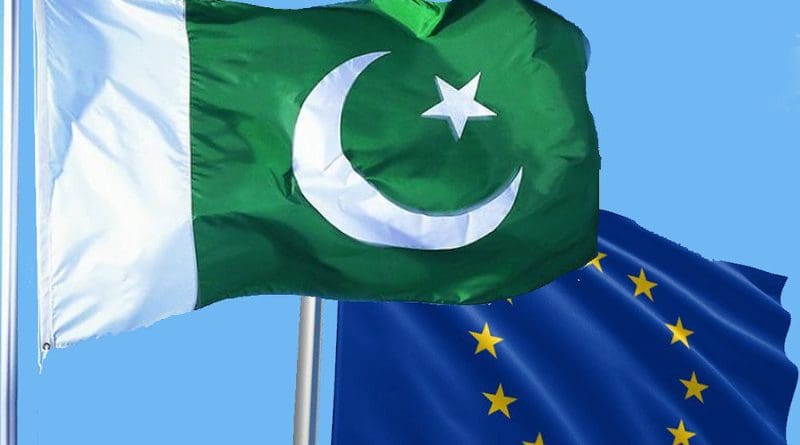
A Strategic Opening For Pakistan-EU Economic Partnership – OpEd
By Dr. Sahibzada Muhammad Usman
The High-Level European Union-Pakistan Business Forum is planned in 28-29 April 2026 in Islamabad and faces a crucial juncture in the economic diplomacy of Pakistan. With a history of over 60 years of diplomatic and economic relations between Pakistan and the European Union, this forum cannot be considered just another conference, but a serious attempt to translate goodwill into investment and diversifying trade and long-term institutional cooperation.
EU is already one of the most crucial economic partners of Pakistan. The EU, being the second largest trading partner of Pakistan and the largest destination of its exports, constituted 15.3 percent of the total trade of Pakistan in 2023, with the bilateral trade of the two countries amounting to €11.87 billion. These numbers demonstrate that there is a relationship there but also indicate untapped potential. Pakistan has long been largely overly dependent on textiles and apparel as its exports to Europe. Although textile will continue to be critical, the future of Pakistan to EU trade should grow to be agri-business, digital innovations, fintech, green logistics, renewable energy, climate solutions and responsible mining.
Of special importance is the introduction of EU-Pakistan Business Network at the forum. An official association of EU firms in working Pakistan can end up serving as a viable link between investors, regulators and local companies. When well applied, it can be useful in detecting policy bottlenecks, enhancing regulatory knowledge and lobbying towards a more predictable business environment. Pakistan should have such an organized interaction, more so when investment choices are not only based on the market size, but also transparency, consistency and institutional confidence.
The theme of the forum on the business to government and business to business interaction is opportune. Pakistani companies, in particular, SMEs require to have direct access to the knowledge of the European markets, certification opportunities, technology partners and financing organizations. Equally, the European investors require certainty on the regulations, taxation, repatriation, dispute resolution and industry related opportunities. Having policymakers, investors, financial institutions and entrepreneurs in the same room can also help lessen mistrust and turn the wide ambition into bankable projects.
The connection with the EU Global Gateway strategy, the European Investment Bank, and bilateral European financial institutions is one of the best the forum has to offer. Pakistan can use the instruments like EFSD+ to investigate the blended financing, grants and guarantees on the sustainable infrastructure, renewable energy, SME development and export diversification. This is important since the development needs of Pakistan are too big to be financed solely using public funds. Patient capital, believable project pipelines and powerful public-private alliances are needed to sustain climate resilience and clean energy and modern logistics.
The GSP + of Pakistan is the key to this relationship. It has assisted Pakistani exports to rise substantially since 2014 as it has granted free access to the vast EU market with tariffs. But GSP+ is not merely a trade facility; it is also associated with sustainable development, labour rights, environmental standards, human rights and good governance. The fact that Pakistan has ratified all the 27 core conventions is a good starting point, but adoption must be credible, observable and on-going. Compliance, traceability, labour protection and environmental responsibility are increasingly becoming important in the export competitiveness in Europe.
The forum must not shun hard discussions then. There will be an inherent scrutiny of governance, rights, sustainability and regulatory certainty by European investors and institutions. Pakistan must act with assertiveness, facts and reformation, rather than defensiveness. The constitutional rights to equality, religious freedom, education, non-discrimination, involvement of women and human working conditions of the country offer a good legal foundation. The progress on minorities and social rights is also evidenced in such reforms as the Hindu Marriage Act, Sindh child marriage legislation, and Hindu marriage legislation.
Simultaneously, Pakistan should learn to understand that it is the global narratives that affect investment. The accusations of human rights, forced disappearances, and civil rights are frequently brought before the international arenas. The role of Pakistan should be to tackle real issues with the institutions, due process and transparency as well as take up discriminatory criticism where need be. The presence of the Commission of Inquiry on Enforced Disappearances since 2011 has its role, yet credibility of institutions relies on the further openness, timely resolution and citizen confidence.
The EU-Pakistan Business Forum 2026 has the potential to be the most important economic event of the year, provided it can generate follow-up mechanisms as opposed to formality statements. The presentation of high-profile project opportunities by the Board of Investment should be accompanied by investor facilitation, timelines and accountability. Breakout sessions on each sector are to discover regulatory issues and suggest them. Meetings with the EIB and European financial institutions should bring promising projects to the feasibility and financing and implementation.
The EU Business Forum 2026 is not just a networking event. It is a challenge of whether Pakistan and Europe can be able to modernize a 60-year relationship according to a new economic era. The speeches will be followed by seriousness: the success of the regulations, the effective compliance, credible projects, responsible business practices and the effective institutional dialogue. When both parties are ambitious and disciplined, not only would Islamabad be able to host not only a forum, but the start of a stronger Pakistan-EU economic collaboration.

