From The Coast To The Core: Capital Relocation As A National Security Strategy – OpEd
A capital refers to the city which contains the seat of government of a state or a polity. A capital city is not merely a seat of governance; it is the spatial expression of a state’s power, identity, and historical trajectory. Control over capital frequently determines control over the whole state. The relocation of capitals is not a new phenomenon; rather, it has occurred throughout history owing to a host of factors, including strategic, economic, environmental, and political factors. In many cases, countries change their capitals for security purposes, as the security of the capital is fundamental to state survival.
In the contemporary era, the vulnerability of capital cities remains evident, especially after the recent United States (US) military operation in the Venezuelan capital of Caracas that resulted in the capture of Venezuelan President Nicolas Maduro by US forces. Since Caracas is located not far from the Caribbean coast, it was easier for the US forces to stage such a military operation in Venezuela. Venezuela is a large state, and if its capital was located deep in the interior, it would have been comparatively more difficult for the US forces to apprehend the Venezuelan president. This incident illustrates that securing the capital is almost synonymous with securing the state itself. Hence, the relocation of capitals is a strategic mechanism through which states attempt to align geography with security priorities.
British India: From Kolkata to Delhi
Under British colonial rule, Calcutta (now known as Kolkata) served as the capital of India between 1772 and 1911. However, the British government decided to shift the capital to Delhi owing to a number of factors, including its geographical centrality, its imperial symbolism (Delhi was previously the capital of the Mughal Empire), the need to court Indian Muslims in the face of growing political activism of Indian Hindus, administrative efficiency, and its proximity to the summer capital Shimla. However, internal and external security considerations played a prominent role in the British decision. Owing to the Partition of Bengal, Kolkata had emerged as a major center of anti-colonial nationalism, and the British sought to marginalize the effects of Bengal-based nationalist outfits by shifting the capital. Moreover, contemporary events, such the Japanese capture of fortified Port Arthur from Russia in 1905, demonstrated the vulnerability of coastal cities in the age of modern warfare, and Kolkata is a coastal city. Hence, the British shifted the capital to Delhi to reduce internal and external security threats.
Brazil: From Rio de Janeiro to Brasília
Rio de Janeiro was the capital of Brazil between 1763 and 1960, but the capital was officially moved to Brasília in 1960. The decision was driven by several factors, including overpopulation and water scarcity in Rio de Janeiro, the need to develop the country’s interior, and foster national unity. However, security considerations played a crucial role in the decision. Rio’s coastal location made it vulnerable to naval attacks, and throughout the Second World War, the Brazilians feared a possible German attack on Rio, which, however, did not materialize. Moreover, the global conflict between the superpowers during the Cold War made the coastal capitals of Southern states potential targets. Under these circumstances, Brasília was formally designated as the new capital because of its inland location, which offered greater strategic protection.
Pakistan: From Karachi to Islamabad
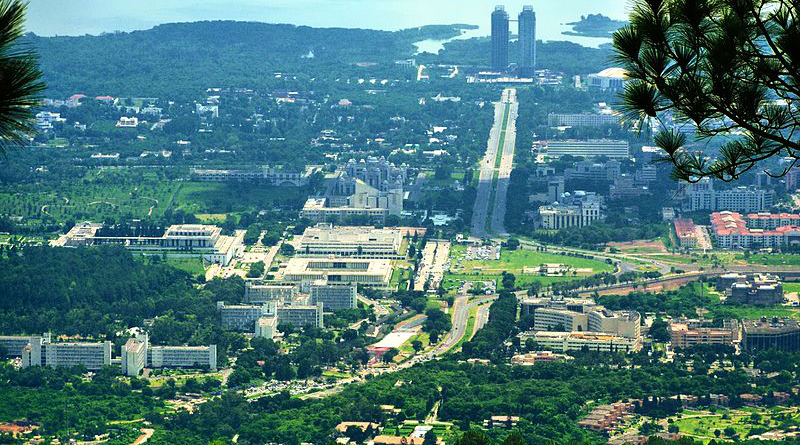
Karachi became the capital of Pakistan after its independence in 1947. However, the capital faced various problems, such as overpopulation caused by the influx of refugees from India, and the difficulty in administering northern and eastern regions of Pakistan from a southern port city. Located in the province of Sindh along the Arabian Sea and relatively close to the Indian border, Karachi was strategically exposed and vulnerable to naval and air attacks, Consequently, Pakistan shifted its capital in two stages: first to Rawalpindi as a temporary measure due to its proximity to military headquarters, and later, in 1967, to Islamabad. Islamabad’s inland location and surrounding hills reduced security vulnerability and provided a more controlled administrative environment. During the Indo–Pakistani War of 1971, India conducted devastating air and naval strikes on Karachi, and this incident justified the earlier relocation of the capital from the port city.
Nigeria: From Lagos to Abuja
Nigeria officially relocated its capital from Lagos to Abuja in 1991. Lagos faced a host of socio-economic, administrative, political, and demographic problems, compounded by its location on the Gulf of Guinea coast, which exposed it to potential external threats. At that time, a number of African states witnessed attacks on their coastal capitals, including the Portuguese attack on the Guinean capital of Conakry in 1970, the French-orchestrated attack on the Beninese seat of government at Cotonou in 1977, and the South African-engineered attack on the Seychellois capital of Victoria in 1981. In contrast, Abuja was selected for its inland and central location, which enhanced Nigeria’s national security by reducing vulnerability to external attacks. Moreover, Abuja was considered politically neutral, providing a more balanced territorial space for Nigeria’s diverse ethnic and religious groups.
Myanmar: From Yangon to Naypyidaw
Myanmar shifted its capital from Yangon to Naypyidaw in 2005, primarily due to the ruling military’s perception of external threats. They feared that Yangon’s coastal location made it vulnerable to naval invasion, particularly in the context of Western opposition to military rule in the country. Naypyidaw, situated in a central and inland location, was constructed to reduce such vulnerabilities. Although officials cited overcrowding and infrastructure concerns, security considerations were widely understood to be central to the decision.
Equatorial Guinea: Malabo to Ciudad de la Paz
On 2 January 2026, Equatorial Guinea officially shifted its capital from Malabo to Ciudad de la Paz. Malabo, located on the Bioko Island, was geographically isolated from the mainland and vulnerable to maritime threats. The new capital, situated in the forested regions of the mainland, enhances territorial integration and external security. Although urban development and long-term planning played a role the relocation, security considerations occupied a prominent role in the equation of the Equatorial Guinean government.
Conclusion
The relocation of capitals across diverse geopolitical contexts demonstrates that such decisions are deeply rooted in considerations of security, administrative efficiency, and state consolidation. Throughout history, governments have relocated capitals to reduce external vulnerability, minimize internal unrest, and strengthen territorial control. From the British shift from Kolkata to Delhi to mitigate nationalist unrest, to the recent relocation from Malabo to Ciudad de la Paz, each case reflects a deliberate effort to enhance national security and state resilience.
Across time and regions, the pattern remains consistent: governments relocate capitals to align geography with strategic priorities and to ensure the durability of state authority. Therefore, capital relocation is not merely an administrative adjustment; it is a strategic mechanism to mitigate external threats, manage internal divisions, and reinforce governmental control.