
The Escalating Tensions: Russia’s Threats, NATO’s Response, And The Shadow Of World War III – OpEd
In recent months, the world has been gripped by a tense and uncertain reality: Vladimir Putin’s Russia has issued stark warnings of nuclear escalation while simultaneously intensifying its military campaigns in Ukraine.
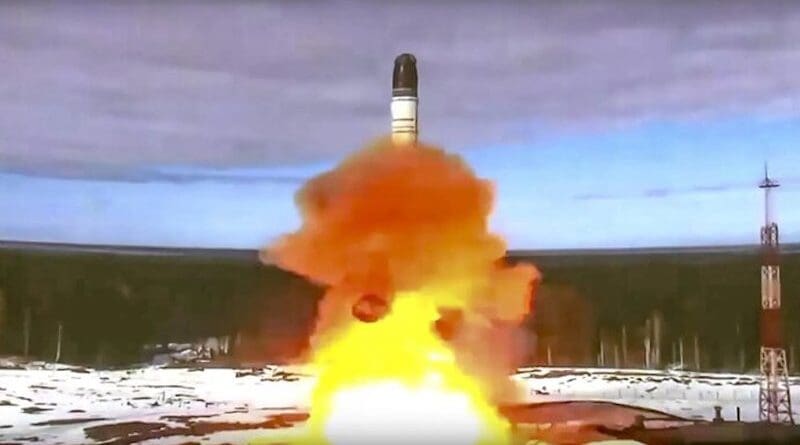
Kremlin officials have not shied away from threatening to launch nuclear missiles against any NATO ally assisting Ukraine, framing such support as a direct provocation. At the same time, Putin has cautioned that a clash of civilizations between Russia and the West could spiral into a devastating World War III. This dual posture— combining threats of nuclear annihilation with aggressive military expansion— underscores the precariousness of the current global security environment.
Yet, amidst this backdrop of danger, NATO’s leadership is actively pushing for an unprecedented buildup of military capabilities. The alliance, which was founded to ensure collective defense and deter Soviet expansion during the Cold War, now finds itself in a new era of high-stakes confrontation. Secretary General of NATO, Mark Rutte, and other leaders across the alliance are calling for rapid and substantial increases in military readiness—particularly in jet fighters, missile systems, and advanced drones—aimed at deterring Russia’s aggressive ambitions and avoiding the outbreak of full-scale war.
In a series of recent interviews, scholars and military analysts have analyzed Russia’s strategic goals and the implications of NATO’s response. Many agree that Russian President Vladimir Putin’s overarching aim is to instill fear and indecision among Ukraine’s allies, thereby paralyzing their support for Kyiv. Simultaneously, Russia is developing new weapons systems, including hypersonic missiles and nuclear-capable delivery platforms, designed to face off with NATO’s advanced arsenals. This relentless arms race is, in effect, a bid to reassert Russia’s influence over territories that once comprised the Soviet Union, and perhaps even to recreate the Russian empire itself.
The Threat of Escalation and Russia’s Military Rejuvenation
NATO’s chief, Mark Rutte, has been outspoken about the alarming pace of Russia’s military modernization. During a recent address at the Royal Institute of International Affairs in London, Rutte warned that “war has returned to Europe,” emphasizing that Russia is not only rearming but doing so at a pace that surpasses Western expectations. He highlighted that Russia’s defense industry is producing weapons at an extraordinary rate—three months’ worth of NATO’s annual ammunition production, for example, is being matched or exceeded by Russia’s factories.
Rutte’s warning that Russia could be prepared to use military force against NATO within five years underscores the urgency of the alliance’s response. To prevent such a scenario, NATO is advocating for a fourfold increase in air and missile defenses, alongside a significant expansion of its missile interceptors, tanks, and naval assets. The goal is clear: to create a formidable defensive shield that deters Russian aggression before it can escalate into a wider conflict.
A major element of NATO’s strategy involves acquiring new-generation fighters, like the American F-35, with plans to deploy hundreds of these jets across member states. Additionally, NATO partners are investing heavily in advanced drones, missile technology, space-based sensors, and cyber warfare capabilities. Secretary Rutte proudly states that “$400 drones are taking out $2 million Russian tanks,” illustrating how technology is increasingly shaping modern warfare. The overarching aim is to prepare for any scenario that might threaten European stability.
Will NATO’s Military Build-Up Prevent or Provoking War?
While NATO’s military expansion is framed as a defensive measure, critics warn it could inadvertently provoke Russia into a more aggressive stance. Some scholars believe that Russia’s ongoing missile strikes on Ukraine could escalate into a broader conflict, with the potential to ignite a larger war involving NATO countries. The question remains: can increased military preparedness serve as a deterrent, or does it risk crossing a line that leads to open conflict?
Spenser Warren, a researcher specializing in Russia’s nuclear and conventional forces, emphasizes that unpredictability is the core challenge. “Most conflicts, even minor ones, have pathways to escalation,” Warren explains. He points to historical parallels—such as the outbreak of WWI, which started from a seemingly minor incident but snowballed into a continent-wide war—and warns that current tensions are no different. Small miscalculations, accidental clashes, or misinterpreted signals could set off a chain reaction.
Warren warns that if Russia were to attack Ukraine and then broaden its offensive—targeting NATO supply depots, accidentally or intentionally striking NATO aircraft, or even misfiring nuclear weapons—the escalation could quickly spiral out of control. “The risk of a limited conflict turning into a global war is always present,” he notes, “and we should be prepared for that eventuality.”
The Likelihood of a Preemptive Strike and the Role of NATO’s Nuclear Deterrent
One of the most troubling aspects of the current crisis is Russia’s nuclear saber-rattling. Putin has repeatedly warned that Russia would use nuclear weapons if its existence or vital interests were threatened. While many analysts believe that Moscow remains cautious about crossing the nuclear threshold, the possibility of a “preemptive” strike cannot be entirely dismissed.
NATO’s nuclear powers, especially France and the United States, continue to maintain nuclear deterrence as a cornerstone of their defense strategy. France, which possesses its own independent nuclear arsenal, has even signaled a willingness to extend its nuclear umbrella to cover other NATO allies. French President Emmanuel Macron has spoken about the importance of extending nuclear deterrence across Europe, particularly in light of Russia’s threats.
Yet, the effectiveness of nuclear deterrence depends heavily on perception. If Russia believes NATO’s nuclear forces are credible and ready, it might be deterred from escalation. Conversely, if Moscow perceives NATO’s defenses as weak or unwilling to respond decisively, the risk of nuclear escalation could increase.
The Path Forward: Diplomacy, Deterrence, and the Danger of Miscalculation
Despite the aggressive military buildup, diplomacy remains vital. Many experts stress that dialogue and arms control negotiations are essential to prevent misunderstandings and accidental war. However, with both sides engaged in a game of brinkmanship, the line between deterrence and provocation is razor-thin.
The current climate echoes historical moments where fear of the other side’s intentions led to increased armament and heightened tensions. The challenge now is to find a balance—strengthening defenses enough to deter Russia without pushing it further into a corner where escalation becomes inevitable.
In conclusion, the world stands at a critical juncture. NATO’s push to modernize and expand its military capabilities aims to prevent another devastating European war. Still, the shadow of nuclear conflict and the unpredictable nature of modern hybrid warfare mean that escalation could happen in unexpected ways. The hope remains that diplomacy, backed by credible deterrence, will prevail over conflict, and that the lessons of history will guide policymakers away from the brink of global catastrophe.

Like what you read?
Please consider supporting Eurasia Review. Thank you for your consideration!

Need of the Hour is the resolution of the Ukraine crisis requires unity and global cooperation, not division and confrontation. Once again, the global community urges the US-NATO, Ukraine and Russia to stop baselessly prolonging the war and invest more in diplomatic efforts to contribute genuinely to promoting a ceasefire, de-escalating the conflict, advancing peace talks. US-NATO should stop investing in their profit earning Military-Industrial Complexes at the cost of the ongoing wars especially the Ukraine War .Weapons may achieve initial peace or victory but not lasting peace.