
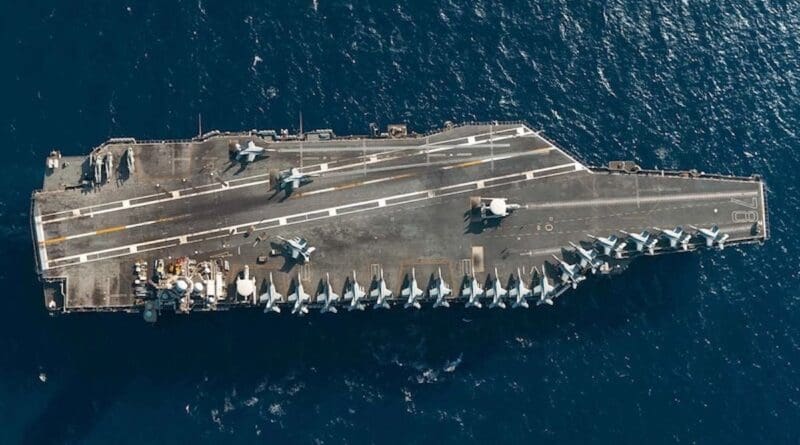
U.S. Navy To Power Base With Aircraft Carrier’s Nuclear Reactors
Key Takeaways:
- The U.S. Navy plans to test powering Naval Station Norfolk this summer using electricity exported from the nuclear reactors of the aircraft carrier USS Gerald R. Ford.
- The demonstration is part of a broader Department of War effort to ensure energy resilience at military bases in case of attacks or natural disasters that disrupt conventional power sources.
- Similar initiatives are advancing across the services, including Air Force and Defense Innovation Unit plans to site portable nuclear microreactors at selected bases to provide independent, baseload power.
The United States Navy will demonstrate the versatility of its nuclear-powered aircraft carrier USS Gerald R. Ford when it uses the ship’s two A1B reactors to power its homeport base in Virginia. Acting Secretary of the Navy Hung Cao said at a hearing of the House Armed Services Committee in May 2026 that the planned test is part of a pilot program, according to the website Military Times.
“This summer, [Naval Station Norfolk] is going to be powered from an aircraft carrier,” Cao said on May 14. “We’re going to export the energy from the aircraft carrier to the base.”
The Department of War (DOW) is driving development of alternative nuclear power plants to ensure energy security at its bases home and abroad if an attack or natural disaster disables power sources.
“The Department of the Navy is executing a multipronged strategy to ensure the delivery of firm, baseload power to our installations for energy resilience and mission assurance,” a Navy spokesperson told The War Zone (TWZ) news website. “One line of effort in the strategy is to deliver power from a Ford-class nuclear-powered aircraft carrier to a compatible shore installation, to demonstrate the capability to meet emergent, mission critical needs. An initial test of this capability is being planned for later this year at Naval Station Norfolk.”
The statement refers only to a Ford-class carrier, but the USS Gerald R. Ford is currently the only ship of its class that the U.S. Navy has commissioned into service, according to TWZ. The supercarrier, which is the world’s largest, returned to Norfolk from a marathon 326-day deployment in May 2026 — the longest for a U.S. carrier since the Vietnam War.
Cao, during the armed services committee hearing, pointed out the innovative possibilities for using a carrier: Its power could be used for sustaining military bases or to supply fresh, potable water to drought-stricken areas, according to Military Times. At the hearing, U.S. Navy Adm. Daryl Caudle, the chief of naval operations, said the test is a step toward the service’s creation of pilot programs comparable to those underway for the U.S. Army and U.S. Air Force, Military Times reported.
The DOW is investing in nuclear microreactors to power bases through several initiatives, including the Air Force’s Advanced Nuclear Power for Installations (ANPI), according to a May 2026 Reuters report. The Air Force and Defense Innovation Unit recently selected Buckley Space Force Base, Malmstrom Air Force Base and Joint Base San Antonio (Texas) as potential microreactor sites. ANPI picked three companies to develop and operate microreactors: Radiant Industries, Westinghouse Government Services, and Antares Nuclear, according to Reuters.
A microreactor can operate as part of an electrical grid, independently from a grid or as part of a microgrid to generate up to 20 megawatts of thermal energy to generate electricity, according to the U.S. Department of Energy’s Idaho National Laboratory (INL). Most microreactors are portable, and semis can transport them, according to the INL.
- This article was published by Sentry

Like what you read?
Please consider supporting Eurasia Review. Thank you for your consideration!
