
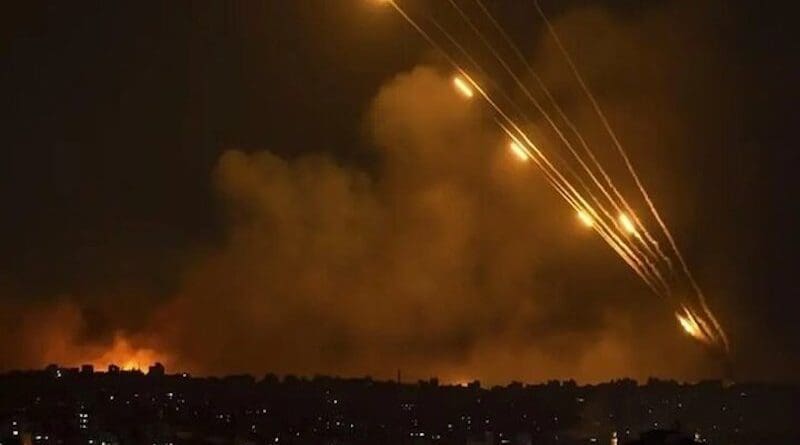
Iran Firing Missiles At Israel
(RFE/RL) — Iran has fired missiles at Israel as air-raid sirens blared across the country with residents being ordered to shelter, according to several international news agencies.
The firing of missiles by Tehran on October 1 came amid warnings from Washington and Israel that there would be “severe consequences” if it did so.
Earlier on October 1, the Israeli military said it had launched “targeted and precise” raids inside Lebanon in what it called a “limited” ground incursion that started overnight, adding that its troops were engaged in “heavy fighting” with Iran-backed Hezbollah.
Iran had vowed to retaliate for Israeli air strikes in recent weeks that killed the top leadership of its Hezbollah allies in Lebanon, including Hassan Nasrallah, the head of the militant group, which is designated as a terrorist organization by the United States.
The European Union blacklists Hezbollah’s armed wing but not its political party, which has seats in the Lebanese parliament.
Air-raid sirens sounded in central Israel on October 1 after an Israeli military spokesman said the missile attack was expected to be widespread.
A U.S. official, who spoke on the condition of anonymity, had said the United States was actively supporting Israeli defensive preparations. U.S. ships and aircraft are positioned in the region to assist Israel.
Israeli Defense Minister Yoav Gallant spoke with U.S. Secretary of Defense Lloyd Austin to discuss the threat of an attack by Iran, the Israeli Defense Ministry said in a statement.
They discussed Israel’s “operational readiness to defend its citizens and military assets, as well as U.S. force posture in the region,” the statement said.
The Iranian attack comes after the Israeli military on October 1 warned people to evacuate nearly two dozen Lebanese border communities hours after announcing what it said were limited ground operations against Hezbollah.
Hezbollah said it had responded to the Israeli offensive by firing a barrage of missiles into Israel, including at its intelligence agency near Tel Aviv.
An Israeli security official said elite commando and paratrooper units were involved in incursions in southern Lebanon that went only a short distance over the border.
Earlier, Avichay Adraee, an Israeli military spokesman, wrote in a message published in Arabic on Telegram that “heavy fighting” was taking place in southern Lebanon. “For your personal safety, we ask you not to travel by vehicles from the north to the southern area of the Litani River.”
Adraee said the operation involved the elite 98th Division, which was recently deployed to the north from Gaza, and would target Hezbollah strongholds.
Israel has vowed to keep up the pressure on Hezbollah and has declared a military zone in parts of its northern border with Lebanon, despite calls from around the world to de-escalate the situation.
British Foreign Secretary David Lammy said Israel should not get “bogged down in a quagmire” in Lebanon.
Spanish Foreign Minister Jose Manuel Albares said Israel should stop conducting the ground raids into Lebanon to avoid an escalation of the conflict.
On September 30, French Foreign Minister Jean-Noel Barrot also urged Israel “to refrain from any ground incursion and to cease fire.” He also called on Hezbollah “to do the same and to refrain from any action likely to lead to regional destabilization.”
“In accordance with the decision of the political echelon, a few hours ago, the IDF (Israeli Defense Forces) began limited, localized, and targeted ground raids based on precise intelligence against Hezbollah terrorist targets and infrastructure in southern Lebanon,” the IDF said in a statement late on September 30.
“These localized ground raids will target Hezbollah strongholds that threaten Israeli towns, kibbutzim, and communities along our border,” military spokesman Rear Admiral Daniel Hagari said early on October 1.
The launching of the ground operation came just hours after U.S. President Joe Biden, when asked whether he was comfortable with Israel taking such a move in Lebanon, said: “I’m comfortable with them stopping. We should have a cease-fire now.”
Later, as tensions mounted, the White House said in a statement that Washington believes the way to get an Israel-Lebanon cease-fire is to have a diplomatic resolution.
Israel has launched withering air attacks on Hezbollah in recent weeks, including missile strikes that killed the group’s longtime leader, Hassan Nasrallah, as well as claiming the lives of multiple Hezbollah leaders and other members of sanctioned militant groups.
Israeli attacks in Lebanon and in Yemen against Iran-backed Huthi rebels and claims by Tehran-allied Hezbollah militants that they had fired into Israel with their new “Nour missile” — which observers say might be a ballistic missile — led to increased fears that there could be an all-out war in the Middle East.
Separately, Iran said it would not deploy forces to Lebanon or the Gaza Strip to fight Israel amid the intensified attacks against Hezbollah in Lebanon.
“There is no need to send extra or volunteer forces of the Islamic Republic of Iran,” Foreign Ministry spokesman Nasser Kanani said on September 30, saying Lebanon and fighters in the Palestinian territories “have the capability and strength to defend themselves against the aggression.”
Kanani’s statement came as Naim Qassem, deputy head of Hezbollah, said in a video message that a replacement for Nasrallah will be chosen “sooner, rather than later.”
In the message, he said the selection will be made within the regular mechanisms of Hezbollah. He gave no further details.
Nasrallah was killed last week in an Israeli air strike on the southern command center of Hezbollah.
Israel’s military has also widened its attacks on Iran-backed militant groups, striking the Yemeni port city of Hodeida, which is held by Tehran-allied Huthi rebels, even as it intensified air strikes on Hezbollah strongholds in southern Beirut and elsewhere in Lebanon.
The losses suffered by Hezbollah appear to be the heaviest since Iran’s Islamic Revolutionary Guards Corps helped create the militant group in 1982 to blunt an Israeli invasion of Lebanon.
Nasrallah joined Hezbollah to fight in that conflict and in 1992 became its leader, building the group into Lebanon’s most powerful military and political force.

Like what you read?
Please consider supporting Eurasia Review. Thank you for your consideration!
