
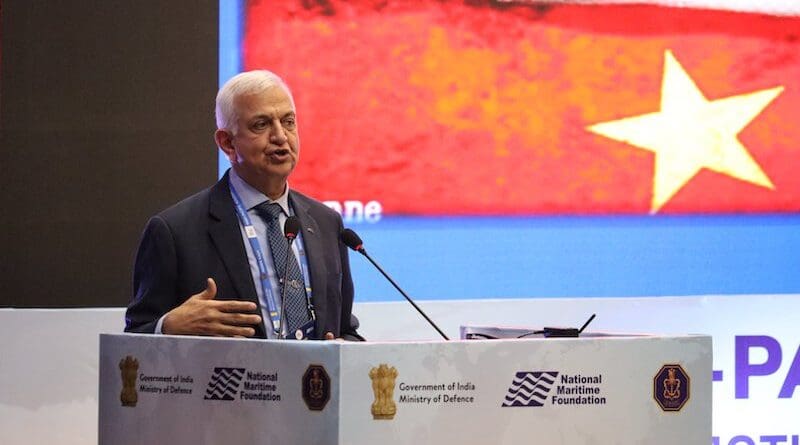
Vice Admiral Pradeep Chauhan, DG NMF, On IPRD 2025 And India’s Expanding Maritime Vision From SAGAR To MAHASAGAR – Interview
As the curtains fell on the seventh edition of the Indo-Pacific Regional Dialogue (IPRD 2025) in New Delhi, the three-day conclave left behind a rich exchange of ideas on regional capacity-building and holistic maritime growth. In this exclusive post-event interview, Vice Admiral Pradeep Chauhan, Director General of the National Maritime Foundation (NMF), situates India’s evolving maritime journey — from SAGAR to MAHASAGAR — within the broader Indo-Pacific discourse, and explains why maritime awareness must become a national mindset, not merely a coastal concern.
Q1. How has India’s maritime outlook evolved from SAGAR in 2015 to IPOI 2019 to MAHASAGAR now?
I would say that from SAGAR to MAHASAGAR, the guiding principle has essentially been the same, although the minor change in the geographical context is readily apparent. To explain this, allow me to hearken back to SAGAR. Prime Minister Modi enunciated SAGAR in March 2015, during the commissioning of the Barracuda for the Mauritius Coast Guard. On that occasion, Mr Modi had said that India “will work to ensure a safe, secure and stable Indian Ocean Region that delivers us all to the shores of prosperity”.
This was arguably one of the most succinct articulations of India’s maritime policy — a recognition that India’s growth was inextricably linked to the growth of other States in the region. Despite its pithiness, SAGAR encapsulated within itself an expansive definition of India’s understanding of regional security and growth. It is no small coincidence that exactly ten years later, in the same country, Mr Modi expanded the ambit of India’s maritime policy by announcing MAHASAGAR (Mutual and Holistic Advancement for Security and Growth Across Regions).
Although MAHASAGAR has been referenced as a vision for the entire Global South, I think that it relates to a much larger context — both geographically, and conceptually. The substitution of the term “region” which appeared in SAGAR with “regions” in MAHASAGAR, signals India’s preparedness to play a constructive role not just in the Indian Ocean, but in geographies beyond it. This also underscores our nuanced understanding of the maritime domain — that the continents of the globe are, indeed, enveloped by a single “world ocean” that has four recognised ocean basins. Importantly, Prime Minister Modi, while speaking at the Shangri La Dialogue in 2018 had categorically rejected a purely geographical definition of the Indo-Pacific. Instead, he had stated that the Indo-Pacific not only included all nations within its geography, but also others beyond who had a stake in it. Therefore, MAHASAGAR has reinforced this concept of the Indo-Pacific. Further, the two adjectives – “Mutual” and “Holistic” – in MAHASAGAR emphasise India’s collaborative and broad-based approach to maritime affairs in the Indo-Pacific. So, in a way, the SAGAR – IPOI – MAHASAGAR continuum mirrors India’s own evolving concept of security and growth.
This continuum found tangible articulation at IPRD 2025, where discussions repeatedly echoed the principles of holistic and mutual growth embedded in MAHASAGAR.
Q2. Why was IPRD created in 2018? What unique purpose does it serve now?
Let me begin by emphasising that the ‘Indo-Pacific Regional Dialogue’ is the generic name given to a series of annual conferences organised at the apex-level of the Indian Navy and conducted in seamless coordination with the Navy’s knowledge partner, the National Maritime Foundation (NMF). By 2018, the term “Indo-Pacific” had already moved quite decisively from its origins within the discipline of ‘biogeography’ into ‘geopolitics’ and had acquired very considerable traction therein. The contemporary spatial extent of the ‘Indo-Pacific’ is a predominantly maritime expanse, even if not an exclusively “maritime” one.
It incorporates all littoral and islandic nation-states of West Asia and Africa; goes right across the Indian Ocean in its entirety, envelops Southeast Asia (ASEAN), stretches into the Western Pacific to include the littorals of East and Northeast Asia (including North and South Korea, Japan and China), and even reaches across Australia and New Zealand into the sprawl of Southern Pacific island nations. Its north-south extend is equally majestic, from the southern coast of the Eurasian landmass to the northern shoreline of Antarctica.
Basically, the widespread usage of the term Indo-Pacific signifies a growing recognition that economic and security connectivities between the Indian and the Pacific oceans are so extensive and intensive that they can be sensibly considered only as a single strategic system. This contemporary recognition restores the historical ‘strategic-unity’ of this region, as typified by the extensive and strong maritime-trade links and other forms of maritime intercourse that existed for millennia between its kingdoms and other geopolitical entities.
Within the Indo-Pacific, one encounters a heady mix of maritime connectivity, collaboration, cooperation and competition — all of which are increasingly being recognised as exigent for the world, Asia, and, especially, for India. Clearly, it remains essential that connectivity, cooperation and collaboration should always trump competition, confrontation and most certainly, “conflict”. How could this best be done? Well, the first step was quite obvious, even in 2018. All of us who were connected by this regional construct needed to listen to one another, so as to understand and appreciate the perspectives that drove our respective strategies, be these security strategies, economic strategies, or cultural ones. This business of “listening” to one another requires a platform upon which these various perspectives could be aired. It was, of course, well recognised that “security” is far more than “military” security alone. There were (and still are) several dimensions of security — an economic dimension, a human dimension, an environmental dimension, a political dimension, a societal dimension, and so forth. Of these, military security is only one — arguably the most important one but, it is, nevertheless, only one. Given that peace and prosperity are common goals for all of us, all these dimensions needed to be addressed. This is why the IPRD came into being.
In 2019, our Prime Minister, Narendra Modi, brilliantly enunciated the concept of the Indo-Pacific Oceans Initiative (IPOI) with its seven maritime lines-of-thrust or pillars. This IPOI provides first-order specificity of our maritime policy, which is encapsulated in the acronym “MAHASAGAR”. Now, what each successive annual edition of the IPRD has continued to do is to sequentially focus attention upon one or another of the seven pillars of the IPOI and to flesh it out so as to generate second-order specificity, third-order specificity, and so on. The IPOI itself is best envisioned as a deeply interconnected web of seven spokes.
The contemporary and enduring relevance of the IPRD is that through the international recognition that this conference has acquired, the Navy is able to identify and recommend to the Government of India, how each of the seven maritime lines-of-thrust or spokes of this web may best be translated into meaningful and mutually beneficial action across the entire region. This why the IPRD has become the Indian Navy’s international outreach to the region at the strategic level and why the IPRD has been referred — at the level of our Cabinet ministers, as the maritime supplement to the Raisina Dialogue.
The recently concluded IPRD 2025, by focusing on regional capacity-building and capability enhancement, exemplified this continuity.
Q3. Why does maritime awareness matter to the average Indian who doesn’t live near the coast?
To the average Indian, the sea might evoke a sense of adventure, occasionally a thrill of the unknown, or even a streak of philosophical musing arising from the seemingly infinite expanse of the ocean. For many, especially those dwelling in the coastal states, the sea may represent a more intimate relationship with Nature’s elements – a source of livelihood and, perhaps, a vignette of their daily lives. But it would be nigh impossible to say, with any reasonable degree of assurance, that the Indian public shows a sustained interest in oceanic affairs, in the belief that India’s future greatness lies on the sea – something that KM Panikkar, at the dawn of the nation’s independence, had exhorted in his seminal work India and the Indian Ocean.
This is because of many reasons, the most important of which is that how could people who have never seen the sea – such as communities in the hills of Kumaon or in the forests of Chhattisgarh – be expected to inculcate a maritime consciousness?
But just because they have not been anywhere near the coastline, let alone having sailed upon the seas, does not mean that they need not be aware of the deep oceanic connect that Indians have had since millennia. If we flip back to the earliest pages of our history when our ancestors sang hymns in praise of Varuna, the Lord of the Oceans and verses were dedicated to the goddess Aditi, invoking her benediction for safe sea voyages, we realise that in those times, our linkages with the oceans were so strong that it transcended daily lives and came to be embedded in religion and culture. Without elaborating any further on India’s maritime heritage, which by the way is the richest among all nations of the world, let me go straight to the question of why the seas should matter to Indians today.
Today, we talk about “Viksit Bharat 2047”. Indeed, our national aim is to guarantee the material, economic, and societal well-being of our countrymen. How else are we to achieve this, if not through the sea? Today, more than 95 per cent of our merchandise trade goes over the oceans. More than 99 per cent of our communication with the rest of the world is enabled by undersea communication cables. About half of the domestic production of crude oil and 70 per cent of natural gas is from offshore basins. We are also the third largest producer of fish in the world, a sector which employs about 1.5 crore people. Increasingly, the sea is also gaining importance as a source of critical minerals such as cobalt, nickel, copper and manganese and it is estimated that there might be over 380 million tonnes of polymetallic nodules in the seabed of our EEZ.
Offshore energy is another area where our sea-dependence is going to increase. The offshore wind energy potential in our country is 127 GW, which is more than half the current peak power demand. How will we seize these opportunities without a whole-of-nation participation? We need skilled workers, professionals, scientists and academicians, and most importantly, policy makers who have the knowledge, the skill, and the understanding of why oceans matter to us. All this, of course, is underscored by our ability to preserve ocean health, to prioritise sustainability of oceanic resources. This is what ‘Blue Economy’ means, and this really requires that all of us be conscious of the fundamental connect that humans share with the oceans.
IPRD 2025’s emphasis on maritime education, heritage, and sustainability reaffirmed this call for greater ocean consciousness across all sections of Indian society.
Q4. How does IPRD 2025 advance India’s vision of the Indo-Pacific as a “strategic geography, not a strategy”?
IPRD-2025 provided a voice to India and several other powers that operate within the maritime reaches of the Indo-Pacific to articulate the fact that for each of them, the term Indo-Pacific is not a strategy against someone. It is, instead, a “strategic” geography in which each country is free to pursue not one but several strategies. But we need, perhaps to begin with the question, what is a “strategic” geography and how does it differ from “real” geography? If one were to take a chart or map that depicts ‘real’ geography and then place upon it a set of coordinates defined by specific latitudes and longitudes, such that they enclose or bound a given area, and, within the area that has been so ‘bounded’, if one were to then give special focus — at the national-level — in terms of the planning and execution of one’s geopolitical strategies, this enclosed or bounded area would define one’s ‘strategic geography’. Obviously, the strategic geography of one country can hardly be expected to be the same as that of another. Thus, the strategic geography of, say, Tonga, will not be the same as that of, say, India. Likewise, the strategic geography of, say, Sri Lanka, will not be the same as that of, say, Russia. The name we have given to our strategic geography is the Indo-Pacific. There is nothing remarkable in the fact that some other nation might well give the same name to its own ‘strategic” geography — just as several people might well have the same name, without every other physical attribute also having to be similar between them! With that out of the way, let me address the question of IPRD-2025 advancing India’s own strategies.
Since a strategy seeks to provide one or more pathways to attain a desire goal, it is important to recognise that India, like all other countries, has a set of geoeconomic goals and another set of non-geoeconomic goals. Illustrative examples of India’s geoeconomic goals might well include: the development of a high-quality, digitalized economy; to move from a four trillion US Dollar economy (in terms of our nominal GDP) to a thirty trillion dollar one by 2047, while avoiding the middle-income trap; to reduce national and regional wealth-inequality, to transition from a ‘brown’ economic model to a ‘blue’ one; to become a major manufacturing hub in global supply- and value-chains; to become an advanced country (Viksit Bharat) by 2047; and so on.
Likewise, illustrative examples of our non-geoeconomic goals might include: the sustenance of India’s territorial and cartographic integrity; to build and enhance India’s prestige and its reputation for wise and sagacious regional leadership across the Indo-Pacific; to obtain permanent membership of the UNSC; to be the “Preferred Security-Partner” within the Indo-Pacific; to inspire the Global South, and so forth. Insofar as the maritime domain is concerned, India’s three broad goals are to protect our territorial integrity; to establish and maintain our prestige and an enduring reputation as a reliable and preferred maritime partner; and, perhaps most important of all, to grow our economy through maritime shipping and port-led development. Each of the goals, whether geoeconomic or non-geoeconomic, will need one or more strategies, largely contextualised to the Indo-Pacific. These are the issues that the Indian interlocutors in IPRD-2025 sought to advance.
The dialogue’s diverse participation, from Africa to the Pacific Islands, showcased how India’s conception of the Indo-Pacific as a ‘strategic geography, not a strategy’ continues to find wide resonance.
The Indo-Pacific Regional Dialogue 2025 was organised by the Indian Navy in association with the National Maritime Foundation as its knowledge partner from 28–30 October in New Delhi.

Like what you read?
Please consider supporting Eurasia Review. Thank you for your consideration!
