
The Hype Layer: How ‘Hypersonic’ And ‘800 Km Range’ Claims Formed A Reality Of Their Own – OpEd
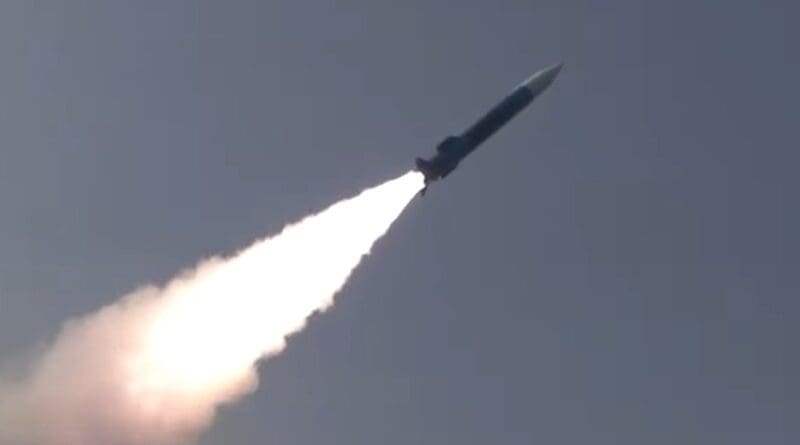
When Pakistan fired its latest naval missile, the event itself was almost unremarkable: a controlled ignition, a rising flame, a predictable arc, and a splash somewhere in the Arabian Sea. What followed was far more dramatic. Social media erupted with declarations that Pakistan had secretly crossed a technological threshold. The missile was suddenly “Mach 8”, then “800 kilometres in range”, and eventually “South Asia’s first hypersonic anti-ship ballistic missile launched from a warship.” None of these phrases came from official channels, but by the end of the day they had taken on the weight of fact simply through repetition.
This feverish excitement created a second event parallel to the missile test: an information phenomenon in which speculation hardened into certainty, certainty hardened into national pride, and national pride insulated itself from evidence. The hype became the story, eclipsing the modest reality of what Pakistan had actually demonstrated. The missile did not break the atmosphere at hypersonic velocity. What did go hypersonic was the narrative.
The origins of this narrative lie not in Pakistan’s military establishment but in the digital ecosystem that surrounds it: defence enthusiasts eager to celebrate symbolic victories, anonymous online accounts that trade in exaggerated claims, and self-styled commentators who rely on dramatic headlines for reach. These actors filled the information vacuum in the hours after the test, linking the missile to entirely unrelated Chinese systems, attaching speculative performance figures, and circulating AI-generated images and dramatic infographics that made the missile appear larger, faster and more capable than anything seen in the official footage. Across this landscape, the missile seemed to be upgraded in real time.
Against this rising tide of online certainty, Pakistan’s own statement was almost austere. The ISPR simply announced that a naval platform had successfully launched a missile. There was no reference to hypersonic flight, no claim of extraordinary range, no attempt to position the event as a technological breakthrough. The restraint was conspicuous. When countries achieve a genuine leap in missile technology—especially in a domain as strategically charged as anti-ship ballistic weaponry—they usually broadcast it quite openly. China has unveiled its DF-21D and DF-26 systems with fanfare. India publicises its hypersonic trials. The United States releases extensive telemetry and tracking footage whenever it conducts major missile demonstrations. None of this happened here.
The technical landscape reinforces the quiet tone of the official statement. Hypersonic weapons leave signatures that are unmistakable: intense heat envelopes visible in infrared, high-velocity radar profiles, and flight paths that are distinct from conventional ballistic trajectories. Pakistan released none of this data. The missile shown in the footage matches the proportions of the Chinese CM-401 family, a short-range anti-ship ballistic system designed for coastal defence. It is a compact weapon optimised for quick-reaction strikes within a roughly 250 to 300 kilometre envelope. Nothing about its size, structure, or likely propulsion suggests a sudden transformation into an 800 kilometre vehicle.
Equally important is the supporting architecture that long-range ASBM systems require. These missiles mean little without a kill chain that can identify, track and continuously update the position of a moving ship far beyond the horizon. That architecture demands maritime reconnaissance aircraft, long-endurance drones, wide-area radars, and satellite coverage—all part of an integrated data network. Pakistan has no publicly demonstrated version of this ecosystem. Even China, the only country with a mature ASBM capability, took years to refine the sensor and communication network that gives the DF-21D its credibility. Pakistan is nowhere near that level of integration.
The contrast between the missile’s actual design and the extraordinary claims attached to it speaks to a larger pattern in contemporary conflict narratives. In an era where national pride, political signalling and online engagement intersect, the symbolic value of a missile test can outweigh its operational meaning. A short-range coastal defence weapon can, through sheer digital enthusiasm, be reframed as a strategic game-changer. And because social media platforms reward speed and emotional content, the most dramatic interpretation of an event is usually the one that spreads fastest, regardless of its factual grounding.
This dynamic has consequences. When inflated narratives become widely believed, they begin to shape public expectations and, at times, policy thinking. False confidence can generate strategic miscalculation just as surely as false pessimism can. When a hypersonic capability exists only in the national imagination, it distorts assessments of deterrence, escalation and military balance. It also obscures the real state of a country’s defence development. Policymakers misinterpret what their own forces can do; analysts misjudge what their rivals can respond to; publics rally behind achievements that never occurred. These distortions can heighten tension during crises, where misreading capability is not simply an intellectual error but a strategic hazard.
Strip away the noise and a far more grounded interpretation comes into focus. Pakistan appears to have tested a CM-401–derived missile: a useful, fast, tactical system designed for area denial near the coastline. It is not insignificant, but it is not a hypersonic breakthrough. It does not alter the strategic geography of the Arabian Sea. It does not threaten Indian carrier groups operating at standoff distances. It does not signal a leap into a new generation of naval warfare. It is simply an incremental step within a known technological lineage.
The missile’s real trajectory was fixed and predictable. Its symbolic trajectory was wildly unstable, climbing to heights far beyond what the hardware can support. What Pakistan tested was a weapon. What social media launched was a myth. And as the dust settles, it becomes clear that the myth travelled farther, faster, and with far greater impact than the missile ever could.

Like what you read?
Please consider supporting Eurasia Review. Thank you for your consideration!
