
President Of Uzbekistan Pays State Visit To Kyrgyzstan, Joins Regional Consultative Meeting – OpEd
Key Takeaways:
- Uzbekistan and Kyrgyzstan elevated their partnership to an allied relationship with a new Treaty on Allied Relations, an Interstate Council, and a target to raise bilateral trade to $3 billion.
- The talks advanced practical cooperation on transport (including the China–Kyrgyzstan–Uzbekistan railway), energy, water resources, industry, and border issues, while producing a package of supporting agreements.
- At the broader Consultative Meeting, Central Asian leaders and Azerbaijan discussed building a common development space focused on economic connectivity, education and innovation, climate adaptation, and stronger regional institutions.
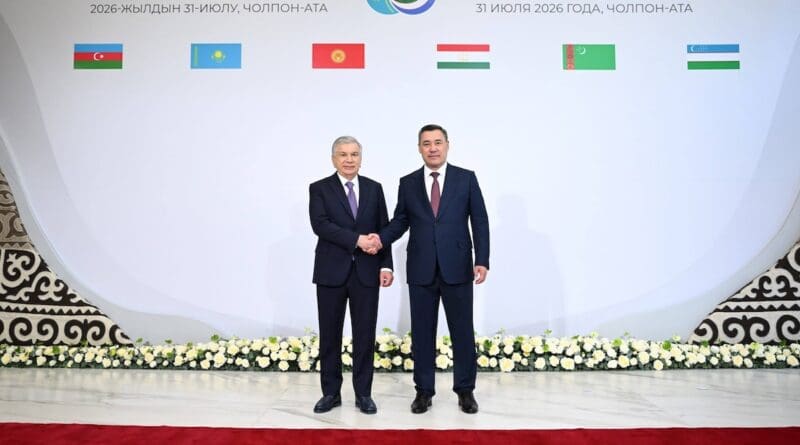
On July 30, President of Uzbekistan Shavkat Mirziyoyev arrived in Kyrgyzstan for a state visit, where he held high-level talks with President Sadyr Japarov in Cholpon-Ata and participated in the informal Consultative Meeting of the Heads of State of Central Asia and Azerbaijan. The visit brought together bilateral agreements on trade, transport, energy, culture and humanitarian cooperation with broader discussions on regional integration, economic connectivity, climate change and the future of Central Asian cooperation.
The Uzbek President was officially welcomed by President Sadyr Japarov at Issyk-Kul International Airport in Cholpon-Ata. The two leaders later held talks at the Ruh Ordo cultural center, where they discussed the development of Uzbek-Kyrgyz relations and practical cooperation across priority sectors.
Uzbekistan and Kyrgyzstan Deepen Strategic Partnership
President Mirziyoyev described Uzbek-Kyrgyz relations as being at a historic peak. Bilateral trade has increased almost tenfold in recent years, reaching more than $1.2 billion last year. The two countries now have around 450 joint enterprises, while 15 air routes and five bus routes connect their cities.
A major outcome of the talks was the signing of the Treaty on Allied Relations, which elevates the partnership between the two countries to a new level. The presidents also agreed to establish an Interstate Council, chaired by the two heads of state, as a central mechanism for implementing the allied relationship and setting long-term priorities.
The two sides set a new target of increasing bilateral trade to $3 billion and discussed industrial cooperation in energy, electrical engineering, pharmaceuticals, agriculture, textiles and the joint development of natural resources. They also agreed to make greater use of the Joint Development Fund to support cooperation projects.
Transport connectivity was another important part of the discussions. The presidents reviewed progress on the China–Kyrgyzstan–Uzbekistan railway and agreed to develop trade and logistics infrastructure along the route, introduce digital solutions into transport and trade procedures, and create better conditions for road carriers. Cooperation on the Kambarata-1 hydropower project and transboundary water resources was also discussed.
The visit also produced a broad package of bilateral documents covering sections of the Uzbek-Kyrgyz state border, the joint use of the Chashma spring, social insurance and pensions, recognition of higher-education credits, border-crossing procedures, tourism, culture and agriculture. Plans were also adopted for cooperation in culture and tourism in 2026–2027.
President Mirziyoyev was additionally awarded the Order of Manas, First Degree, one of Kyrgyzstan’s highest state honors, in recognition of his contribution to strengthening friendship, good-neighborly relations and cooperation between the two countries.
Central Asia and Azerbaijan Look Toward a Common Development Space
On July 31, President Mirziyoyev joined the informal Consultative Meeting of the Heads of State of Central Asia and Azerbaijan in Cholpon-Ata. The meeting brought together the presidents of Uzbekistan, Kyrgyzstan, Kazakhstan, Tajikistan, Turkmenistan and Azerbaijan to discuss sustainable development, economic growth, security and the well-being of their peoples.
In his address, President Mirziyoyev emphasized the progress made by the countries of the region ahead of the 35th anniversaries of their independence. He noted that Central Asia, which was once more fragmented, is increasingly consolidating around common development goals.
The Uzbek leader also highlighted the significance of Azerbaijan joining the Consultative Meeting format. In his view, this has moved cooperation beyond Central Asia toward a wider macro-regional framework connecting Central Asia and the South Caucasus. He described the current period as a historic opportunity to create a common development space linking Central Asia, the South Caucasus and Afghanistan.
President Mirziyoyev called for the creation of a more sustainable architecture of regional cooperation based on effective institutions, stronger contacts between government agencies, direct links between regions and long-term joint programs. He also stressed the importance of closer coordination within international organizations and “Central Asia Plus” formats to strengthen the region’s international role.
Economic and transport connectivity were among the main priorities. The Uzbek President called for further development of regional trade, transport links, industrial and technological chains, shared digital services and investment platforms. These efforts, he said, should help create a more interconnected regional economy capable of competing globally.
Another priority was education, science and innovation. President Mirziyoyev proposed developing Central Asia into a competitive hub for education, science and big-data innovation by creating infrastructure that connects human capital, artificial intelligence technologies, data centers and energy capacity.
Climate change also featured prominently in his remarks. Referring to the extreme heat experienced this summer, he said climate change is increasingly affecting economic activity, water and energy security, public health and quality of life. As environmental challenges cross national borders, he called for common long-term approaches to climate adaptation.
The humanitarian dimension remained another important part of the regional agenda. President Mirziyoyev noted that the peoples of Central Asia have lived alongside one another for centuries, exchanging trade, knowledge and cultural traditions. He argued that deeper modern cooperation is also strengthening a broader regional identity while preserving each nation’s distinct character.
The meeting concluded with the adoption of the Cholpon-Ata Declaration, setting out a framework for continued regional cooperation. The state visit by the President of Uzbekistan combined a new stage in its allied relationship with Kyrgyzstan and a broader regional agenda focused on connectivity, economic integration, innovation, climate resilience and closer ties across Central Asia and the South Caucasus.

Like what you read?
Please consider supporting Eurasia Review. Thank you for your consideration!
