
Clarity Over Confusion: India’s Role In Russia-Ukraine War – OpEd
The refusal of India to take sides, especially in the Russia-Ukraine war, demonstrates India’s stand in the conflict-torn spaces. Since the Cold War era, India has been demarcating the line between involvement and monitoring. For India, involvement and tracking in a particular world event depends upon the rationality of national interest, not the perception of what great powers think. Interestingly, India has also refused to cast a vote in the general assembly, which, to confirm its stand in the Russia-Ukraine War, is not an inaction but an action with conscious results.
In such a precarious event, the stand of India denotes the balanced diplomacy to tackle the situation without hampering the basic foundation of India’s foreign policy – “The world is one family”. Despite the rumours and perception of Western media over India’s inclination towards its Russian counterpart, India reached the highest level of diplomatic engagement. Relying on the principle of dialogue-based settlement of disputes, the course of events in the Russia-Ukraine war was somehow influenced by the same principle of India, if not explicitly, then perhaps implicitly.
Indifferently, the engagement of India has been driven by the interests of the people of India, not by the fancies and whims of the structural order of the world, occupied by the elite powers, exercised through the established norms and perpetuated to manage the status at the global level. To make an inclusive world order, India has been a constant voice in reforming all the mechanisms influencing the day-to-day whereabouts of the world. The current Russia-Ukraine war promotes the role of India-way-of-diplomacy in reshaping the structure, which is responsible for not being able to minimise the contradictions and conflicts between the states.
In nutshell, India’s partnership with Russia has been strategic, perpetual and time tested; Russia, in particular, maintains the strategic importance through military, territorially and diplomatically; militarily, India has been the consumer of Russian weapons and military hardware; territorially, Russia supports India’s stand on Kashmir issue and considers this matters as truly India’s own, not to be negotiated globally; diplomatically, Russia has been at the forefront to open up the door of Security Council of UN for India to make the Council more diverse and inclusive. Over the years, the bilateral relations between India and Russia could be judged through constant adherence to strategic partnership, geopolitical balance and economic collaboration.
Despite the tightness of the relationship, India, since the outbreak of the conflict, has never supported either party in various forums. Knowing the civilian casualties and massive destruction, India convinced the Russian counterpart to adhere to diplomatic channels and through-the-dialogue methods to mitigate the conflict. Besides, India extended humanitarian support to Ukraine and delivered essential supplies to promote human rights. At this juncture, the question arises: why doesn’t India clear its stand in the war? The answer to this question seems to be more realistic, not altruistic. India’s firm support to Russia would curtail India’s vision for inclusive humanity and collective brotherhood. In addition, India could not even support Ukraine to dismantle Russia’s strategic role in India’s geopolitics.
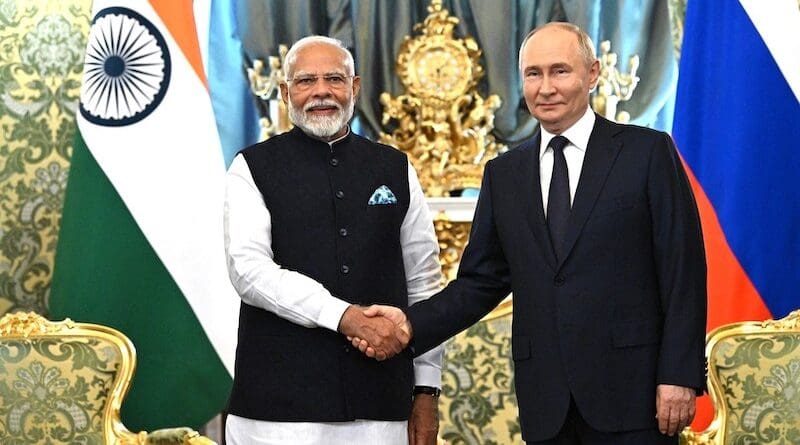
Russia’s recent initiative to allow India to intervene in the conflict as a mediator has significantly upgraded India’s diplomatic standard. Moreover, after detailed deliberation with the Ukrainian President, India’s Prime Minister conveyed the message to the Russian President through India’s National Security Advisor (NSA). India’s diplomatic victory was the trust of Russia over India’s logical dimension towards global peace and security.
The confusion over India’s diplomatic stand in the conflict has become a lesson for the rest of the world. India, Russia, and Ukraine maintain a balance to construct a golden path between strategic partnership and human security. The mutual debate and negotiation path could be more impactful than military aggression and bloodshed. India’s balanced diplomacy has provided a clear signal of peace and security without lying on a military-based solution.

Like what you read?
Please consider supporting Eurasia Review. Thank you for your consideration!
