
Pakistan-Occupied Jammu & Kashmir: A Rebellion Pakistan Cannot Contain – OpEd
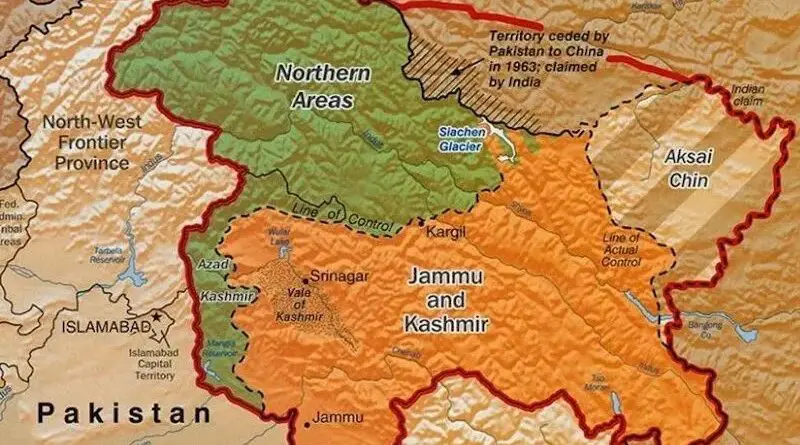
Pakistan-Occupied Jammu & Kashmir (POJK) is once again on the boil. Over the past week, a wave of mass protests has erupted across the territory, exposing the structural fault lines of Islamabad’s governance. For decades, Pakistan has projected POJK as the showcase of its solidarity with the people of Jammu and Kashmir. The lived reality, however, has been one of systematic neglect, extractive governance, and denial of political rights.
The protests, spearheaded by the Jammu Kashmir Awami Action Committee (JKAAC) led by Shaukat Nawaz Mir, represent the most significant challenge to Pakistan’s authority in the region in recent years. The demonstrators are not rallying against India, as Islamabad often claims in its narrative to the world. Instead, they are demanding relief from Pakistan’s own exploitative grip—an unprecedented inversion of Pakistan’s Kashmir strategy.
From Rawalakot to Muzaffarabad: Civil Resistance in Motion
The protests have cut across geography and community. Rawalakot, Mirpur, Kotli, and Dadyal—all once considered quiet zones under Pakistan’s iron hand—have become epicentres of mobilisation. Convoys of thousands braved barricades to march towards Muzaffarabad, the administrative capital.
The state’s response was swift and brutal. At Dhirkot and Dadyal, police opened fire on unarmed demonstrators, killing at least six and injuring dozens. In Muzaffarabad, Lal Chowk became the focal point of resistance, where nearly 2,000 protestors staged sit-ins despite aerial firing and tear gas shelling. Markets in Kotli and surrounding towns observed a complete shutdown, signalling mass support.
The symbolism is unmistakable. The very towns and valleys once cultivated by Pakistan’s Inter-Services Intelligence (ISI) as springboards for proxy militancy against India are now hubs of anti-Islamabad resistance.
The Colonial Governance Model
The roots of discontent lie in the colonial governance architecture that Pakistan has imposed on POJK. Since the first India-Pakistan war of 1947–48, Pakistan has exercised direct control over the region while maintaining the façade of an “Azad” Jammu and Kashmir (AJK) administration. The so-called AJK government functions largely as a client regime, with real power concentrated in Islamabad’s Ministry of Kashmir Affairs and the Pakistani military establishment.
Hydropower projects divert electricity to Punjab while locals endure power shortages. Water and forest resources are extracted without reinvestment. Refugee settlers enjoy privileges denied to locals. Elections are stage-managed, with candidates required to pledge allegiance to Pakistan as a precondition for contesting. In essence, POJK is administered as a colony—exploited for resources, used for propaganda, but denied dignity and development.
The situation in Gilgit-Baltistan (GB) follows a similar trajectory. Islamabad has avoided granting it provincial status while retaining tight administrative control. Both territories remain outside Pakistan’s constitutional framework, leaving residents disenfranchised in their own homeland.
Brutality and Denial
The repression unfolding in recent days—firing on civilians, mass arrests, and communication blackouts—is not an aberration but part of a consistent pattern. In Balochistan, enforced disappearances and collective punishment have been the norm. In Khyber Pakhtunkhwa, military operations regularly devastate civilian zones. In Sindh’s interior and South Punjab, economic neglect fuels bitterness.
Rather than engage with local grievances, Islamabad habitually externalises blame. The armed rebellion in Balochistan is attributed to “foreign conspiracies.” The Tehreek-e-Taliban Pakistan (TTP) insurgency is dismissed as “India-sponsored.” Now, the protests in POJK are similarly being painted as the handiwork of “external hands.” This narrative may work for domestic consumption, but internationally it rings increasingly hollow.
Global Reverberations
The protests in POJK are not just an internal Pakistani crisis. They hold wider implications for South Asia’s fragile stability. With Pakistan’s economy shackled to IMF bailouts, its political system paralysed by factional warfare, and its military overstretched on multiple fronts, its ability to manage a sustained uprising in POJK is questionable.
For India, this represents both an opportunity and a challenge. On the one hand, Pakistan’s long-standing use of POJK as a staging ground for proxy war is undermined when its own citizens rise in rebellion. On the other hand, instability in POJK carries risks of spillover across the Line of Control, potentially sparking escalatory cycles that neither side may control.
Internationally, these protests complicate Pakistan’s efforts to portray itself as a victim in the Kashmir dispute. When residents of its own administered territories accuse Islamabad of colonial exploitation, the credibility of its claims on Kashmir erodes dramatically.
The Road Ahead
The question now is whether Islamabad chooses repression or reform. Past practice suggests the former. Communication shutdowns, curfews, and mass detentions may temporarily contain unrest, but they cannot extinguish the grievances driving it. The anger is deeply rooted in systemic economic exploitation, in denial of political agency, and in a lived experience of marginalisation.
For the people of POJK, the long march to Muzaffarabad is more than a protest; it is a declaration of agency. For Islamabad, it is a reckoning. And for the international community, it is a reminder to look beyond the rhetoric of the Pakistani state and acknowledge the realities on the ground.
Unless Pakistan abandons its colonial mindset towards POJK and Gilgit-Baltistan, it risks facing not just episodic protests but a long-term erosion of control. The rebellion from within has begun, and it may prove more difficult for Islamabad to contain than any pressure from outside.

Like what you read?
Please consider supporting Eurasia Review. Thank you for your consideration!
