
India’s Naval Leadership Signals Strategic Confidence At NDA Passing Out Parade – OpEd
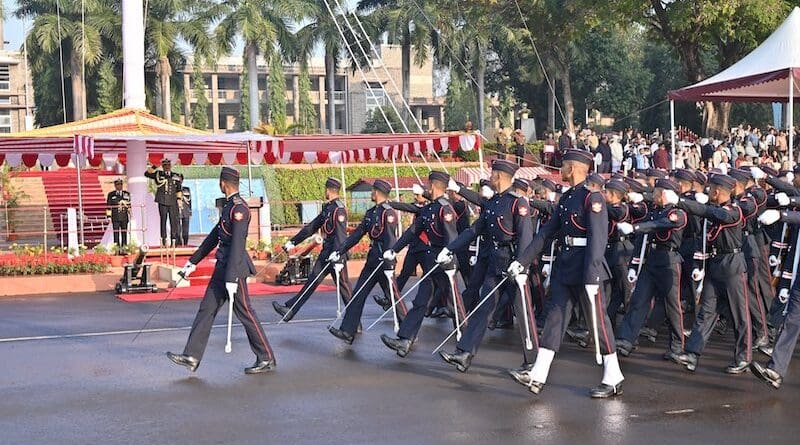
The Passing Out Parade of the 149th National Defence Academy course in Pune offered more than ceremonial precision. It provided a window into how India’s senior military leadership interprets the strategic landscape unfolding across Asia — and the responsibilities India’s next generation of officers will inherit.
Reviewing the parade, Indian Navy Chief Admiral Dinesh K. Tripathi delivered an address that moved well beyond the traditional congratulatory script. His speech reflected a worldview shaped by shifting balances of power, rapid technological change and an expanding set of security responsibilities for India in the Indo-Pacific.
The Navy Chief began by reaffirming the academy’s role in shaping “the next generation of military leaders — disciplined, determined, and ready to safeguard the peace, security, and sovereignty of India, and those of our partner nations.” That final phrase — partner nations — spoke to a recurring theme in India’s external engagements: the rising expectation that India acts not only as a stabilising power in its immediate neighbourhood but also as a key security partner for countries across the wider Indo-Pacific.
This year’s parade made that dynamic explicit. The 149th course included cadets from 20 friendly foreign countries, part of a long-term effort by New Delhi to deepen military-to-military links through training, doctrine familiarisation and officer-level interoperability. Such exchanges, while often understated, have become essential instruments of India’s defence diplomacy. They allow partner states to build institutional familiarity with Indian military culture while enhancing New Delhi’s visibility and influence in multilateral frameworks.
Admiral Tripathi’s address captured this outward-looking confidence. It also carried a candid assessment of the world the cadets are entering. He described a security environment “that no longer draws clear lines between peace and conflict, or truth and manipulation,” referencing a spectrum of challenges that include disinformation campaigns, unmanned systems, undersea contestation, cyber vulnerabilities and dual-use technological disruption. From a geopolitical standpoint, these concerns reflect the Indian Navy’s own operational realities — a far more congested maritime domain, increased presence of extra-regional players, and the complex dynamics of grey-zone competition in the Indian Ocean.
The Admiral anchored his message in three virtues that he argued will determine how officers navigate these pressures: competence, courage and character. His insistence that “rank may define your credentials, but competence will define your credibility” aligns with the modern Indian military’s push toward technologically enabled warfare and a higher premium on domain expertise. It mirrors reforms underway across the services, from jointness initiatives to capability upgrades driven by indigenous programmes and selective foreign partnerships.
His remarks on courage — “the ability to advance despite fear” — reflected an enduring military ethos but carried salience in the present moment, where officers must operate in environments marked by ambiguity, contested narratives and asymmetric threats.
The third virtue, character, was the moral centrepiece of his address. By invoking Captain Mahendranath Mulla of INS Khukri, who went down with his ship in 1971, Admiral Tripathi drew attention to an element of leadership that technology cannot replace: ethical judgement under pressure. In an era where automated systems, real-time intelligence and algorithmic decision support increasingly influence combat outcomes, the Admiral’s emphasis on integrity served as a reminder that leadership in the Indian military remains grounded in human responsibility.
The presence of the second batch of women cadets underscored another aspect of India’s evolving defence landscape. As fifteen women cadets marched past, Admiral Tripathi said the Services honour “only one standard, and that is merit.” The remark encapsulated both the inclusiveness and the demands of modern military service, where opportunities have expanded but expectations remain uncompromising.
From a wider strategic perspective, the NDA POP mirrored India’s military trajectory: professional, confident and increasingly intertwined with regional and global security structures. The combination of foreign cadets, gender integration, and the Navy Chief’s pointed articulation of contemporary challenges spoke to an institution preparing its officers for a far more interconnected operational environment.
For Eurasia Review’s international readership, the event offers three takeaways.
First, India’s officer training pipeline is now directly linked to its diplomatic footprint, with partner nations sending cadets as a signal of long-term trust.
Second, India’s senior military leadership is acutely aware of the hybrid technological and geopolitical pressures reshaping global security.
And third, despite these shifts, the normative foundation of Indian military leadership — duty, discipline and ethical conduct — remains deliberately intact.
As the cadets marched off the parade ground for the final time, the broader message of the event became clear: India is preparing officers not only for the challenges of national defence, but for a strategic environment where India’s choices increasingly matter to the region and beyond.

Like what you read?
Please consider supporting Eurasia Review. Thank you for your consideration!
