
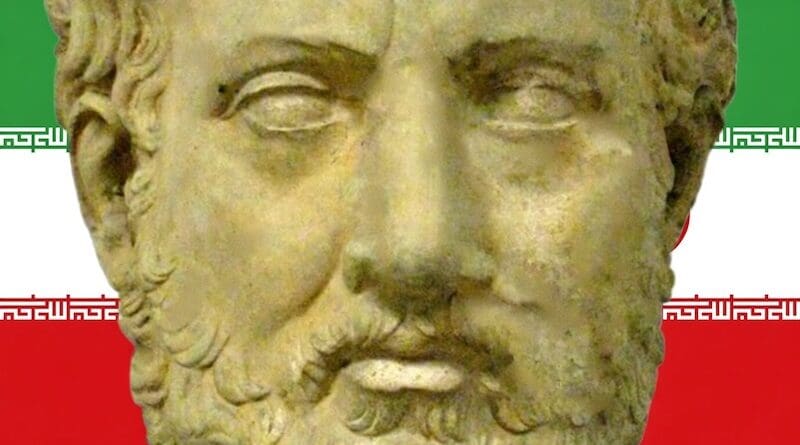
Iran: Away From The Thucydides Trap? – Analysis
By Mauricio D. Aceves
The Islamic Revolution rewired society, recast identity, and turned religion into public power. For those who lived it, 1979 is not just a headline—it is the origin and the before-and-after that defined a lifetime and the future of a regional power. In September 1980—after border clashes—Saddam Hussein, president of Iraq, calculated that a war against post-revolutionary Iran would be quick and decisive. Instead, it became an opportunity for Ayatollah Ruhollah Musavi Khomeini: a conflict that hardened the state, rallied supporters, and supplied a unifying enemy across Iran’s western border. From a regional optic, the war also opened a new diplomatic theatre. Once it became clear that neither side could secure a victory, states moved to contain spillover, protect energy routes, and prevent a wider conflict.
That conflict created a paradox: it obturated identities and security doctrines, yet it also forced the region to practice crisis management—back channels, coalition-signalling, and ceasefire-engineering. Even when mediation did not succeed, diplomacy served as a tool of containment, shaping alignments and laying early templates for the region’s politics. If 1979 was the turning point, 1980 was the point of no return.[1] The Iran-Iraq War broke regional dynamics and cemented a harsher reality in which security trumped politics. In 1987, President Ronald Reagan stated, “This conflict threatens America’s strategic interests, as well as the stability and security of all our friends in the region.” [2]
To this day, the echoes are unmistakable: Iran is again caught between internal rupture and external pressure even without Iraq as a rival. As economic stress fuels domestic unrest and speculation about a conflagration, the region returns to a cycle: fragility invites intervention and intervention consolidates the state. Nowadays, Israel´s strategic interest still includes preventing Iran from reaching military superiority, nuclear capabilities, and degrading the networks that enable pressure on Israel’s borders[3] and blocking Iran from approaching the Gulf states.
In 1980, the Iran–Iraq War was among the last major conflicts fought in broadly symmetrical terms: armies, territorial objectives, and a front line you could follow on a map. The Eritrea-Ethiopia War of 1998 is another example. Today, the geometry has changed. The battlefield is a network—drones, cyber operations, maritime disruption, precision strikes, and partner forces stretching from Iraq and Syria to Lebanon and the Red Sea. External involvement multiplies asymmetries or reduces them, allowing actions to trigger outsized strategic effects, as reports detail about the ongoing war in Ukraine[4] or, properly, Israel´s Operation Rising Lion of last June.[5]
At the same time, Iran’s neighbours prize containment more than ever. As Iran faces mounting economic, political, and social pressure, and as the risk of a broader conflict rises, regional diplomacy increasingly runs in parallel. Silent de-confliction channels through Muscat, Riyadh, Doha, and Ankara function like pressure valves: they do not guarantee peace, but prevent a misread signal or maritime incident from triggering a direct military engagement.[6] The battlefield is not only where force is applied; it is where the regional order is negotiated in real time, crisis by crisis, minute by minute, in Washington or in Muscat, in Tehran or Tel Aviv.
Three elements reflect the current scenario in Iran. First, Iran’s internal instability, which is being securitized and anchored in economic dislocation—the rial’s depreciation,[7] and acute cost-of-living pressures that are translating into unrest across the country. The state’s approach remains security-first – publicly distinguishing licit dissent from violence, signalling firmer enforcement, and managing connectivity as an instrument of stability through restrictions. The official narrative frames external rhetoric as interference but simultaneously reports a toll of thousands of casualties among protesters.[8]
Second, a near-term direct conflict risk is not imminent, but certainly, the probability of kinetic action is elevated. International rhetoric raises the risk of miscalculation. In contrast, regional actors appear to be showing restraint,[9] given the importance of the Hormuz Strait, the regional narrative of certainty and potential violence spillovers.
Third, the most probable escalation pathway remains “limited and deniable,” such as cyber and covert action, and short-duration strikes rather than sustained conventional war. Both sides have strong incentives to avoid a long campaign. The Twelve-Day War was a showcase of limits from both sides. It does not discard a major strike; the sense of opportunity will be crucial. Meanwhile, the Abraham Lincoln Carrier Strike Group has made its way from the South China Sea to the Gulf of Oman.[10] [11] This action could boost U.S. striking power in the coming days and create credible strike options.
What to expect next? Deterrence around Iran is unusually explicit: threats against regional bases and maritime assets are being framed as potentially existential escalators, tightening decision timelines. President Masoud Pezeshkian warned that any attack on Supreme Leader Ali Khamenei would amount to a “declaration of war.”[12] At the same time, regional restraint is material: Gulf states remain highly exposed to energy-market disruption and have supported diplomacy.[13] [14] A U.S. recession[15] or an increase in social unrest is “far” geographically from the Middle East, but it is not strategically distant: it can still shape escalation. A downturn can compress political timelines or increase risk tolerance. Historically, leaders may use external pressure to gain domestic leverage.
Overall, the most plausible trajectory is a moderate risk. The current environment suggests an elevated risk window in the coming days, with the most likely triggers being a renewed cycle of direct Iran-Israel exchanges. The odds of a sustained conventional war are low, as the cost is prohibitive. Yet the region remains a chessboard where one actor may still gamble that someone else will pay the price. On the other hand, indirect operations are likely, consistent with established retaliatory logic. Then, rather than a Thucydides’ trap, there is room for constraint; words usually move faster than fleets.
In the diplomatic and strategic realm, the Joint Comprehensive Plan of Action (JCPOA) has remained dormant since the June strikes, and the diplomatic track has stalled amid sanctions pressure. The nuclear talks in Vienna have disappeared as a backchannel for negotiations, but they can return as a guide to reestablish negotiations.[16] Meanwhile, the nuclear program is no longer verified. Conversely, Iran retains a deterrent capacity through a missile inventory.[17] Unofficial reports say Iran is rushing to rebuild its air defences, and the stock of ballistic missiles is still significant.[18] In the other corner, Israel retains long-range strike options, Washington signals readiness to use force if defined red lines are crossed such as a Casus belli action. Until then, coercive diplomacy remains the operative.[19] [20] The foreign minister of Türkiye, Hakan Fidan, has called for dialogue “Hopefully, the United States and Iran will resolve this issue among themselves – whether through mediators, other actors, or direct dialogue”.[21]
Finally, a triad of indicators merits monitoring. First, any renewed tightening of information on the Iranian street, such as expanded internet restrictions or large-scale arrests, will signal a shift from episodic policing to a sustained social and political crisis – the biggest since the protests of September 2022, or even comparable to the uprising of the Islamic Revolution. Second, visible changes in regional posture, such as alerts for visitors, airspace closures, or evacuation of diplomatic representations, indicate preparations for a larger disruption. Third, the language of leaders reveals a shift from deterrent warnings and rhetoric to objective indicators of operational military authorizations.
Escalation begins with the use of vocabulary before it actually occurs. Unofficial reporting indicates Turkish officials reviewed Iran-related contingency scenarios, emphasizing measures to keep any potential refugee flows on the Iranian side of the border.[22] These can be read as early indicators of anticipatory planning, as decision-makers hedge against a latent tempest.
As 1979 reminds, history rarely announces its pivots: a political shift can set into strategic fact, then its consequences radiate outward, crossing borders and reshaping international theatres and the future of a regional power and a splendid culture. James Joyce´s Ulysses recalls that history is a nightmare – from which today’s Iran is trying to awake.
- About the author: Mauricio D. Aceves is an advisor for security and border issues at STRATOP Risk Consulting, a Mexican Council on Foreign Relations member, and an analyst on contemporary Middle East and Central Asia issues.
- Source: This article was written for Gateway House: Indian Council on Global Relations.
References:
[1] Kim Ghattas, “Black Wave: Saudi Arabia, Iran, and the Forty-Year Rivalry That Unraveled Culture, Religion, and Collective Memory in the Middle East”, Henry Holt and Co. January 28, 2020. (https://www.amazon.com/Black-Wave-Saudi-Iran-Religion-Destroyed/dp/1250131200)
[2] Ronald Reagan, “Statement on the Iran-Iraq War”, Ronald Reagan, Presidential Library & Museum, February 25, 1987. (https://www.reaganlibrary.gov/archives/speech/statement-iran-iraq-war)
[3] Prime Minister’s Office (Government of Israel); “Statement by Prime Minister Netanyahu regarding Iran”; GOV.IL; June 24, 2025; https://www.gov.il/en/pages/event-statement240625
[4] Institute for the Study of War (ISW); “Russian Offensive Campaign Assessment, January 18, 2026”; understandingwar.org; January 18, 2026; https://understandingwar.org/research/russia-ukraine/russian-offensive-campaign-assessment-january-18-2026/
[5] Mauricio D. Aceves, “Iran’s second chance to transition”, Gateway House Indian Council on Global Relations, July 3, 2025. https://www.gatewayhouse.in/irans-second-chance-to-transition/
[6] Foreign Ministry of Oman; “Minister discusses regional developments with French Foreign Minister”; fm.gov.om; January 2026; https://www.fm.gov.om/minister-discusses-regional-developments-with-french-counterpart/
[7] Geopolitical Intelligence Services (GIS Reports); “Iran protests 2026”; GIS Reports Online; January 2026; https://www.gisreportsonline.com/r/iran-protests-2026/
[8] Reuters, “Iranian official says verified deaths in Iran protests reaches at least 5,000”, Reuters, January 19, 2026. https://www.reuters.com/business/media-telecom/iranian-official-says-verified-deaths-iran-protests-reaches-least-5000-2026-01-18/
[9] India News Networks, “Gulf Nations Mobilise for Diplomatic Efforts Amid US-Iran Tensions”, India News Networks, January 17, 2026. https://www.indianewsnetwork.com/en/gulf-nations-mobilise-diplomatic-efforts-amid-us-iran-tensions-20260117
[10] Howard Altman, “Signs Emerge Of U.S. Navy, Air Force Push To Middle East”, The War Zone, January 16, 2026. https://www.twz.com/news-features/signs-emerge-of-u-s-navy-air-force-push-to-middle-east
[11] Middle East Eye, “US naval carrier group nears Iranian strike range”, Middle East Eye, January 26, 2026. https://www.middleeasteye.net/news/us-carrier-strike-group-nears-iranian-strike-range
[12] Asharq Al-Awsat (English); “Iran President Says Any Attack on Supreme Leader Would Be Declaration of War”; Asharq Al-Awsat; January 18, 2026; https://english.aawsat.com/world/5231052-iran-president-says-any-attack-supreme-leader-would-be-declaration-war
[13] The Arab Weekly; “Iran’s neighbours keep watchful eye on crisis fearing unchecked escalation of conflict”; The Arab Weekly; January 2026; https://thearabweekly.com/irans-neighbours-keep-watchful-eye-crisis-fearing-unchecked-escalation-conflict
[14] Al Jazeera; “Gulf countries gear up diplomacy to stave off US-Iran escalation”; Al Jazeera; January 16, 2026; https://www.aljazeera.com/news/2026/1/16/gulf-countries-gear-up-diplomacy-to-stave-off-us-iran-escalation
[15] Trading Economics, “Summary: United States Dollar”, Trading Economics, January 27, 2026. https://tradingeconomics.com/united-states/currency
[16] Iran International; “Iran confirms receiving messages on possible resumption of nuclear talks”; Iran International; November 2, 2025; https://www.iranintl.com/en/202511025961
[17] Global Firepower; “Iran Military Strength”; globalfirepower.com; 2025; https://www.globalfirepower.com/country-military-strength-detail.php?country_id=iran
[18] International Crisis Group; “Iran in Crisis: Time for a Change from Within”; crisisgroup.org; January 12, 2026; https://www.crisisgroup.org/middle-east-north-africa/iran-united-states/iran-crisis-time-change-within
[19] Edward Wong; Tyler Pager; “Trump, Under Pressure From Allies, Weighs Options on Iran”; The New York Times; January 15, 2026; https://www.nytimes.com/2026/01/15/us/politics/trump-iran-israel-us.html
[20] Patrick Wintour; “Gulf states and Turkey urged Trump not to launch strikes against Iran”; The Guardian; January 15, 2026; https://www.theguardian.com/world/2026/jan/15/gulf-states-and-turkey-urged-trump-not-to-launch-strikes-against-iran
[21] Ibid
[22] Middle East Eye, “Turkey plans buffer zone if Iran government falls Ankara draws up plans to prevent a wave of potential refugees in case of a US attack on Iran”, Middle East Eye, January 27, 2026. https://www.middleeasteye.net/news/turkey-plans-buffer-zone-if-iran-government-fall

Like what you read?
Please consider supporting Eurasia Review. Thank you for your consideration!
