
Trump-Zelensky Confrontation Meeting Fiasco: The Aftermath – OpEd
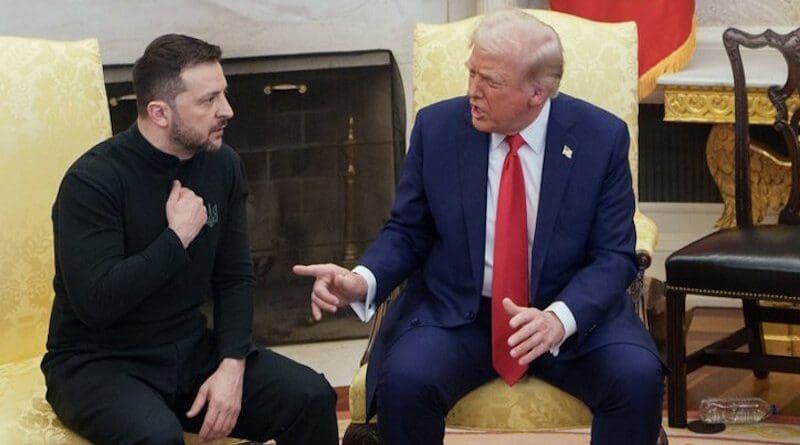
Hollywood could not have scripted and produced a more unlikely and dramatic movie than the one now appearing on handphone and computer screens all over the world.
Featuring Donald Trump, US president; JD Vance, US vice president; and Volodymyr Zelensky, Ukraine president; the live meeting before a disbelieving and shell shocked audience has produced a torrent of commentary and analysis unlike any similar event relating to American foreign policy during the past 3 decades.
The extraordinary public confrontation took place over what had been touted as a public relations event during which Zelensky would sign a mineral agreement with the US as prelude to a US brokered peace agreement to end the war in Ukraine. Instead this much anticipated American foreign policy triumph ended in a shouting match leaving both presidents with egg on their faces. It also shattered hopes of a quick end to the war promised by Trump during his presidential campaign.
American Take On The Clash
In the US, the Oval Office clash has produced an unsurprising deep divide between Democrat and Republican leaders and supporters with the former upbraiding Trump and his “bully tactics” against what they see as a heroic leader standing firm in his country’s freedom fight against Russia; and the latter defending Trump and agreeing that Zelensky had overplayed his card and disrespected the US and American contribution to Ukraine’s survival.
The public confrontation has unnerved American pro Ukraine and anti Trump media so much that its columnists have devoted entire columns excoriating Trump whilst its readers are calling for his impeachment and removal from office. It is also providing the Democratic Party with ammunition for a new campaign to demonize Trump and pull him and his ruling Republican party further down.
Away from the American response influenced by its domestic politics, policy makers in other parts of the world are drawing their own conclusions especially in relation to the following concerns:
- Impact and repercussions
- Winners and losers
- Scenarios for Ukraine, Russia, the European Union and NATO going forward
Immediate and Longer Term Impact
There is little disagreement about its immediate impact as Zelensky was ordered out of the White House and with the remaining events of his program cancelled.
The diplomatic humiliation of Zelensky is unprecedented and has adverse repercussions on the standing of the US in the eyes of political leaders and public in Western Europe and what the West regards as the “free world”.
Other outcomes are also apparent:
- Zelensky has made an enemy in Trump, Vance and Mario Rubio, the US Secretary of Defense who has provided an articulate defense of Trump and Vance and critique of Zelensky in the Oval Office showdown. The Ukrainian concern now should be that their president is perceived by the three leaders as not only disrespectful of the US but also of them personally. The trio are the most important figures in US diplomacy and foreign policy making for at least the next 4 years and possibly more. Any negotiations by Zelensky and/or replacement Ukrainian leaders on the war and its aftermath will have to live with this cloud of personal animosity that could well influence some of the outcome.
- Trump and company will not attempt to broker a ceasefire or peace agreement until Zelensky eats humble pie, apologises and returns to a negotiation table set up and dominated by the US and Russia.
Winners, Losers and Future Scenarios
- The undoubted winner from the meeting debacle is Russia and President Vladimir Putin. Putin will now be sure that not only cannot Ukraine win the war but also that if the US stops its military and financial support, Ukraine cannot continue the war.
The Russian president will go into any peace negotiations with a much stronger hand and with the prospect of the Crimean part of Ukraine now occupied by Russian forces likely to remain in Russian control as part of the settlement.
He will also have won a significant victory by stopping Ukraine from NATO membership. This has been a consistent and non-negotiable Russian precondition for any peace talk and settlement.
If successful, this outcome will have political and strategic implications by forestalling NATO expansion into the eastern flank of Europe with its traditionally pro Russian countries and governments. It needs to be emphasised that most neutral observers maintain that the catalyst for Putin’s military action in Ukraine stems from NATO’s duplicitous membership and military expansion drive along the Russian border. If brought to the negotiation table, Putin’s victory paradoxically could provide the basis for a more durable and sustainable peace between Russia and Western European countries propagandized into belief of the impending military expansion of a new Soviet Union.
- The biggest loser is Ukraine. Without a truce and peace agreement in sight, it will see its civilian and military casualties mount. Although Russia is also suffering from the war, its threshold for pain – with or without Putin – is much higher. Ukrainians who have fled the war and sought refuge in other countries – an estimated 7 million or one sixth of the pre-war population has left the country – are unlikely to return if there is no peace.
- The other key player in the war – European Union (EU) countries – will see an attempt by their leaders to cut their losses. Without the support and active participation of the US as the war’s main sponsor, facing increased pressure to significantly ramp up their domestic defence budgets, and confronting the loss of public support for the continuation of what many Europeans (perhaps the majority) and the rest of the world recognize as an unwinnable war, the EU will have to defer to US and Russia shape and have the final say on whatever peace settlement is reached.
- Another big loser is NATO. The most enthusiastic advocate of the war and provider of an unprecedented level of military support that has prolonged it, many observers see NATO as an irrelevant and discredited military alliance remnant from the cold war that is now in deep crisis following the Trump Zelensky clash.
Fixated on providing a military counterpoint against Russia and other ‘free world enemies’, critics of NATO have pointed to its support role in wars waged by the US and argue that the organization is an obstacle rather than a force for peace.
Once a peace settlement is reached in Ukraine without NATO’S involvement, Trump with his direct transactional approach to foreign policy and his MAGA mission will see NATO decline further as an influential force in world politics.
Asia Pacific Region Served Notice
The message and lessons to be learnt from Ukraine and the end game unfolding in Europe will not be lost to countries in the Asia Pacific region. Taiwan, the Philippines, Australia, Japan, South Korea, New Zealand, Singapore and other treaty and non-treaty allies of the US have entered into a new era of global politics and economics in which their national interests will count for nothing or little in Trump’s MAGA foreign and domestic policy and actions.

Like what you read?
Please consider supporting Eurasia Review. Thank you for your consideration!

The evil and mischievous leaders are from EU who used the stupid clown zelenski to provoke and destroy the peaceful Russian bear. EU deliberately spun and hyped that the peaceful Russia want to invade Europe. The people of Ukraine should lynch zelenski for bringing the war into the country when there is no necessity to join nato. He was paid billions of corruption money into his own account.