
Blurring Borders, Fueling Conflict: How Afghanistan’s Rhetoric Undermines Regional Stability – OpEd
When Afghan Taliban Spokesperson Zabihullah Mujahid declared that the Durand Line was “not an official border” between Afghanistan and Pakistan because it divided the Pashtuns, he was echoing a long-standing Afghan narrative. Yet from Islamabad’s perspective and under international law the line is legally valid, historically grounded, and strategically indispensable to Pakistan’s sovereignty and regional stability.
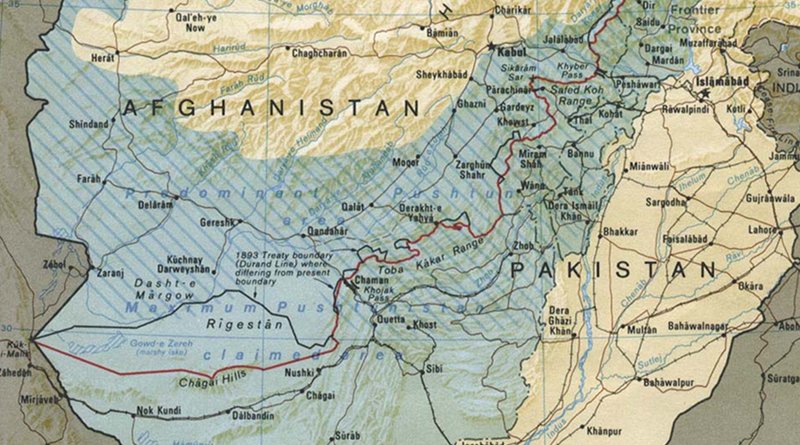
The Durand Line was negotiated in 1893 between Abdur Rahman Khan, the then-Emir of Afghanistan, and Sir Henry Mortimer Durand, acting for British India. It outlined the sphere of influence between Afghanistan and British India.
Successive reconfirmations underpin the solidity of the line as a demarcation line. For instance, in 1905, 1919 (Treaty of Rawalpindi), and 1921, Afghanistan acknowledged the border with British India, which means that the concept of the border was ratified by the Afghans at different periods.
From the perspective of Pakistan, when the British left in 1947 and Pakistan emerged, Pakistan inherited all legal boundaries of British India, including the Durand Line. Under the principle of uti possidetis juris, this line became Pakistan’s western frontier.
Pakistan’s foreign office has termed the Durand Line as a “closed and settled issue” time and again. For instance, in 2012 Islamabad declared the line as being its internationally recognised border.
Additionally, legal commentary in Pakistan highlights that boundary treaties cannot be unilaterally revoked due to political changes by the parties to such treaties, as boundary agreements are permanent in international law.
Afghanistan’s objection centres on two arguments: Firstly, that the Durand Line was imposed on it under colonial duress; and secondly, that the line divides the Pashtun ethnic community across two states. Mujahid recently reiterated both: “We do not agree to the term ‘border’ the Durand Line is imaginary.”
While these narratives are emotionally appealing—particularly to the Pashtun communities—they have major legal and practical demerits. Afghanistan itself recognized the line in earlier treaties, yet it later reversed its position once Islamabad became a separate state.
For Pakistan, the Durand Line is a matter not of legal formality but of security, migration, counter-terrorism, and regional stability. The border region has witnessed infiltration, militant movement, and cross-border violence for decades. Legitimization of the boundary allows Pakistan to manage and patrol the frontier by building fencing, controlling movement, and curbing militancy. Failure to do so compounds terrorism risks.
When Afghan authorities refuse to recognize the boundary, Pakistan faces a dual challenge: an unresolved territorial issue and external vulnerabilities along a porous 2,600-kilometre frontier.
Reconciling Pashtun Concerns with State Realities Mujahid claims that the Durand Line has “divided the Pashtuns”. While the human dimension is real, Pakistan declares that state sovereignty and border integrity need to be the priority in today’s world. Ethnic affinity alone cannot trump internationally demarcated borders. In fact, every modern state has ethnic cross-border communities. The logic of the critique of Durand would otherwise render many international boundaries invalid.
Pakistan maintains that the way forward is better management of the cross-border Pashtun community through trade, people-to-people contacts and cooperative governance not the dismantling of the border. The Way Forward: Diplomatic Engagement, Not Denial Pakistan’s policy objective remains: secure the border, ensure peace, manage migration, and fight terrorism. Recognition of the Durand Line is foundational to that strategy. The message to Afghan counterparts will be: let’s move from ideological disputes to concrete mechanisms of border management, economic cooperation, and security. Denying the border only perpetuates mistrust and instability.
While Pakistan respects Afghan sovereignty and cultural links across the Pashtun belt, it insists that recognition of the boundary does not negate the rights of Pashtuns it secures them within a safe, stable state structure. Mutual recognition lays the basis for joint infrastructure, legal frameworks, refugee regulation, and anti-terror cooperation.
The Durand Line is not a phantom border but an internationally validated border, both legally and historically. Pakistan’s assertion of its border is underpinned by treaties, international law, and strategic imperatives. While Afghanistan’s narrative emphasizes ethnic justice and colonial legacy, Pakistan invites both sides to focus on the shared future rather than the contested past. The time has come to convert legal certainty into operational partnership for the benefit of both nations and the Pashtun community that spans across them.

Like what you read?
Please consider supporting Eurasia Review. Thank you for your consideration!
