
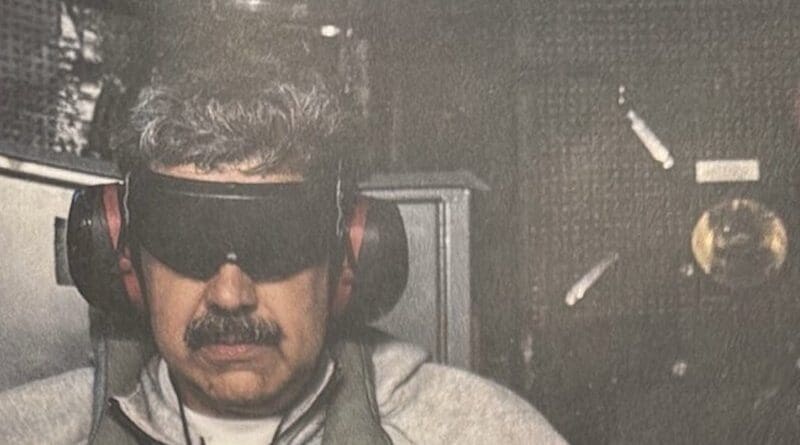
Kidnapping A Nation: How Washington Turned Venezuela Into A War Laboratory – OpEd
The reported US attack on Caracas and seizure of Venezuela’s sitting president marks a historic escalation—from economic siege to outright capture. This is not democracy promotion. It is imperial governance by force, where oil, discipline, and spectacle override sovereignty, law, and the lives of ordinary Venezuelans. “Sanctions failed, elections failed—so the empire escalated from coercion to capture.”
This Was Not About Maduro—It Was About Power
The reported abduction of Nicolás Maduro on the orders of Donald Trump must be understood not as a sudden rupture in hemispheric norms, but as their logical culmination. What unfolded in Caracas—the airstrikes, the seizure, the triumphant announcement—was not a reaction to an emergency. It was the execution of a long-standing imperial script.
Sanctions failed to produce surrender. Diplomatic isolation failed to fracture the state. Elections failed to deliver a compliant outcome. At that point, the empire escalated—not reluctantly, but deliberately. The capture of a sitting head of state is the point at which coercive diplomacy gives way to open colonial enforcement.
This was not about restoring democracy to Venezuela. It was about reasserting imperial authority over a defiant state whose crime was not authoritarianism per se, but refusal to align its political economy with US strategic and corporate interests.
From Economic Siege to Military Seizure
For nearly a decade, Venezuela has lived under conditions of economic warfare. US sanctions targeted oil exports, financial transactions, shipping insurance, and access to international credit. These measures did not surgically harm the governing elite; they collapsed state revenue, crippled imports of food and medicine, and accelerated mass impoverishment.
The humanitarian catastrophe that followed was then weaponized rhetorically. The very suffering produced by sanctions became proof that the Venezuelan state was illegitimate, dysfunctional, and dangerous. This circular logic—destroy, then condemn the ruins—has become a staple of modern imperialism.
When starvation and scarcity did not yield capitulation, Washington widened the theatre. Naval fleets amassed offshore. Venezuelan tankers were seized. Airstrikes were launched under the banner of “counter-narcotics,” despite mounting civilian casualties and warnings from human rights groups. What we witnessed was the transformation of economic pressure into military normalization.
The seizure of Maduro was simply the next step: regime change stripped of euphemism.
The Long War on Venezuelan Sovereignty
The antagonism between Washington and Caracas did not begin with Maduro. It hardened when Hugo Chávez reasserted state control over oil rents and used them to fund redistribution, regional integration, and political autonomy. Chávez’s crime was not corruption—long tolerated elsewhere—but insubordination.
From the failed 2002 coup onward, Washington’s message to Venezuela has never wavered: break with neoliberal rule and you will be punished. After Chávez’s death, Maduro inherited a country already under siege—financially strangled, commercially blockaded, and politically targeted. What followed was not internal collapse but externally imposed attrition, as sanctions and isolation hollowed out state capacity and social life by design.
Empire does not act in the name of democracy. It acts to enforce obedience. Governments that submit are protected, no matter how brutal; governments that resist are branded criminal and crushed. The United States openly embraces regimes whose records of repression rival or surpass Venezuela’s. Moral language is the cover. Discipline is the goal.
Lawfare and the Criminalization of Politics
The path to capture was paved not only by bombs and sanctions, but by lawfare. Maduro was recast from adversary to international criminal through indictments, bounties, and public accusations that bypassed transparent adjudication and international courts. Allegations of narcotrafficking—hotly disputed by experts—were elevated to existential threats.
This criminalization strategy performs two functions. First, it dehumanizes the target, transforming political conflict into a policing problem. Second, it erodes the norms of sovereignty by suggesting that certain states and leaders exist outside the protection of international law.
If accusations—untested, politicized, unilateral—are sufficient to justify abduction, then sovereignty becomes conditional. International law collapses into enforcement by the most powerful actor. What emerges is not a rules-based order, but a hierarchy enforced by force.
Oil, Energy, and the Material Core of the Conflict
Strip away the rhetoric of democracy and drugs, and the material stakes become unmistakable. Venezuela possesses the largest proven oil reserves on the planet. Control over energy flows is not simply economic; it is geopolitical power—over markets, allies, and rivals alike.
For decades, Venezuela’s oil has been treated in Washington not as a national resource, but as a mismanaged inheritance to be reclaimed. Nationalization, redistribution, and south–south alliances disrupted that expectation. Sanctions were designed not merely to punish, but to reorder ownership and control.
When Maduro signalled openness to foreign investment without surrendering political authority, it exposed the contradiction at the heart of US policy: access without submission is unacceptable. In imperial logic, sovereignty is tolerated only when it does not obstruct extraction.
Elections, Recognition, and Manufactured Illegitimacy
Democracy, in this context, functions as a conditional language. Elections are recognized when they produce favorable outcomes; rejected when they do not. Parallel authorities are elevated, opposition figures are crowned presidents-in-waiting, and diplomatic recognition is weaponized.
This practice does not strengthen democratic norms—it corrodes them. It teaches populations that ballots matter only insofar as they align with external interests. It converts political opposition into a tool of foreign policy, hollowing out domestic legitimacy on all sides.
Calls by opposition leaders such as María Corina Machado for foreign-backed “liberation” illustrate the tragedy: a society trapped between an abusive state and an abusive empire, each claiming to speak for democracy while denying popular sovereignty.
Decapitation and the Politics of Chaos
Imperial planners are not naïve about the consequences of leadership seizure. War-game simulations have long predicted the likely outcomes: institutional fragmentation, rival claimants to power, refugee surges, capital flight, and violent contestation. These are not unintended consequences; they are calculated risks.
Chaos weakens collective resistance. It opens space for external arbitration by creditors, security contractors, and multinational firms. Disorder becomes a governance environment—one in which reconstruction is conditioned on compliance and privatization.
For ordinary Venezuelans, this promises not freedom but prolonged instability. For the region, it sets a catastrophic precedent: that sovereignty can be suspended by force if a government resists alignment.
Accounting of Responsibility: A Critique
Maduro’s government must answer for repression, corruption, and the erosion of democratic institutions. These are not trivial failings; they have inflicted real suffering. But accountability cannot be subcontracted to a superpower whose own record—from Guatemala to Chile to Iraq—reveals a consistent pattern of devastation masquerading as liberation.
Justice delivered by cruise missiles is not justice. It is domination. A Left that abandons this distinction forfeits its moral and analytical coherence.
The task is not to defend rulers, but to defend principles without which emancipation is impossible: sovereignty, self-determination, and the primacy of international law over imperial convenience. To reject US abduction is not to endorse Maduro—it is to refuse a world where might decides right.
The Broader Warning
What happened in Caracas is not an exception; it is a rehearsal. If normalized, it will not stop at Venezuela’s borders. It will travel—across regions, regimes, and resource frontiers. Any state that insists on autonomy, redistribution, or non-alignment becomes a potential target.
The capture of a president by a foreign power should alarm anyone committed to democracy,. Once the threshold is crossed, no election, constitution, or institution can protect a people from external veto.
Draw the Line Here
The reported seizure of Venezuela’s president marks a decisive moment in contemporary imperialism: the transition from coercion to capture. To accept it is to accept a world in which sovereignty is conditional and democracy is subordinate to energy strategy.
Venezuela’s future must be decided by Venezuelans—free from sanctions strangulation, naval intimidation, and military abduction. Anything less is empire without alibi. “If allegations justify abduction, sovereignty becomes conditional on US approval.”

Like what you read?
Please consider supporting Eurasia Review. Thank you for your consideration!
