

Will Wendy Yuan ‘Unfilter’ Her China Stories And Views? – OpEd
Former politician Wendy Yuan has embarked on either a groundbreaking venture or a path to terminal irrelevance.
“This podcast can serve as a vehicle to tell a lot of truth, true stories, and also break some silos,” she declared at the launch of “Wendy Yuan Unfiltered” (1) on December 15.
“I can be honest (and) I can be blunt sometimes too.”
If she means it, the former candidate for Federal and provincial seats will end up confronting some hot issues in Canadian politics tied to the country’s increasingly difficult Chinese Question.
I was at the event on the invitation of the veteran journalist and her co-host Charlie Smith, and I came with a list of questions:
– What does she think of the persistent allegations that Canada’s 1.7 million Chinese population is vulnerable to political interference activities by Beijing?
– Why don’t and why can’t the pro and anti-Beijing camps among Canada’s splintered Chinese communities talk to each other in Vancouver and other Canadian cities?
– Will she invite her former political opponents and colleagues onto her show? People like Hon Chan (2) or Kenny Chiu (3) who beat her to the right to represent the conservative cause at the provincial and Federal levels?
– Will she invite Sam Cooper to talk about his “investigative journalism” that sparked nationwide fears about the extent of China’s political interference operations in Canada and resulted in costly defamation lawsuits against him and his former employer, Global News?
– Why the controversy over her resume (4) when she sought the nomination for the federal Liberal seat in Steveston-Richmond East in 2015?
– Where does she stand on China with regards to human rights and freedom of speech?
– Is China committing genocide in Xinjiang? How should Canada respond?
– What does she think of China’s treatment of Hong Kong, particularly the jailing of the dissident, or subversive, Jimmy Lai for allegedly violating the former British colony’s national security law?
– What are her views on Taiwan and China’s attempts to “reclaim” the fully-functioning, self-governing island republic?
– Has she been invited to any events in Canada hosted by the People’s Republic of China? Has she attended any of them?
– Has she been invited to any events in Canada hosted by Taiwan’s consular offices? Has she attended any of them?
– What does she make of Vancouver’s housing crisis that has been blamed on Chinese people and Asian capital by populist politicians, academics, and the media?
– Does she agree with British Columbia Premier David Eby that Chinese folks are responsible for B.C.’s money laundering crimes and affordability crisis?
– If Chinese folks have been unfairly blamed for B.C.’s affordability and housing crises, should Premier Eby and his supporters in academia and the media retract and make a full formal apology?
– Is Canada’s habit of scapegoating its Chinese minority or Beijing’s attempts to manipulate Chinese Canadians the greater threat to democracy in her adopted country?
– Is Canada’s mainstream media predisposed to scapegoating Canada’s Chinese population? If the answer is yes, has she spoken out on the issue and what needs to be done?
– Is Prime Minister Mark Carney risking Canada’s sovereignty by courting China for trade and investment? If Yuan was advising the prime minister on China, what would she tell him?
– If the United States and China go to war with each other, what would she do, and how would she advise Canada and Canadians to respond?
– How concerned are the Chinese of Richmond City, who form around half its population, about the Cowichan land title issue? Will many sell their properties and leave the city in response to the recent court ruling that Cowichans and other indigenous groups have primary claims over land ownership?
– Why are Asians (comprising largely Chinese, Indians, Filipinos and Japanese) so under-represented at Richmond’s city hall? Is the city’s bureaucracy quietly discriminating against hiring Asians, especially at the senior levels and the fire department, even though Asian communities have the skills and are better educated than the general Canadian population?
In the end, I held back, mindful of the time constraint. Each question would require a lengthy discourse that would probably be best tackled by Yuan and Charlie, and their guests, over the course of their podcasts.
The press conference, held at a studio in Richmond city, British Columbia, drew about 50 people, including local politicians, their supporters and advisers, and a handful of reporters. Most seemed friendly to Yuan’s moderate conservative politics. The guest list is available at the end of this article.
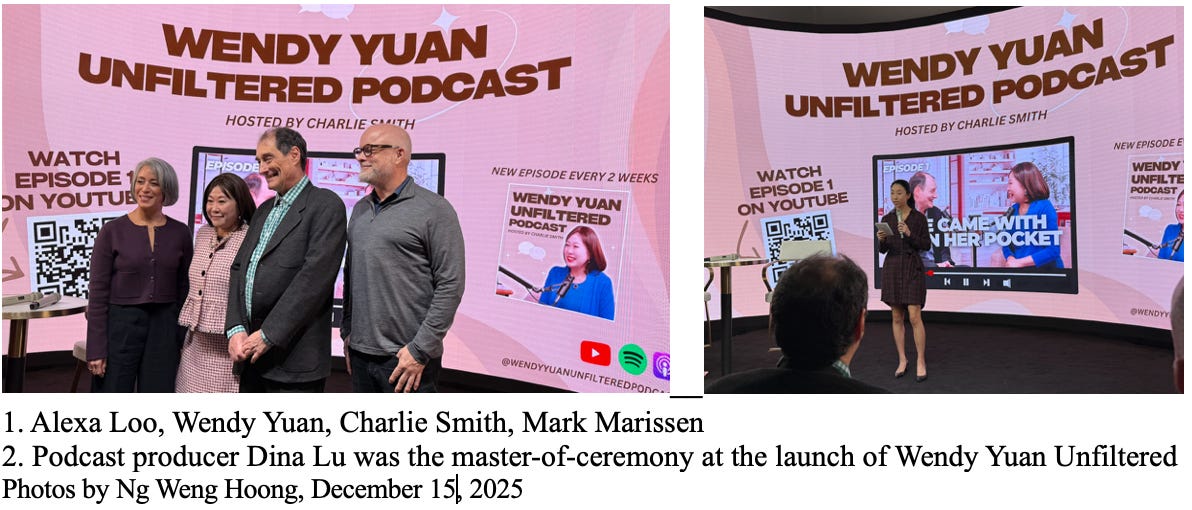
Co-host Charlie Smith’s Pivotal Role
Instead, I lobbed an easy one.
Whose idea was it to launch the podcast: Yuan’s or Charlie Smith’s, the founding editor of the Taiwan-linked publication Pancouver and former editor of the Georgia Straight?
It started with Charlie who had initiated the idea of Yuan writing an autobiography. The proposed book would cover her childhood in China during the turbulent Cultural Revolution years and her immigration to Canada in 1984 where she became an adult and succeeded as a student, wife, mother, entrepreneur, and public figure.
Charlie and Yuan somewhat crossed path during B.C.’s provincial election in October 2024 where both ran as independent candidates in separate ridings. (As Charlie is a good friend (5), I’ll reference him by his first name).
She lost decisively in Richmond Centre despite the initial expectations (6) for a tight contest while he, the novice progressive politician without a campaign team and grassroots support, was predictably crushed in conservative Richmond-Bridgeport.
She is right-of-centre while he is left-of-centre. It sets the stage for a promising ying-yang podcast as they disagree over major issues covering drug policies, Sexual Orientation and Gender Identity (SOGI) education in schools, homelessness, healthcare, and the climate.
What pulls them together is mutual respect.
Charlie is impressed by her achievements and curious about her life experiences. He was full of praise for her for not crossing over to the then revitalized provincial Conservatives when her B.C. United party (rebranded from B.C. Liberals) imploded just months before the October 2024 election. Yuan’s campaign immediately lost momentum. But instead of quitting, she ran as an independent conservative in full knowledge of her sudden handicap against the candidate that had the Conservative party backing.
She lost badly, taking less than 6.4% (7) of the vote. It was her latest in several failed attempts (8) to gain a foothold in Canadian politics going back to 2004 (9) and 2008 (10). But those defeats have not dampened her enthusiasm for public service as she still maintains an active persona in Richmond.
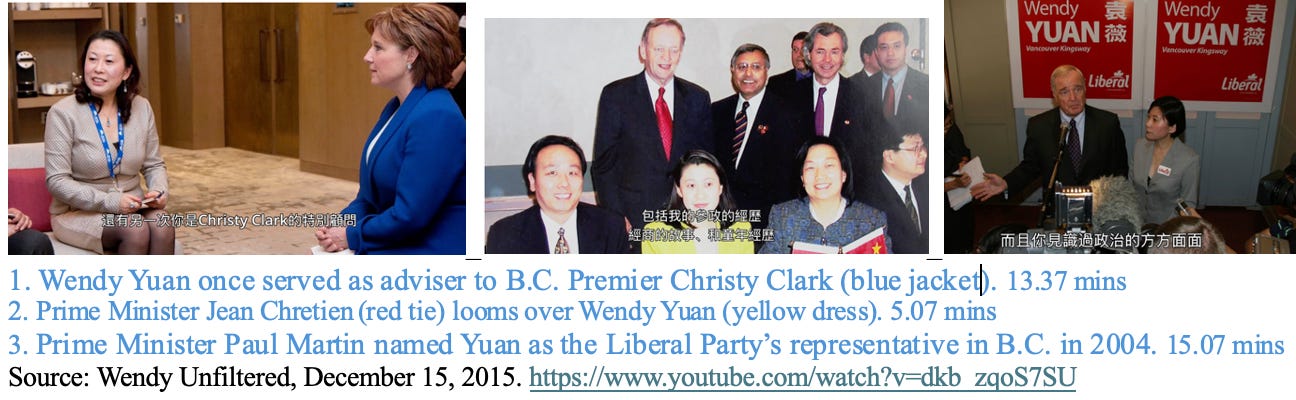
Yuan thinks highly of Charlie, expressing her “longing to be interviewed (11) by you. And now here’s my chance and I’m feeling very privileged that we can actually do this podcast.”
This unlikely duo have much to talk about. They should start diving into the issues that they disagree over, and the extent to which their differences represent the country’s ideological divide.
Their opening conversation (12) was polite and deferential to the point that they risk losing the audience from the start. Irrelevance would be their punishment. Whether Yuan is planning another electoral run or not, she must leave the safe zone to address the topics that she knows best: China and Canada’s Chinese communities.
Canada is seriously lost on China and Chinese issues. It is currently overrun by one-dimensional “experts” and “investigative journalists” peddling the singular message of the China Threat. Someone needs to launch and lead a proper debate on these issues without the Sinopobic undertone, the boring racism, and the pro-Beijing tilt.
How should Canada address the mounting challenges from China’s emergence as an assertive global superpower while facing off against an increasingly threatening United States? What does she make of Ottawa’s struggle with understanding Canada’s Chinese communities? Why can’t and why won’t the Chinese communities tackle their differences? When are Chinese Canadian groups going to step up their engagement with mainstream Canada? How can Chinese Canadians contribute to helping the country navigate its way through the post-global liberal order?
This is Yuan’s best opportunity to speak her mind on issues close to her heart. She will not have all the answers, but who does? With Charlie’s support, the podcast has the potential to platform thoughtful discussion.
There are risks, for sure, but how else is she going to achieve those lofty goals to “tell the truth” and “break some silos” if she doesn’t do risk?
Guests at the launch of “Wendy Yuan Unfiltered”, December 15, 2025
• Richmond City councillor Alexa Loo
• Former Richmond City councillor and former MLA Ken Johnston
• Former Burnaby City councillor Mike Hillman
• Founder and principal of Burrard Communications Mark Marissen
• Partner at McEwan Partners David Gruber
• Political campaign manager and strategist Manuel Santos
• Owner of Dawa Business News Zai Xin Ma
• Former senior researcher at the Asia Pacific Foundation of Canada Kenny Zhang
• Columnist, communications strategist, and community advocate Peter Xie
• Columnist and former United Nations interpreter Leon Yang
• Surrey community activist William Li
• Dina Lu, producer and host of Wendy Unfiltered
• Vancouver journalist Ng Weng Hoong
Wendy Yuan Unfiltered was launched at Upperland Studio which sponsored the venue and the recording services. Upperland is located atWireless Way in Richmond City.
- This article was published at WengCouver

Like what you read?
Please consider supporting Eurasia Review. Thank you for your consideration!
