
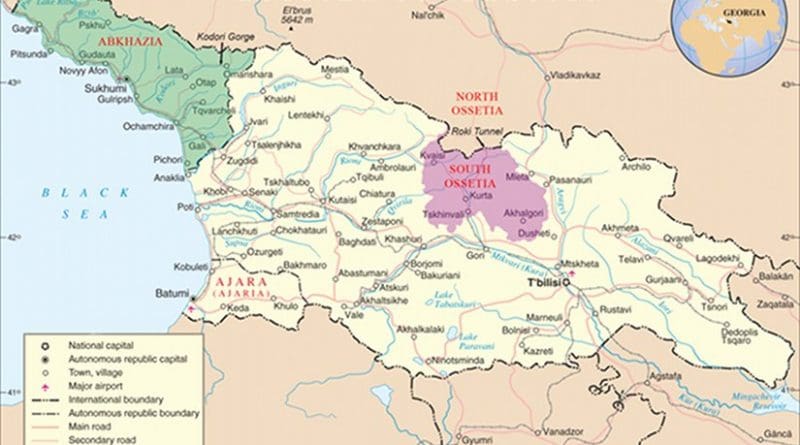
Russia-South Ossetia Ink Accord Formalizing Merger Of Military
(Civil.Ge) — Moscow and Tskhinvali signed a new defense agreement on March 31 “On the Order of Inclusion of Certain Units of the Armed Forces of South Ossetia in the Russian Armed Forces,” formalizing the merger of the region’s military units into the Russian armed forces.
The Russian Defense Ministry reported that the sides also signed a separate agreement on the military courier-postal services.
Speaking at the signing ceremony on March 31, Russian Defense Minister Sergei Shoigu, who was one of the signatories to the documents, said that the agreements “will further strengthen the security in the region” and will serve “as yet another factor” against resumption of hostilities. “Russia has spared no efforts to support South Ossetia, which was countering the aggression of the enemy, and was the first to recognize its independence,” Shoigu stated.
The region’s de facto Defense Minister Ibragim Gasiev, who signed the agreements on behalf of Tskhinvali, noted that the agreements “are very important” for South Ossetia.” “A great deal of productive work was done in the preparatory phase, compromises were found on all questions. Above all, we will significantly strengthen the defense and security of our state and create conditions for active cooperation between the defense institutions of our countries,” he said.
According to Gasiev, Moscow will admit the South Ossetian army personnel, who are in possession of Russian citizenship, for military service at the Russian military base in breakaway South Ossetia. “At the same time, they will be eligible for all the guarantees and benefits provided to the Russian servicemen,” he explained.
Ibragim Gasiev also underlined that the agreement has “not only military-political, but also great socio-economic importance,” since it allows for the recognition of mandatory military service in the armed forces of South Ossetia.
Will the Region’s Army Exist?
According to the agreement, the South Ossetian army will be integrated into the Russian military command structure in two ways: some detachments will join the Russian military base, while the remaining forces will be reduced by a corresponding number of servicemen and the figure, as well as “the tasks and the structure,” will have to be agreed with the Russian Federation.
When combined, the two elements of the decree would practically make all South Ossetia troops either formally integrated, or practically run under Russian control. The region’s leaders, however, are stating the opposite.
Addressing the region’s Defense Ministry staff at a meeting on March 31, South Ossetian leader Leonid Tibilov said that “the continued functioning of the South Ossetian Defense Ministry” was “one of the main agenda items” during his “first official visit” to the Russian Federation. “We were then able to sensibly convey our position to the Russian side and managed to preserve the number of our military personnel. And today our army is combat-capable and has a great potential,” Tibilov explained.
Leonid Tibilov spoke on the matter a day earlier as well. In his interview with Russian daily Kommersant, the South Ossetian leader recalled his meeting with Vladimir Putin in March 2016 and noted that he saw “full understanding” in the Russian President “that South Ossetia should have its own, albeit small, but maneuverable army.” “And we [still] stand on this [position],” he added.
Touching upon the new agreement, Leonid Tibilov stated that the document does not entail the incorporation of “entire units” of the region’s army. “Only [individual] servicemen and not units will enter the Russian army and these servicemen … will be listed in the Russian units,” he explained.
“At the initial stage, we are talking about 100-150 soldiers,” Tibilov went on. “It is important that the servicemen who will not pass the selection [in the Russian Army], will remain in their own [South Ossetian] units … So the independence of our army is not affected, the army remains, the staff structure remains [intact].” he added.
Tbilisi’s Reaction
The Foreign Ministry issued a statement on March 31 condemning “the signing of so called agreement on incorporation of the unlawful military units of the occupied Tskhinvali region into the armed forces of the Russian Federation” and saying that it “represents yet another step towards the annexation of Abkhazia and Tskhinvali regions.”
“This provocative step and unambiguous aggression against the Georgian statehood on the part of the Russian Federation is directed towards destabilization of the situation in the region and the ultimate destruction of the European security system,” the Ministry said.
It also added that the Russian Federation “is seriously harming” the Geneva International Discussions and “is intentionally obstructing any potential progress in the peace process.”
“It is all the more disturbing that Moscow still declines the non-use of force commitment and impedes the creation of international security arrangements in Abkhazia and the Tskhinvali regions,” it added.
The Foreign Ministry called upon the Russian Federation to “desist from the practice of provocative actions, to comply with the provisions of the August 12, 2008 Ceasefire Agreement and withdraw the military units from the territory of Georgia.”
It also appealed to the international community to “duly assess the aggressive steps by the Russian Federation and take the necessary measures in order to effectively react on the situation in Georgia’s occupied regions.”
International Reactions
Speaking at his press conference ahead of NATO Foreign Ministers’ meeting on March 30, NATO Secretary General Jens Stoltenberg stated that the Alliance “fully supports” the territorial integrity and the sovereignty of Georgia.
“South Ossetia is part of Georgia and therefore we will never recognize South Ossetia as anything else than a part of Georgia. And we have strongly conveyed this support to Georgia several times. We will continue to provide strong political support to Georgia but also practical support to Georgia,” Stoltenberg said.
“And we also think very much that what Russia now does is just undermining the efforts to try to find a peaceful and negotiated solution and a process which is going on in Geneva,” he added.
The agreement “On the Order of Inclusion of Certain Units of the Armed Forces of South Ossetia in the Russian Armed Forces,” is part of the treaty on “the Alliance and Integration” signed between Russia’s President Vladimir Putin and the South Ossetian leader Leonid Tibilov on March 18, 2015 for a period of 25 years.

Like what you read?
Please consider supporting Eurasia Review. Thank you for your consideration!
