
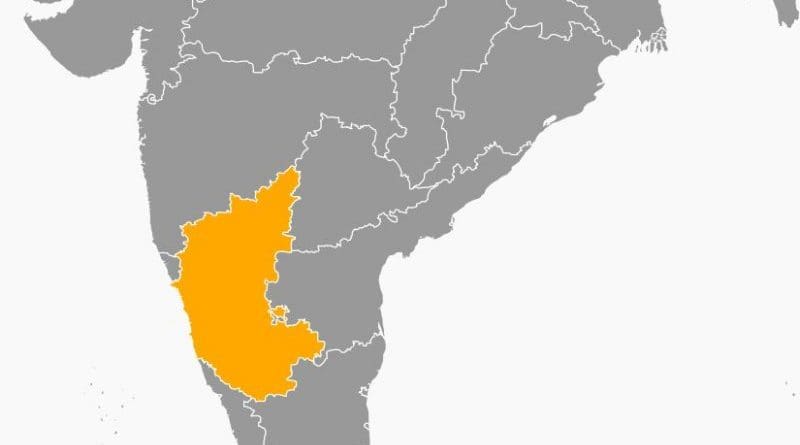
India: Is Karnataka Maoist-Free? – Analysis
By Deepak Kumar Nayak
On March 7, 2025, presenting the State Budget for FY 2025-26 in Bengaluru, Chief Minister Siddaramaiah, who also serves as the State’s Finance Minister, announced that the Anti-Naxal Force (ANF) would be disbanded as the State was ‘free’ of the outlawed members of the Communist Party of India-Maoist (CPI-Maoist). The announcement to dissolve the ANF followed the surrender of the last batch of known Maoists in the state on January 8, 2025, when six Maoists, including four women, surrendered at a government event in the Chief Minister’s presence. A few days later, another Maoist also surrendered. Siddaramaiah, as well as Home Minister Parameshwara, then proclaimed that Karnataka was “Naxal free”.
On February 2, 2025, CPI-Maoist cadre, Lakshmi, who had three cases registered against her and had been hiding in Andhra Pradesh, surrendered unconditionally in the presence of Deputy Commissioner Vidya Kumari and Superintendent of Police (SP) Arun K. in Udupi District. She had been actively involved in furthering the Maoist agenda in the Chikmagaluru and Udupi Districts.
On January 31, 2025, CPI-Maoist cadre Kotehonda Ravindra (44), who had been operating underground since 2007 and had a total of 27 cases registered against him, surrendered before SP Vikram Amathe in Chikkamagaluru District.
On January 10, 2025, six CPI-Maoist cadres operating in the coastal and hilly regions of Karnataka surrendered before Chief Minister Siddaramaiah at his home office, Krishna, in Bengaluru. The surrendered group included members from Karnataka, Tamil Nadu, and Kerala, representing a regional collaboration against Naxalism [Left Wing Extremism, LWE]. The group included four Maoists from Karnataka: Mundagaru Latha from Sringeri, Vanajakshi Balehole from Kalasa, Sundari Kutluru from Dakshina Kannada, and Mareppa Aroli from Raichur. The remaining two were Vasantha K. from Vellore in Tamil Nadu and N. Jeesha from Wayanad in Kerala.
According to partial data collated by the South Asia Terrorism Portal (SATP), at least eight Naxalites (Left Wing Extremists) have surrendered in Karnataka in the current year (data till March 30, 2025). Though no Naxalite had surrendered in 2024, or in 2023 in Karnataka, one Naxalite surrendered in 2021. In total, 21 Naxalites have surrendered since March 6, 2000, when SATP started compiling data on LWE-related violence and activities.
Meanwhile, no incident of arrest has been recorded in the current year (data till March 30, 2025). However, at least three Naxalites were arrested through 2024, though there were no arrests recorded in 2023. Two arrests were recorded in 2017. A total of 63 Naxalites has been arrested since March 6, 2000.
Karnataka recorded one incident of killing resulting in one fatality (Maoist) through 2024. No Maoists were killed in 2023. A maximum of six such fatalities were recorded in 2007, while a total of 19 Maoist fatalities were recorded since March 6, 2000.
For the 13th year in a row, SFs did not suffer any loss in the state in 2024. The last SF fatality was recorded on October 8, 2011, when a Police Constable was killed in an encounter with suspected CPI-Maoist cadres near Manja village in Belthangady, Dakshina Kannada District. A maximum of six such fatalities were recorded in 2005, nine SF personnel have been killed in the State since March 6, 2000. SFs maintained dominance over the rebels on the ground, with a positive overall SF:Maoist kill ratio of 1:2.11.
No civilian fatalities, a crucial index of security, were registered in 2024, nor in the 16 years preceding, in the State. The last fatality in this category was recorded on December 7, 2008, when a civilian, Keshav Yadiyal, brother of the general secretary of the district unit of the then Janata Dal (Secular) Jagadish Yadiyal, was shot dead and his jeep was burnt by a group of suspected Maoists at Yedageri near Hallihole village in the Udupi District. The Maoists had previously asked the family to give them huge amounts of food grains and money, which was refused. A maximum of three such fatalities were recorded in 2008, while seven civilian fatalities have been recorded since 2000.
Several other parameters of LWE violence also suggest that the Maoists have failed to retain their sway in the State. The Maoists failed to carry out a single major incident (resulting in three or more fatalities) in 2024 as well as in 2023 and 2022. The only such incident was recorded on February 11, 2005, in which six police personnel were reportedly killed when suspected cadres of the CPI-Maoist attacked a Karnataka State Reserve Police (KSRP) camp at Venkammanahalli under Pavagada revenue division in the Tumkur District, with hand grenades.
The Maoists were not able to execute any incidents of arson in 2024 as well as in 2023. The last such incident was reported on June 9, 2013, when CPI-Maoist cadres set ablaze the motorcycle of a villager, Kempanna, at Shirlu village in the Sringeri tehsil (revenue unit) of Chikmagaluru District, warning him not to support the Government’s rehabilitation package for forest dwellers. While Shirlu village was known to be sympathetic to the Maoist cause, Kempanna had reportedly been voicing his support for the rehabilitation package of the Government, angering the Maoists. A total of five such incidents of arson have been reported since 2000. No incident of abduction was reported in 2024. The last such incident was recorded on November 4, 2008, when Maoists abducted Bharatiya Janata Party (BJP) ‘President’ Ranganath along with seven others from Holale Mavina Kadu village near Sringeri in Chikmagaluru District. All the eight abductees were released, hours after they were taken to an undisclosed spot inside the forest near Sringeri. A total of four incidents of abduction have been recorded since 2000.
Significantly, LWE-related incidents in the State have followed a cyclical trend, with four such incidents in 2024. There were no incidents recorded in 2023 or in 2022. One such incident was recorded in 2021. A total of 86 such incidents were recorded in the State since March 2000.
An overall analysis of the Naxalite situation in Karnataka suggest that the rebels have sought to develop some of the Districts in the State, along with of Kerala and Tamil Nadu [KKT (Karnataka-Kerala-Tamil Nadu) tri-junction] principally with a view to provide shelter to their leadership in the event of increased anti-Maoist operations in its strongholds in central India. The Union Ministry of Home Affairs (UMHA) in its internal communication has time and again reiterated that the CPI-Maoist’s efforts in the direction of expanding its organisational base in the Western Ghats and the area around the KKT tri-junction have been discernible. The activities included the relative increase in movement of armed cadres in the area, along with activities of Maoist front organisations and over-ground elements. Accordingly, the UMHA disclosed that the presence and movement of armed CPI-Maoist groups had been noticed on several occasions in the Mysore, Kodagu, Udupi, Chikmagaluru and Shimoga Districts in Karnataka, and Malappuram, Wayanad and Kannur in Kerala. Though adjoining areas of Tamil Nadu saw no significant movement of armed Maoist cadres, activities of front organisations had increased noticeably in Erode District. CPI-Maoist cadres were trying to reach out to the targeted social sections in these areas, raising issues of displacement, discrimination, ‘neo-liberal’ economic policies and social subjugation, while exhorting them to join the ‘revolutionary struggle’ to ‘recapture’ forest, water and land resources, as well as factories.
On August 26, 2010, disclosing that the Karnataka Police had been successful in curbing Naxalite activities, the then State Home Minister V.S. Acharya noted that the Union Government had removed Karnataka from the list of Naxalite-infested states. He claimed that steps taken to strengthen the Police network in the State had yielded results and the law-and-order situation in the State could be termed satisfactory.
On May 26, 2019, the then Director General and Inspector General of Police (DG&IGP), S.T. Ramesh, had noted,
The discussion in Police and Intelligence circles in Karnataka in the late 80s was around the inputs that Maoists were using the state as a sanctuary. They would take shelter in lodges on the national highways. They later found bases in (the) Malnad belt, Agumbe Ghat, Dakshin Kannada, Shivamogga and Udupi, where there was thick forest cover and tribal population.
Earlier, the August 3, 2002, Draft Report on Social Conditions and Tactics, the Karnataka State Committee of the then Communist Party of India – Marxist Leninist – Peoples’ War (also known as the People’s War Group, PWG, which merged into the CPI-Maoist in September 2004) under the head The Perspective Area observed:
The Western Ghats, with an average width of about 100 kilometres, runs from North to South for about 2,200 kms… It passes through Kerala, TN, Karnataka, Goa, Maharashtra and Gujarat…The longest part, the widest and deepest forests of the Western Ghats are located in Karnataka… The Western Ghats that runs through Karnataka is called as the Malnad (sic). The Western Ghats has its strategic significance for peoples’ war in India owing to the forest and mountainous terrain… It would not be an exaggeration, owing to all these factors, to call Malnad as the strategic midrib of peoples’ war in Karnataka… The Perspective Area falls in the central part of Malnad… Today we have initiated our work in one part of the Perspective Area.
Indeed, Karnataka was seen as the gateway for the Maoists to move into the safe sanctuary falling under the KKT tri-junction. However, over the years, continued combing operations in the suspected regions of Maoist presence have largely contained their movement.
Meanwhile, on November 18, 2024, the Karnataka Police ANF killed the last known CPI-Maoist leader in the state, Vikram Gowda, in an encounter with the rebels in the Kabbinale Forest region near Sitambailu under the Karkala Taluk (administrative division) of Udupi District. The SF team had received information about the movement of four to six alleged Naxalites in the Hebri and Sringeri areas. When the alleged Maoists came face to face with the SFs, an exchange of gunfire ensued, in which Gowda was killed on the spot, while three of his associates managed to flee. Gowda, who had been active in areas including Sringeri, Narasimharaja Pura, Karkala, and Udupi, had eluded Police capture for over two decades. It is suspected that the group held organisational meetings in Koppa and Sringeri to strengthen their presence amid public opposition to the Forest Rights Act and land acquisition for projects.
Subsequently, as mentioned above, the seven Maoists alleged to be known as the last batch, surrendered on three occasions, prompting CM Siddaramaiah and Home Minister Parameshwara declaration of Karnataka as “Naxal Free”.
Meanwhile, on March 27, 2025, the Karnataka ANF and Kerala Police, in follow-up action against the rebels, produced CPI-Maoist leader B.G. Krishnamurthy before the Judicial Magistrate (First Class) Civil Court in Sringeri. Krishnamurthy was brought to the court premises at 1 PM [IST] under Police security and presented for questioning before Judge Dasari Kranti Kiran at 1.30 PM. At 3 PM, he was produced for questioning regarding a case of assault on Chandrakanth, a resident of Bukkadibail Hemmige. When the judge inquired if Krishnamurthy had any evidence to prove he did not commit the assault, he replied in the negative. Subsequently, the judge adjourned the case to May 5 for further arguments.
The Karnataka Police has been extraordinarily successful in containing the LWE-threat, despite critical deficits in capacities and deployment in the State Police. According to the latest Bureau of Police Research and Development (BPR&D) data, as of January 1, 2023, Karnataka had 150.95 Police personnel per 100,000 population, below the inadequate national average of 154.84. Both the State and national averages for Police personnel per 100,000 population are below the sanctioned strength, at 165.05 and 196.88, respectively. Similarly, the Police/Area Ratio (number of policemen per 100 square kilometres) is just 53.14, against the national average of 65.14. Both the State and national averages on the Police/Area ratio are below the sanctioned strength, at 58.10 and 82.82, respectively. The sanctioned strength for the States’ Police is 111,426, but only 101,911 personnel were in position, a deficit of 8.53 per cent. In addition, the sanctioned strength of the apex Indian Police Service (IPS) Officers in the State is 215, but only 191 officers were in position, a deficit of 11.16 per cent, which considerably weakens the executive supervision of the force.
Moreover, according to a March 28, 2025, media report, the Police are strongly opposing the State Government’s plans to disband the ANF, arguing that, while there may be no active CPI-Maoist cadres in Karnataka, Naxalism as an ideology is far from dead. An unnamed high-ranking Police Officer revealing that the law enforcement establishment was not consulted before the decision to disband the ANF was made, observing,
This is a wrong move. There may be no active Naxals in Karnataka but Naxalism as an ideology isn’t dead. Just because there are no known Maoists now doesn’t mean the movement won’t resurface. We must prevent that from happening.
Maoist activities in Karnataka have never escalated, largely because of continuous SF vigilance and consolidation, whenever the Maoists sought to establish a presence in the state. Indeed, as the Maoists are known to use the KKT tri-junction to regroup and resurface, given the pressure they are under in their remaining heartland areas, a push into the state remains likely. The residual risk cannot be ignored, and Karnataka needs to address the critical deficits in the Karnataka Police and re-examine the disbanding of ANF to ensure that the State does not, once again, become an active Maoist theatre.
- Deepak Kumar Nayak
Research Associate, Institute for Conflict Management

Like what you read?
Please consider supporting Eurasia Review. Thank you for your consideration!
