
India And New Zealand Turn A Trade Deal Into A Strategic Partnership – OpEd
Key Takeaways:
- Indian Prime Minister Narendra Modi’s July 2026 visit to New Zealand—the first by an Indian PM in four decades—elevated bilateral ties to a Strategic Partnership and endorsed a “Roadmap to 2030” covering diplomacy, defence, trade, technology, education, and regional security.
- The partnership builds on the April 2026 Free Trade Agreement, which aims to double trade to NZ$7 billion by 2030, while expanding cooperation into maritime security, joint military exercises, and shared interests in a free and open Indo-Pacific.
- Beyond economics, the relationship now emphasizes technology collaboration, education, people-to-people ties (including India’s 300,000-strong diaspora in New Zealand), and strategic alignment as both democracies navigate intensifying geopolitical competition in the region.
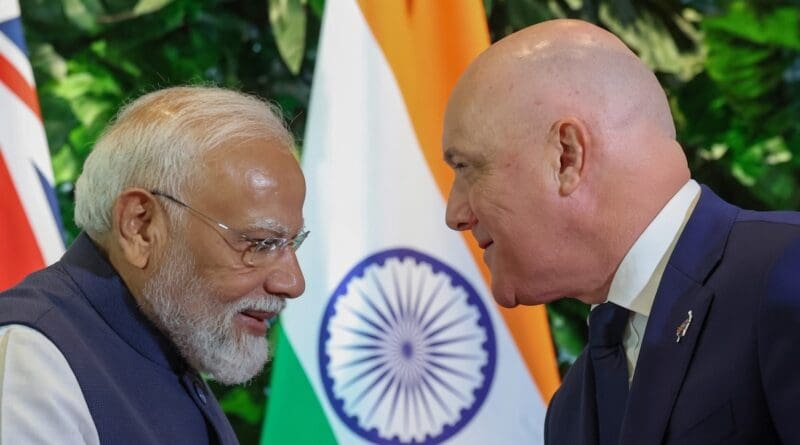
Indian Prime Minister Narendra Modi’s visit to New Zealand on July 10–11 has marked a historic moment in bilateral relations. It was the first visit by an Indian prime minister to New Zealand in four decades, and its significance has gone beyond the merely symbolic. During the two-day visit, Modi and New Zealand Prime Minister Christopher Luxon elevated the relationship between the two countries to a Strategic Partnership, endorsing the “Roadmap to 2030” — a framework meant to guide cooperation across diplomacy, defence, trade, technology, education and regional security.
This announcement has come just months after India and New Zealand had signed a Free Trade Agreement (FTA) on April 27, 2026. While the FTA marks an important step in itself towards expanding economic ties, the Strategic Partnership shows that both governments view their relationship as part of a much larger geopolitical transformation.
The Indian media outlet Firstpost observed that the visit marked “a new era” in India–New Zealand relations, reflecting a partnership that is increasingly moving beyond commerce into strategic cooperation. Firstpost stated: “The bond between India and New Zealand has emerged as a significant and dynamic alignment. Historically anchored in shared Commonwealth heritage, cricket, and democratic values, the bilateral connection has matured into a multifaceted strategic partnership.”
The timing of this development assumes considerable significance. Across the Indo-Pacific region, economic relationships are being shaped more and more by security concerns. Supply-chain resilience, maritime stability, technological cooperation and access to critical infrastructure have today become inseparable from national interest. For India and New Zealand, strengthening ties is not merely a question of increasing trade volumes; rather, it is about building a partnership between two democracies which share a common interest in a stable, open and rules-based regional order.
From trade agreement to strategic partnership
The India–New Zealand FTA provides the economic bedrock for this new phase of cooperation.
As Firstpost explained: “New Zealand offers 100% duty-free access to all Indian exports. India has liberalised duties on about 70 per cent of tariff lines for New Zealand exports. By eliminating tariffs on a vast array of Indian exports and establishing Centres of Excellence for agriculture, the economic synergy between the two nations has deepened significantly.”
The two governments have also set themselves the ambitious target of doubling trade in goods and services to NZ$7 billion by 2030. Achieving this target will require much more than tariff reductions alone. It will depend, in large part, upon improving connectivity, strengthening business linkages, and encouraging greater participation from the private sector.
The Roadmap to 2030’s creates no financial obligations. Its importance lies in putting in place mechanisms for sustained cooperation. The two countries have committed themselves to regular consultations between leaders, ministers and senior officials, thereby ensuring that the Strategic Partnership remains an ongoing process and not just a symbolic declaration.
Security cooperation in a changing Indo-Pacific
The most significant transformation in India–New Zealand relations is, perhaps, taking place in the security sphere itself. Firstpost explained that the geopolitical landscape has drawn India and New Zealand closer together, largely due to converging interests in the Indo-Pacific: “Both nations are committed to upholding a free, open, and inclusive Indo-Pacific, grounded in the rules-based international order and freedom of navigation.”
Today, both countries have come to recognise that the strategic environment around them has changed considerably. The Indo-Pacific has emerged as the centre of global economic activity; at the same time, though, it has also become a region where maritime disputes, military competition and geopolitical rivalry are increasingly shaping international affairs.
The defence component of the Roadmap is reflective of this reality. Building upon the 2025 Memorandum of Understanding on Defence Cooperation, India and New Zealand have agreed to expand military exchanges, joint exercises, maritime cooperation and professional exchanges between their respective armed forces.
Of particular importance is the focus on maritime security. Both countries depend heavily upon secure sea lanes for the purposes of trade and energy supplies. Cooperation on naval exercises, hydrography, logistics support and maritime dialogue is indicative of a shared understanding that regional stability depends, in no small measure, upon the maintenance of an open maritime environment.
Technology, education and human connections
The Roadmap places considerable emphasis on education, research and innovation. India’s rapidly growing technological capabilities, taken together with New Zealand’s own expertise in areas such as agriculture, environmental research and advanced industries, create genuine opportunities for meaningful collaboration. Joint work in digital transformation, climate-related technologies and scientific research could well go on to become important drivers of future cooperation.
People-to-people ties provide another important foundation. New Zealand is home India’s 300,000-strong diaspora, which contributes to the country’s economy, culture and social fabric alike. New Zealand government wrote that India’s diaspora forms: “a vital living bridge that strengthens cultural, commercial, educational, and social connections, providing a strong foundation for deeper bilateral engagement.” The Roadmap recognises the diaspora as an active partner in strengthening bilateral relations.
Tourism and connectivity are also important elements. Expanding air links and easing travel facilitation are practical steps to increase business exchanges, educational opportunities and cultural interaction between the two societies.
The India–New Zealand relationship is no longer defined by trade alone
Modi’s visit to New Zealand was far more than a diplomatic milestone. For India, the Strategic Partnership with New Zealand complement its wider engagement with Indo-Pacific partners. For New Zealand, closer cooperation with India offers an opportunity to deepen relations with one of the world’s largest economies, and an increasingly influential regional power.
Firstpost further explained: “As India’s economy expanded, New Zealand recognised the imperative to pivot toward South Asia… New Zealand recognises India’s position as a global economic powerhouse and a crucial hub for supply chain diversification.”
The India–New Zealand relationship is no longer defined by trade alone. The India–New Zealand Strategic Partnership shows that economic security and strategic security are interconnected. Economic cooperation is essential, but it now exists alongside defence coordination, technological collaboration and shared regional interests as well. Trade agreements alone cannot address the challenges posed by geopolitical competition or by vulnerabilities within global supply chains. The FTA created the opportunity for closer India–New Zealand relations; the Strategic Partnership is turning that opportunity into a comprehensive political, economic, and security relationship.

Like what you read?
Please consider supporting Eurasia Review. Thank you for your consideration!
