
The Strait Of Hormuz: Iran’s Strategic Trinity Of Terrain, Technology, And Tenacity In Asymmetric Warfare – OpEd
Key Takeaways:
- The original U.S.-Israeli objectives of dismantling Iran’s nuclear and military capabilities and seeking regime change have shifted toward the more immediate challenge of reopening the Strait of Hormuz, a critical chokepoint for roughly 20 percent of global oil exports that Iran has restricted.
- Iran’s anti-access/area-denial (A2AD) posture exploits the Strait’s narrow geography, mountainous northern coastline, shallow waters, and a chain of fortified islands to create layered defenses of mobile missiles, drones, smart mines, and swarming fast-attack boats that limit adversary maneuverability and detection.
- Disruptive technologies—particularly AI-coordinated swarms, loitering and kamikaze drones, adaptive real-time learning systems, and long-term investment in military AI—enable Iran to manufacture asymmetric disruption more cheaply and adaptively, giving it a strategic edge despite facing stronger conventional forces.
The ongoing war in West Asia, since February 28, was initiated with core objectives of dismantling Iran’s nuclear capabilities, its military infrastructure, and inducing regime change. Iran moved to restrict passage through the Strait of Hormuz, causing a near halt in international commercial shipping and adversely affecting the global energy crisis. The Strait is a critical chokepoint linking the Persian Gulf to global sea lanes, accounting for nearly 20 per cent of global oil exports.
In the face of resilience shown by Iran, the original goals of US and Israel have shifted to the present challenge of opening the Strait, which was open before the war started. Visualising the inevitability of what is unfolding at present, Iran has prepared to fortify the Strait over last several decades, as its primary strategic leverage. Three attributes that have enabled Iran in the given context are – exploiting the geography, leveraging disruptive technologies and conditioning the human resources towards a seamless integration of the above.
Iran has built, developed and refined its anti-access / area-denial (A2AD) strategy over the Strait, by exploiting the geography to its advantage. At its narrowest, the Strait is only about 21 nautical miles wide, with two designated shipping lanes, each about 3.2 km wide. The Iranian coastline on to the north is wooded and mountainous – providing natural camouflage and deep fortified bunkers and tunnels for mobile missile launchers and artillery batteries. This permits a ‘shoot and scoot’ capability to the fire units. The challenge of detecting and engaging these mobile units in this kind of terrain diminishes the technological capabilities of the adversary. The waters in the Strait are shallow and filled with reefs, which confine the ship movement to a predictable water-way with no room to manoeuvre. The ships perforce have to negotiate this ‘defiled’ channel, as sitting ducks to the layered Iranian firepower that comprise drones, rockets and ballistic missiles.
Alexandra Sharp, writing in Foreign Policy, mentions that there are more than 30 islands that are located on Iran’s coast, stretching into the Persian Gulf. Iran has transformed several of these into military and economic outposts, critical to exerting control over the region. Noteworthy are a chain of seven islands – Abu Musa, Greater Tunb, Lesser Tunb, Hengam, Qeshm, Larak and Hormuz – all controlled by Iran. These islands not only provide secure sites and launch pads for Iran’s weapon systems but also act as early warning outposts – an imperative to fight a successful defensive battle.
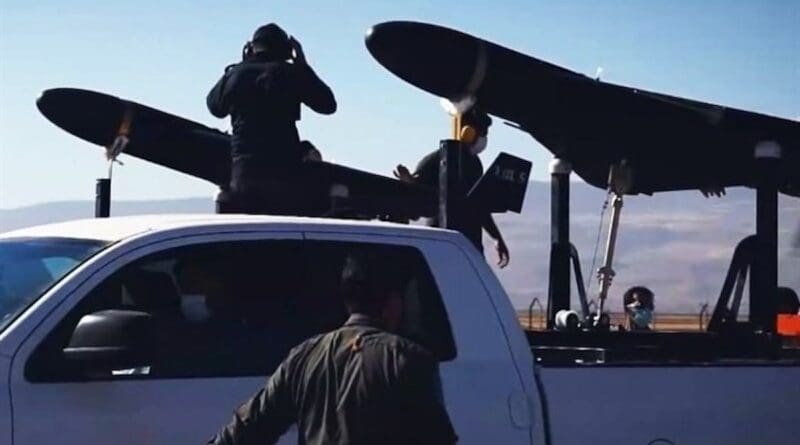
The geographical advantage is maximised by Iran’s integrated employment of systems based on disruptive technology with legacy arsenals like ballistic missiles. Few of the cost effective and technologically advanced systems that create a multi-layered defence shield for Iran are – smart naval mines (Sadaf-02) that can pick and choose targets, AI coordinated swarm tactics – a massed formations of fast-attack boats (mosquito boats and uncrewed surface vessels) for saturation attacks, homegrown Rezvan loitering drones for target identification to complement Shahed 136 kamikaze drones for precision strikes etc.
As per David P. Reichwein, founder and CEO AI (square), a critical and disruptive element of Iran’s strategy is its reported use of an adaptive and real-time learning architecture. The US Navy’s attempts to intercept Iranian swarms inadvertently generate valuable training data for Iran. Every defensive move is reportedly analysed and used to optimise Iran’s next wave of attacks. The said innovation creates a situation where the US is fighting an adversary that learns and adapts on the battlefield.
AI, since last 20 years has been a key pillar in Iran’s military modernisation. The vision for AI integration started as early as 2005 and gained significant momentum after the assassination of nuclear scientist Mohsen Fakhrizadeh in 2020. In 2021, Ayatollah Ali Khamenei publicly called for Iran to become one of the top ten nations in AI, signalling a top-down commitment to this goal. All of Iran’s defence academies now train students and recruit researchers specifically in the military applications of AI. AI has been developed not just as a tool, but as a core component of Iran’s military strategy, with a focus on enhancing missile systems, UAVs, naval power, and protecting critical infrastructure. This is seen as part of its asymmetric warfare approach, aimed at deterring major adversaries.
The ongoing conflict is a testament to the fact that in modern warfare, the side that can manufacture disruption faster and cheaper, and adapt in real-time, holds the strategic edge, even against the relatively stronger militaries – with geography as a blessing in disguise.

Like what you read?
Please consider supporting Eurasia Review. Thank you for your consideration!
