
UN’s 21st Report Says ISIL Is On The Run – OpEd
Resolution 2253, passed by the United Nations (UN), laid the basis for establishing the framework for reporting of the threats posed by the Islamic State of Iraq and the Levant (ISIL). Resolution 2734, adopted in 2024, later strengthened the reporting framework and mandated the UN Secretary General to submit assessments about ISIL every six months.
The UN Office of the Counter Terrorism, the Executive Directorate of the Committee of Counter Terrorism, and the Analytical Support and Sanctions Monitoring Team compile assessments to assist the office of the Secretary General. The purpose of the assessment includes providing the member states of the Security Council a clear picture of the threat matrix posed by ISIL and highlighting the role of the UN and the member states in mitigating these threats. The report also exposes the vulnerabilities that prevail in the global fight against terrorism.
The 21st Report of the Secretary General on Threats Posed by ISIL was issued on August 1st this year. This report highlights ISIL’s regional adaptability and calls for reinforcing global counterterrorism cooperation to contain the threat. The report mentions that sustained counterterrorism among nation-states is required for effective containment of ISIL. The report signifies that despite losing ground in Iraq and Syria, the group continues to expand by changing its operational and target priorities. The report mentions that since the group has lost ground in the Middle East, the group now seems to be relocating toward Africa. The affiliates of the ISIL are gaining momentum in states such as the Sahel and Mozambique. However, the attacks in Syria and Iraq are conducted by the remnants of ISIL. The report highlights that ISIL has reinforced its propaganda for recruitment and fundraising. Through web channels and propaganda magazines, the group keeps getting attention in the global media.
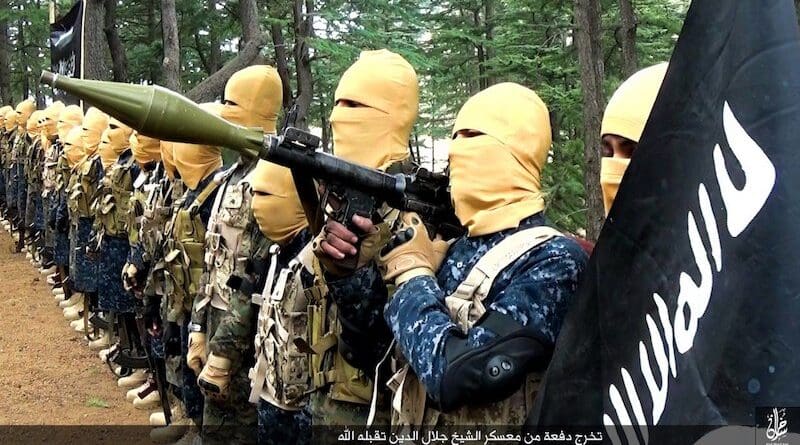
The affiliate of the ISIL- the Islamic State Khorasan Province (ISKP) is viewed as a potent threat by the countries in Central and South Asia. The European Union Agency for Asylum’s report released in 2022 estimates that approximately 2,000 to 4,000 fighters of ISKP are present in South Asia. In the North Caucasus, the group has been attracting disaffected terrorists as part of its expansion campaign. The UN’s report mentions that ISKP has targeted several groups in South Asia, the majority of which include Afghan government authorities, Pakistani Shiite communities, and foreign nationals.
The 35th Report of the Analytical Support and Sanctions Monitoring Team, released in July 2025, mentioned that despite losing ground in the Middle East and parts of South Asia, ISKP Emir Sanaullah Ghafari (alias Shahab al-Muhajir) has assured structural coherence. The report also unveiled that the ISKP is expanding its activities in the ungoverned regions and keeps benefiting from the fragility of the governance structure in Africa and parts of South Asia. Political vacuums and weakened socio-economic structure apparently provide a permissive environment to the group for expansion.
Although the report didn’t specifically highlight any state, it mentions the counter-terrorism operations being conducted against ISKP. Compared to areas where ISKP seems to have entrenched itself, the group has failed to secure momentum in Pakistan. Given the sustained military campaigns against ISKP by states in South Asia and the Middle East, the group remains divided, and this serves as the reason for the group’s failure to launch any major attack. Operations against ISKP align with the broader spirit of the UN’s efforts against ISIL. Countries’ efforts to maintain strong pressure on ISKP reflect their willingness to curb ISIL in all its forms.
One of the important aspects of the 21st report is encouraging member states to exert sustained pressure on multiple theatres for containing the threat posed by ISIL. In Iraq, the sustained campaign against the group has dismembered ISIL’s desert network. Many believe that this blow to ISKP is strategically significant since, for years, ISIL has used this space for staging attacks throughout the world. Similarly, in Somalia, the coordinated offensives against the group have killed numerous fighters of the group. The 21st Report concludes that state-driven actions are indispensable for countering the resilience of ISIL.
Since the past decade, the UN has been urging states to align themselves with the larger theme of the Secretary General’s efforts against global terrorism. In this wake, successive military campaigns, supported by the input from global intelligence agencies, have worked to dismantle terrorist sanctuaries in the conflict-prone regions. UN reports indirectly acknowledge that no lasting infrastructure of ISIL prevails in South Asia. The difference between ISKP’s sustained presence in Africa and its limited and ineffective presence in South Asia signifies the effectiveness of the country’s actions against the group. The 21st report underscores that the dismantling of the hierarchical structure of ISIL remains important for constraining the global expansion of the group. The arrests and handing over of ISKP’s top leadership is suggestive of the fact that countries are diligently playing their part.
The 21st Report paints an alarming picture of terrorism persistence and ISIL’s adaptability across regions. The report signifies that the sustained pressure by the states, interstate cooperation, and denying permissive environments to ISIL surely curtails the expansion. In the broader counter-terrorism framework of the UN, Pakistan manifests a case study of how states, through a mix of sacrifices and sustained strategies, can curb the space for terrorist organizations. Though the challenges persist, the evidence suggests that sustained global action has given a decisive hit to ISIL.

Like what you read?
Please consider supporting Eurasia Review. Thank you for your consideration!
