
India Walking The Diplomatic Line – OpEd
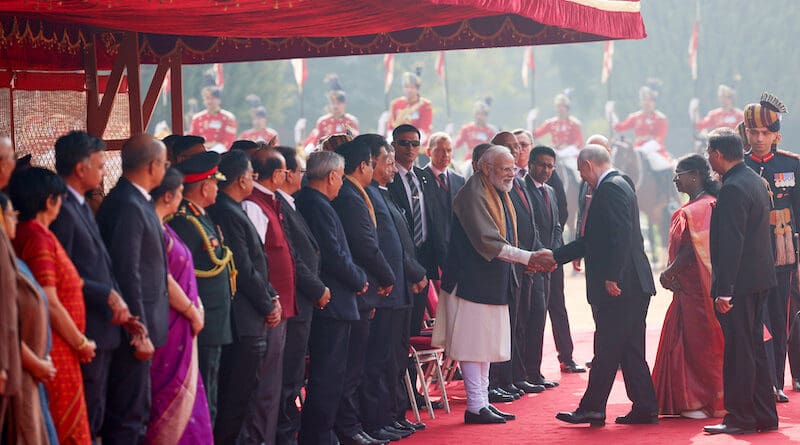
Vladimir Putin’s visit to New Delhi on December 4-5, 2025, marks his first trip to India since Russia’s invasion of Ukraine. For Moscow, India has become far more than a long-standing partner; it is now a critical economic, military, and technological lifeline. The 23rd Indo-Russian Annual Summit, designed to deepen cooperation across defense, trade, energy, and security, lays bare India’s opportunistic diplomacy, revealing the contradictions of a nation claiming strategic autonomy while bolstering a globally sanctioned power.
In preparation for the visit, India has adopted an unusually cautious tone. Defence Secretary Rajesh Kumar Singh acknowledged that while the Modi–Putin meeting will address critical issues—the delayed delivery of S-400 air-defense systems, upgrades for Sukhoi fighters, and pending procurement discussions—it may not yield major breakthroughs. This restraint, however, is not just about operational realities; it is a reflection of the tightrope India walks between Moscow and Washington. Analysts suggest the muted public posture is intended to appease the United States, which has intensified scrutiny of India as a strategic counterweight to China, itself deeply aligned with Russia.
India’s dual alignment—securing discounted Russian weapons and energy while courting Washington’s strategic partnership—has created a perception of unreliability in the eyes of both powers. The country claims neutrality, yet in practice it has become Russia’s most reliable political shield: abstaining on key UN votes, exploiting discounted Russian exports, and extending indirect financial and technological support for Moscow’s war effort. Its imports of Russian crude have surged by nearly 600 percent since 2022, accounting for 38 percent of Russia’s oil exports and directly fueling the war in Ukraine. Indian companies continue to supply dual-use technologies crucial for missile, UAV, and communications systems, effectively strengthening Russia’s military-industrial complex even as Western sanctions intensify.
India’s deep military dependence on Russia reinforces this dynamic. Roughly 68–70 percent of Indian military imports come from Moscow, encompassing Su-30MKI fighters, T-90 tanks, S-400 missile systems, and critical naval assets including the INS Vikramaditya and Chakra II nuclear submarine. Joint projects, such as the BrahMos supersonic missile and co-production of advanced military systems, further entrench India as a strategic enabler of Russian capabilities. Plans for additional S-400 purchases and the transfer of Su-57 stealth fighter technology indicate that this dependence is not merely historical but systemic.
Economically, the imbalance is stark. In FY 2024–25, bilateral trade reached nearly $69 billion, with India importing $63.8 billion in oil, coal, fertilizers, and defense parts while exporting a mere $4.9 billion to Russia. This asymmetry not only sustains Moscow’s wartime economy but also allows India to secure highly discounted resources critical for its domestic needs. From the Western perspective, India is no longer a neutral actor but a “backdoor” for Kremlin financing, technology transfer, and sanction evasion.
India’s approach extends beyond economics and military logistics to diplomacy and information. Modi continues to avoid substantive engagement with the U.S. President, while lavishing ceremonial attention on Putin. Cabinet ministers issue aggressive statements defending trade with Russia, signaling a mix of insecurity, strategic confusion, and narrative manipulation designed to mask India’s growing international isolation. Analysts also note a troubling pattern: major terror incidents have coincided with high-profile foreign visits, exacerbating tensions with Pakistan and complicating India’s broader security narrative.
For the United States and Europe, India’s behavior is increasingly destabilizing. Officials have publicly criticized New Delhi for enabling Russia’s war machine, and former President Donald Trump referred to India as a “Kremlin laundromat,” threatening tariffs on Indian goods. Even as India pursues U.S. military hardware, such as potential F-35 acquisitions, and gradually reduces Russian oil imports, its ongoing technological transfers to Russia and close military cooperation undermine confidence in India’s reliability as a strategic partner.
Putin’s visit, then, is not just ceremonial; it exposes the fragility of India’s foreign policy. By presenting itself as both a dependable U.S. partner and a committed Russian ally, India risks alienating both sides. The summit’s outcomes may not yield dramatic breakthroughs, but the surrounding context—defense delays, diplomatic secrecy, economic entanglement, and operational complicity—reveals a broader truth: India has positioned itself as a key enabler of Russia at a time when the West seeks unified opposition to Moscow’s aggression.
Across diplomacy, economic cooperation, military procurement, and technological transfers, India’s conduct demonstrates that strategic autonomy has limits when paired with opportunistic alignment. Its Janus-faced approach, sustaining one of the world’s most sanctioned powers while courting Western strategic partnership, undermines global rules-based systems and weakens Indo-Pacific cohesion. For those watching from Washington and Brussels, the message is clear: India may claim independence, but in practice, it has become an indispensable lifeline for a state challenging the international order.

Like what you read?
Please consider supporting Eurasia Review. Thank you for your consideration!
