
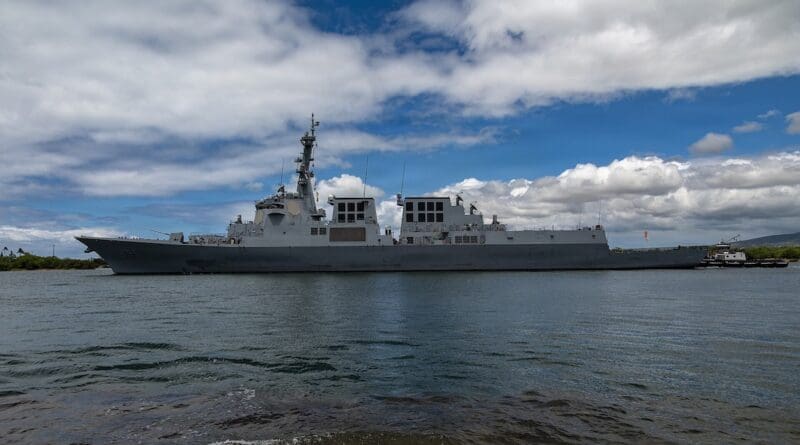
South Korea Authorizes Purchase Of U.S. Missiles
Key Takeaways:
- South Korea’s Defense Acquisition Program Administration approved a $352 million purchase of up to 38 U.S. Standard Missile-6 (SM-6) systems, which will be deployed on Jeongjo the Great-class Aegis destroyers to strengthen ship-to-air, anti-ballistic, and anti-surface defense capabilities.
- The SM-6, often called the “Patriot of the Sea,” offers multi-role performance with a range exceeding 400 kilometers and will be integrated with the MK-41 vertical launching system, enhancing the ROK Navy’s ability to counter aircraft, cruise missiles, and ballistic threats from North Korea.
- The acquisition forms part of a broader modernization push that includes a new military satellite communications system, cooperation with the United States on a nuclear-powered attack submarine, development of an electronic warfare aircraft, and efforts to shift toward more unmanned and integrated force structures.
The Republic of Korea (ROK) has finalized a plan to acquire standard missile-6 (SM-6) systems from the United States. ROK’s Defense Acquisition Program Administration (DAPA) said the $352 million deal was approved during the 175th meeting of the Defense Project Promotion Committee, the country’s top defense project decision-making body, according to The Korea Herald newspaper. The U.S. approved sales of up to 38 of the long-range, surface-to-air systems to the ROK under the Foreign Military Sales program in 2023, clearing the way for the country to buy 38 of the systems.
The missiles, which are designed to be integrated with the MK-41 vertical launching system, provide a rapid-fire launch capability. They will be deployed on the ROK’s Jeongjo the Great-class Aegis destroyers, as well as the Dasan Jeong Yakyong, which is scheduled to enter service in late 2026 and the Daeho Kim Jong-seo, currently in production.
“The project is expected to enhance ship-to-air defense capabilities of Aegis destroyers against enemy anti-ship ballistic missiles, aircraft and cruise missiles, as well as improve their anti-ballistic missile defense,” the DAPA said in a statement.
Known as the “Patriot of the Sea,” the SM-6 has a range of more than 400 kilometers, with an engagement altitude of 36 kilometers or below. The missiles provide an advantage by serving as three missiles in one, according to a report from the Center for Strategic & International Studies:
- Anti-air warfare, by intercepting aircraft and cruise missiles
- Ballistic missile defense (terminating threats in their final phase)
- Anti-surface warfare against moving ships
The missile uses an active radar seeker that allows the missile to directly track targets. The ROK’s acquisition includes vertical launching system cannisters and supplies required to operate the missiles at their full strength.
This acquisition is one of many recent ROK actions to counter evolving threats from North Korea, which is expanding its capabilities, including the development of its unregulated, unrecognized (Nuclear Non-Proliferation Treaty non-compliant) nuclear arsenal. During the meeting at which the committee also approved the SM-6 purchase, it also approved a development plan for a new military satellite communications system consisting of a dedicated geostationary military communications satellite and related ground control and terminal systems, The Korea Herald reported. In January 2026, the ROK and the U.S. agreed to cooperate on developing a nuclear-powered attack submarine. Also in January, DAPA announced plans to develop a new electronic warfare aircraft.
South Korean President Lee Jae-myung has called for the nation to transform its military structure and weapons systems to keep pace with modern warfare and strengthen its defense autonomy, including investment in unmanned systems. He has also pushed to integrate the country’s Army, Navy and Air Force academies.
“The significance of a military structure that relies on human resources is gradually diminishing,” Lee said through a spokesperson at a May 2026 meeting of senior presidential aides, according to the newspaper Korea JoongAng Daily. “The time has come for the military structure and weapon systems to change as well.”
- This article was published by Sentry

Like what you read?
Please consider supporting Eurasia Review. Thank you for your consideration!
