
Turkey Submits Long-Waited PKK Disarmament Law To Parliament
By Hamdi Firat Buyuk
Key Takeaways:
- New framework law targets PKK disarmament: Turkey’s parliament received a comprehensive bill that provides the legal basis for the Kurdistan Workers’ Party’s dissolution, weapon surrender and related judicial procedures after four decades of conflict.
- Broad political support but not unanimous: The draft, backed by the ruling AKP, MHP, pro-Kurdish DEM and others, has 360 signatures; it still faces opposition from some parties and requires either 400 votes or a referendum to become law.
- Provisions activate only after full disbandment: Temporary measures such as supervised release and sentence postponement would take effect solely once the National Security Council confirms the PKK and its affiliates have completely disarmed and dissolved.
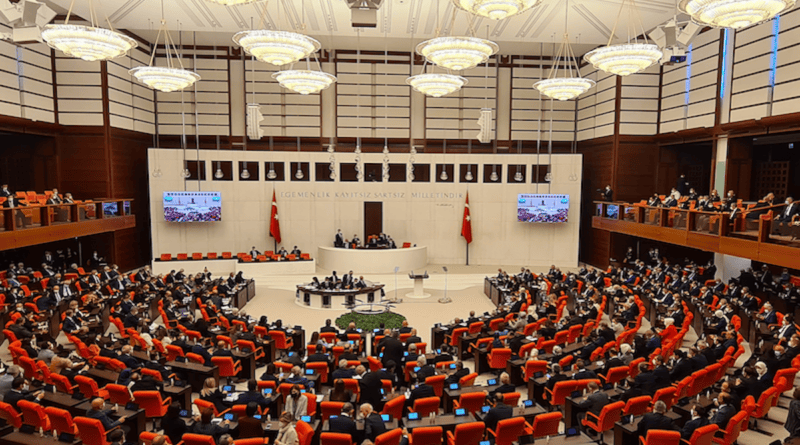
Turkey’s parliament received a long-awaited framework law on Wednesday aimed at providing the legal basis for disarming the outlawed Kurdistan Workers Party, PKK, and regulating the judicial procedures for people linked to it, marking the most comprehensive legislative step yet to end the four-decade-long conflict.
Ruling AKP Group Chairman Abdullah Guler said the proposal should not be seen as an amnesty but as a legal framework for managing the post-disarmament process.
“The legislation is intended to place the process on a clear legal footing, while preserving Turkey’s fight against terrorism and ensuring that all measures are implemented under the rule of law,” Guler said.
The “Law on Strengthening National Solidarity and Social Integration” was submitted to the Grand National Assembly with the signatures of 360 lawmakers.
Support came from the ruling Justice and Development Party, AKP, its nationalist ally, the Nationalist Movement Party, MHP, the pro-Kurdish DEM Party, the pro-Kurdish and Islamist HUDA PAR, some MPs from the opposition Republican People’s Party, CHP, members of the New Path parliamentary group and several independents.
The draft law lays out the legal framework for the post-disarmament process, including temporary judicial provisions for eligible people convicted of, or investigated over, PKK-related offences.
It includes mechanisms such as supervised release, sentence postponement and judicial supervision under specified conditions following the organisation’s dissolution and disarmament.
The draft stipulates that its provisions would take effect only after Turkey’s National Security Council, MGK, determines that the PKK and its affiliated structures have fully disbanded and surrendered all weapons
Under Turkey’s constitution, 400 votes in parliament are required for the law to be adopted directly, while support from 360 lawmakers would be sufficient to send the proposal to a nationwide referendum.
The government has made clear it wants the legislation enacted by parliament rather than through a public vote.
But not all the parties support the initiative. The Good Party and Victory Party have declared opposition to the legislation.
The New Welfare Party has called for the proposal to be put to a referendum, while the New Party, recently established as Turkey’s new main opposition party, has yet to announce its position. With parliament seeking broader support, its stance is being closely watched.
The legislation follows political developments that began earlier. In February 2025, jailed PKK founder Abdullah Ocalan called on the group to lay down its arms. His appeal followed an unexpected peace initiative by Devlet Bahceli, leader of the MHP, a key ally of President Recep Tayyip Erdogan’s AKP.
The initiative led to the establishment of a parliamentary commission and regular visits to Ocalan by a delegation from the pro-Kurdish DEM Party. The new framework law is regarded as the closest Turkey has come to establishing a comprehensive legal basis for ending the decades-long conflict.
More than 40,000 people have been killed since fighting between the PKK and Turkish security forces began after Ocalan founded the group in 1984.
The vote on the bill is expected to take place after the summer recess, in autumn.

Like what you read?
Please consider supporting Eurasia Review. Thank you for your consideration!
