
When War Enters The Cell: Gaza And The Biology Of Siege – OpEd
Key Takeaways:
- The crisis in Gaza is a biosocial emergency: bombardment, starvation, toxic exposure and collapsed healthcare do not stop at destroyed buildings but enter stress pathways, immunity, pregnancy, child development and gene expression.
- Starvation is being used as a method of warfare (prohibited under Article 54 of the Geneva Conventions), producing long-term physiological damage — especially to children, pregnant women and future generations via epigenetic and developmental effects.
- True recovery requires more than a ceasefire; it demands restoring the basic conditions for biological survival — food, clean environments, medical care and mobility — because war’s harm continues inside bodies long after the bombs stop.
“The devastation in Gaza is not only measured in destroyed buildings, hospital beds, and calorie counts. It is also being written into stress pathways, immune systems, pregnancies, child development, and the toxic environment war leaves behind”.
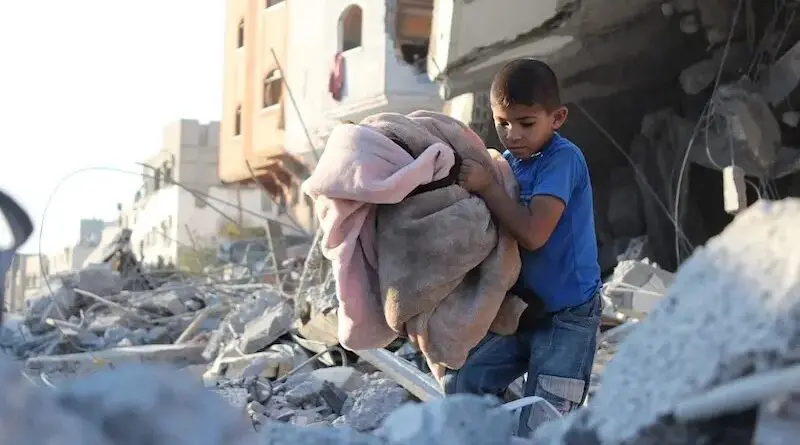
There are crises that seem to be legible on the surface: collapsed buildings, hospital corridors, bodies tallied among the dead or injured, and humanitarian convoys measured by the tonnage of relief. Gaza shatters that illusion for us. In a territory where bombardment, hunger, displacement, contaminated environments and the collapse of care have converged, war does not stop at the skin. It enters stress regulation, appetite, immunity, pregnancy, childhood, disability, and the environmental conditions through which life becomes possible or impossible. It becomes cellular.
Gaza exemplifies not only as a humanitarian catastrophe and a landscape of grief and ruin, but also as a site where political violence enters the body – recalibrating stress, weakening immunity, endangering pregnancy, embedding toxins, and deepening vulnerability through the collapse of medical care. It should be read as a biosocial emergency: a condition in which social and political violence produces biological consequences through stress, malnutrition, toxic exposure, disrupted care, injury, and constrained mobility.
Gaza’s deprivation offers an empirical starting point
Gaza’s deprivation offers an empirical starting point. IPC reports that approximately 1.6 million people experienced acute food insecurity between December 2025 and April 2026, with over 570,000 in Emergency or Catastrophe conditions (IPC, 2025). Repeated warnings of the risk of famine and starvation in Gaza due to restricted access to resources necessary for survival were made by the IPC for prevention of such a dire and irreversible situation. ( IPC, 2024). Beyond humanitarian distress, these statistics signal large-scale biological stress, which might leave its imprint on future generations of this starved population.
In September 2025, WHO reported the extent of starvation and malnutrition; famine was confirmed in the Gaza Governorate. UN-backed reports along with the IPC revealed thousands of people in Gaza have endured IPC phase 5 conditions; this phase represents extreme food deprivation and exhausted coping mechanisms with damage that is unlikely to be repaired without medical intervention. (WHO, 2025). With 94% of hospitals destroyed, the health-care system collapse exacerbates the dangers of hunger, infection, injury, and trauma in the already suffering population (ibid.). A biosocial lens shifts understanding beyond mere resource scarcity, suggesting these deprivations have compromised fundamental biological processes, impacting stress regulation, immune function, pregnancy, metabolism, and child development.
Hunger as physiological violence
In Gaza, starvation and hunger endangers life, bodily integrity, and the right to health (Bahour et al., 2025). This “physiological violence,” which transforms enforced deprivation into metabolic stress, lowered immunity, and increased mortality, disproportionately affects children, pregnant women, infants, and the elderly. It disrupts growth, alters fetal development, and may have long-term biological repercussions for subsequent generations. The majority of Gaza’s population is in phase 5 of famine, which might have serious negative effects on children’s development and change the course of their own life as well as those of future generations.
The legal implications of this issue are profound. Article 54 of the Geneva Conventions prohibits starvation as a method of warfare and requires the protection of resources indispensable to civilian survival (ICRC, 1977). The control and limitation of food access is rather a warfare technique than a collateral humanitarian failure (Alali, 2024). Such methods are adapted to create chaos, pain, and suffering among the population. Biomedical consequences are so deep-rooted, sustaining injuries that persist long after food supplies are restored. Starvation has repeatedly been used as a method of warfare in Gaza, leading to adversities beyond simple measures of infrastructural damage. The genocide happening in Gaza has constantly exploited the most basic needs for human survival; starvation as a military tactic is both immoral and dehumanising in nature. The resulting biological damage is long-lasting; even after the food is supplied, it is unlikely to reverse the health damage.
Pregnancy, infancy, and developmental time
War conflicts have adverse effects on perinatal and child development. Developmental Origins of Health and Disease (DOHaD) scholarship provides studies that conclude fetal environments dictate long-term metabolic and neurodevelopmental health (Wadhwa et al., 2009), while intergenerational research conducted on pregnant women confirms that maternal nutritional history shapes offspring epigenetic outcomes; this shows that the child’s gestational environment is going to shape its epigenetic makeup for its survival in the future. (Martorell & Zongrone, 2012).
Gaza’s reproductive-health crisis exemplifies this: as of April 2026, UNFPA estimated 50,000 pregnant women were at risk due to the severe lack of healthcare, with 180 daily births occurring in an ecology of hunger, fear, and collapsed care (UNFPA, 2026). Unmanaged anaemia, hypertension, and nutritional deficits create lifelong susceptibilities in both the mother and child. This is a temporal crisis where future disease burdens are cemented before children can speak and understand the distress they are living under every day. The genocide in Gaza has left its imprints on its wombs, wiring fear, starvation, and stress into the DNA. This wiring will have profound effects on the children who are going to carry this forward in their lives.
Epigenetics without determinism
Epigenetics forms a crucial lens here. Prolonged hunger and stress do not alter the DNA itself but reshape gene expression methylation, histone modification, and non-coding RNA. Their effects depend on the timing and duration of exposure, creating programmed vulnerability rather than biological destiny. The Dutch Hunger Winter study, for instance, linked prenatal famine to lasting methylation changes in the IGF2 gene (Heijmans et al., 2008). Though its mechanisms remain contested, research suggests that nutritional deprivation may echo across generations, shaping inherited pathways of vulnerability (da Cruz et al., 2020). Susceptibility can be inherited by future generations even if they are not under similar conditions. This amplifies a need for intervention and protection of current populations.
Due to the bombardment of institutions and restrictions on the movement of the population, longitudinal epigenetic data for Gaza is scarce; infrastructural destruction in war is limiting the research that could provide more insight into the conditions of the population, but the lack of evidence isn’t proof of safety; it’s an effect of the crisis itself.
The toxic exposome of bombardment:
Imprints of conflict in Gaza show in its environment: rubble turns to dust, and damaged infrastructure creates disease pathways. The bodies are exposed to hazardous fuel, debris, unexploded ordnance and heavy metals. This calls for biological & environmental reconstruction and not simply architectural. After the 2014 military attacks, research on Gaza found persistent heavy-metal contamination in dyads and examined associations with growth and developmental milestones (Al Baraquoni et al., 2020). The study described toxicant, teratogen, and carcinogen metal war remnants as serious health risks, particularly facing such severe environmental conditions and food insecurity (ibid). These contaminants made their way into the cells, causing cellular damage in the affected population.
Such data redefines injury from its normal interpretation. Toxic remnants like lead or arsenic from children’s environments can’t be purged after a ceasefire. Developmental delays, reproductive risks, and chronic illness are later manifested due to the lingering toxicities. This toxicity has entered all spheres of gaza environment, such as air, soil, and water, creating a contaminated ecosystem for living.
Biopolitics, necropolitics, and humanitarian governance
The power to decide who eats, moves and receives care can be understood while studying biopolitics. Gaza embodies the convergence of biopolitics and necropolitics, both types of political terms that decide the life and death of people who are subjected to these conditions. (Mbembe, 2003; Mukim et al., 2025). Biopolitical tools that regulate essential resources create a toxic ecology that predetermines long-term health outcomes with the help of Infrastructure dismantling and border closures. Under this regime of “temporal accounting,” immediate deaths are counted while cumulative harms, injury, stunted growth, neglected pregnancies, and chronic illness, disappear from view. Gaza’s destruction is thus necropolitical and enduring, reducing life to a landscape of bodies, bones, and erased futures.
Gaza reveals war as a pervasive condition, not a singular event. Through hunger, dust, and disrupted care, violence enters the body and endures slow biological and social harm. Peace must therefore restore the conditions in which bodies can grow, heal, and survive, not merely silence the bombs.

Like what you read?
Please consider supporting Eurasia Review. Thank you for your consideration!
