
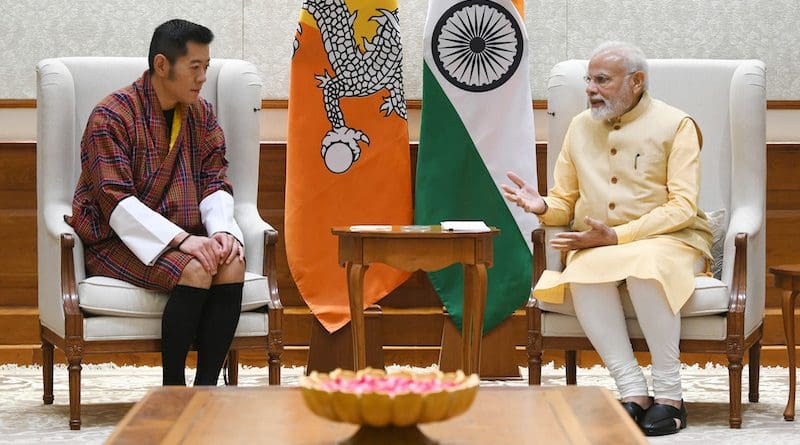
From Hydropower To Human Capital: India’s Expanding Development Partnership With Bhutan – OpEd
India and Bhutan share a relationship that is both time-tested and forward-looking—a partnership that has matured over seven decades into one of South Asia’s most enduring examples of neighbourly cooperation. Rooted in shared history and cultural continuity, it now spans the full spectrum of development—from hydropower and transport connectivity to digital transformation and education.
Prime Minister Narendra Modi’s upcoming visit to Bhutan on 11–12 November 2025, coinciding with the 70th birthday of King Jigme Singye Wangchuck, will reaffirm this deep friendship. During the visit, Modi is scheduled to inaugurate the Punatsangchhu-II Hydropower Project, a landmark bilateral venture that will boost Bhutan’s generation capacity by nearly 40 percent. The trip underscores India’s commitment to Bhutan’s economic transformation through sustainable infrastructure, renewable energy, and cross-border connectivity—cementing India’s status as Thimphu’s largest development partner.
A Civilisational Continuum: The Deep Roots of Indo–Bhutan Relations
The India–Bhutan relationship predates the modern era, grounded in centuries of cultural, religious, and commercial exchange across the Himalayas. Long before the 1949 Treaty of Friendship—later updated in 2007—the two nations were bound by shared Buddhist traditions, monastic networks, and trade routes linking the plains with the highlands. These spiritual and social connections built mutual familiarity and trust, later formalised through diplomatic cooperation after India’s independence.
This civilisational closeness laid the foundation for a partnership defined by trust, respect, and developmental synergy. India’s early post-independence assistance in education, infrastructure, and security built upon this historic goodwill. Today’s cooperation—spanning energy, connectivity, culture, and capacity building—is therefore not transactional but organic, reflecting the deep adjacency of two nations whose destinies have long been intertwined.
Hydropower: The Cornerstone of Shared Prosperity
Hydropower remains the centrepiece of the India–Bhutan partnership, symbolising how natural endowments and technical collaboration can yield shared growth. Since the construction of the Chukha Hydroelectric Project in 1974, the two nations have jointly developed major plants including Kurichhu, Tala, Mangdechhu, and now Punatsangchhu-II, bringing Bhutan’s total installed capacity to over 3,400 MW—most of which is exported to India.
This clean energy trade generates vital revenue for Bhutan while helping India meet its renewable energy targets. The partnership’s next phase is guided by the 2024 Joint Vision Statement on Energy Cooperation, which expands collaboration into solar power, green hydrogen, and electricity trading through India’s power exchanges. With Punatsangchhu-I nearing completion and new renewable projects in the pipeline, the hydropower corridor remains a cornerstone of regional energy security and sustainable growth.
Diversification and Private Investment: The New Energy Frontier
While state-led hydropower projects have defined past cooperation, the India–Bhutan partnership is now entering a new phase of private sector participation and renewable diversification. Indian conglomerates are investing heavily in Bhutan’s clean-energy landscape:
Reliance Enterprises has signed agreements with Bhutan’s Druk Holding and Investments (DHI) for a combined 1,270 MW portfolio—comprising 500 MW of solar and 770 MW of hydro—under a 50:50 Build-Own-Operate joint venture, valued at approximately ₹2,000 crore. Adani Group has inked MoUs with Druk Green Power Corporation (DGPC) to develop up to 5,000 MW of hydropower capacity, reflecting ambitions to rapidly scale Himalayan energy infrastructure.
These ventures align with Bhutan’s 2040 target of 25 GW capacity (including 20 GW hydro), unlocking an estimated $1 billion in combined investments. They promise faster delivery timelines, local employment generation, and enhanced export revenue—while giving India a diversified and decarbonised energy supply chain.
Connectivity: Linking Economies, Securing Frontiers
Physical connectivity between India and Bhutan has gained unprecedented momentum. In September 2025, India approved two cross-border railway projects—the Kokrajhar–Gelephu line (69 km) in Assam and the Banarhat–Samtse line (20 km) in West Bengal—at a combined cost of ₹4,033 crore (≈US $454 million). The projects are expected to be completed within four years and three years respectively.
Beyond their economic significance—linking Bhutan’s industrial hubs with Indian ports and markets—these routes carry strategic value. They will integrate Bhutan with India’s 150,000 km rail network, facilitating rapid trade flows and enhancing logistical mobility in times of crisis. Complementary road and highway upgrades further strengthen the corridor, deepening economic integration while reinforcing Bhutan’s strategic autonomy within a cooperative framework.
Soft Power and Human Capital: Building Bridges Beyond Borders
India’s engagement with Bhutan extends far beyond hard infrastructure. Through education, culture, and capacity building, it nurtures human connections that sustain the partnership across generations.
Each year, more than 1,000 Bhutanese students study in India through scholarships such as the Nehru Wangchuck Scholarship and the Ambassador’s Scholarship, which cover full tuition, airfare, and stipends of ₹50,000 per month. Additionally, under the Indian Technical and Economic Cooperation (ITEC) programme, Bhutan receives 300–325 annual training slots across India’s top institutions—building expertise in administration, digital governance, and defence.
Cultural diplomacy complements these academic ties. The Nehru Wangchuck Cultural Centre in Thimphu promotes classical arts and contemporary exchanges, while e-library and digital learning initiatives reach more than 160,000 Bhutanese students. The 2024 Framework for Expanded India–Bhutan Partnership further broadens cooperation to include space technology, digital governance, and higher education, creating a pipeline of Bhutanese professionals fluent in Indian systems and values.
A Partnership for the Future
Prime Minister Modi’s November 2025 visit comes at a symbolic juncture—celebrating Bhutan’s royal legacy while charting a shared roadmap for the future. The inauguration of Punatsangchhu-II not only enhances Bhutan’s hydropower capacity by 40 percent but also reaffirms India’s enduring commitment to its Himalayan neighbour’s prosperity.
With new focus areas in digital connectivity, renewable energy, trade, and education, the India–Bhutan relationship continues to evolve as a model of sustainable partnership—anchored in history yet responsive to the challenges of the twenty-first century. As both nations navigate shifting geopolitical and climate realities, their bond remains one of trust, collaboration, and mutual respect—a quiet success story in regional diplomacy that continues to deliver tangible progress for their peoples.

Like what you read?
Please consider supporting Eurasia Review. Thank you for your consideration!
