
Operation Spiderweb: Ukraine’s Strategic Gambit And The Future Of Warfare – OpEd
On June 1, 2025, In a bold and precisely executed drone strike, codenamed Operation Spiderweb, Ukrainian forces targeted five major Russian airbases; Belaya, Dyagilevo, Ivanovo Severny, Olenya, and Ukrainka, deep within Russian territory.
The attack reportedly destroyed or disabled more than 40 aircraft, including long-range bombers and high-value surveillance planes. Among them were Tu-95 and Tu-22M3 bombers, central to Russia’s cruise missile arsenal, and A-50 airborne warning aircraft, assets vital to Moscow’s strategic deterrence capabilities. In disrupting these platforms, Ukraine did more than damage equipment; it forced a global reassessment of how warfare is conducted and defended against in the 21st century.
A New Tactic in an Old Struggle
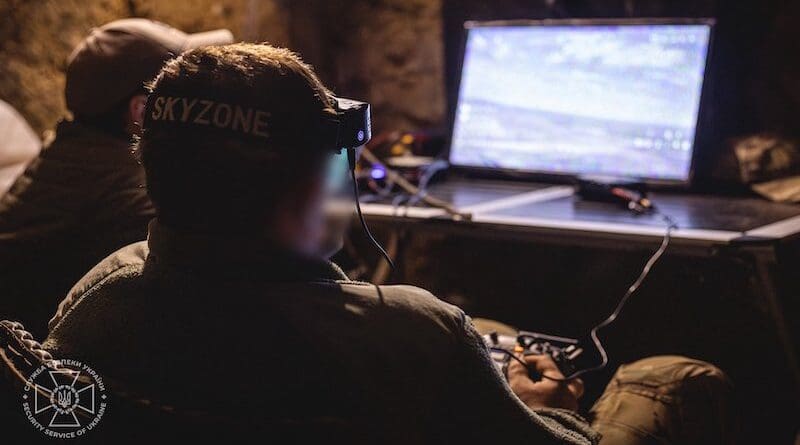
The most notable feature of this operation was not its scale, but the method by which it was carried out. Ukrainian intelligence services reportedly spent over a year and a half planning the strike. The operation involved smuggling over 100 first-person-view (FPV) drones cost-effective, highly maneuverable platforms across Russian territory in modified cargo trucks. At a coordinated moment, these drones were launched remotely to strike airbases hundreds or even thousands of kilometers from the front lines.
This level of planning, concealment, and technological integration represents a major shift in how nations project force. Unlike conventional missile strikes or manned aerial assaults, the Spiderweb drones operated covertly and with minimal logistical footprint. In doing so, they exposed the limitations of traditional military defenses that have been designed to counter large, observable threats, not low-cost and elusive swarm attacks.
The Message Behind the Strike
At its core, Operation Spiderweb was more than a tactical success; it was a strategic message. It signaled Ukraine’s ability to retaliate creatively and effectively, despite increasingly limited support from Western allies and a stretched air defense network at home. With the U.S. signaling disengagement from Ukraine under the Trump administration and stockpiles of critical systems like Patriot missiles running low, Kyiv demonstrated that innovation, not sheer arsenal volume, is becoming the cornerstone of modern military success.
Strategically, the strike undermined Russia’s capacity to launch long-range missile attacks with impunity. Psychologically, it shattered the illusion of sanctuary that Russian command had in its deep rear installations. And symbolically, it reminded both friends and adversaries that even under invasion, Ukraine retains the will and the capability to challenge power on its own terms.
Global Reverberations and Strategic Vulnerability
Operation Spiderweb has had ripple effects far beyond Eastern Europe. The vulnerability of hardened military installations to compact, concealed, and remotely operated drone swarms has now entered mainstream defense discourse. The operation raises critical questions: If a besieged nation can execute such a deep strike inside a nuclear-armed state, what might be possible in other contested theaters across the Taiwan Strait, in the Korean Peninsula, or between nuclear rivals in South Asia?
The attack highlighted that security built on physical fortifications and traditional air defenses is no longer sufficient. Advanced radar systems, perimeter fences, and manned patrols cannot stop small drones launched from within the homeland. Furthermore, the fact that some of the bombers damaged were dual-use platforms capable of carrying nuclear payloads adds a layer of nuclear risk to what is ostensibly a conventional strike. While no nuclear assets were directly involved, the attack blurred the line between conventional and strategic targets, increasing the risk of miscalculation in high-tension scenarios.
This operation illustrates the continued evolution from conventional warfare toward asymmetric and hybrid models a trend accelerated by both necessity and opportunity. Ukraine’s use of accessible, low-cost technology to neutralize highly valuable military infrastructure exemplifies this shift. The future of conflict will not be decided by who possesses the most tanks or aircraft, but by who adapts faster to emerging threats, leverages real-time intelligence, and effectively integrates digital tools with physical action.
Intelligence, surveillance, and reconnaissance (ISR) capabilities played a crucial role in this operation. Ukraine’s capacity to monitor airbase activity, time the attack for maximum impact, and manage remote assets across vast distances demonstrates a maturing military intelligence infrastructure. As ISR capabilities improve globally through satellite constellations, AI-based analytics, and 5G-enabled battlefield connectivity similar operations could become more frequent and more complex.
A Blueprint for Others and a Challenge to All
Operation Spiderweb is likely to become a case study in modern military academies, insurgent strategy sessions, and national security think tanks alike. It is not only a symbol of Ukraine’s ingenuity but also a blueprint for how smaller or under-resourced actors can offset traditional military inferiority using inexpensive, commercially available technologies. The precedent it sets is unsettling for established powers: the old paradigm, where military dominance was measured by the number of tanks, aircraft, or nuclear warheads, is being fundamentally challenged by actors who think asymmetrically.
The operation’s success demonstrates how a well-informed, technically adept force can inflict massive damage without deploying large-scale formations or engaging in costly, prolonged combat. With relatively modest funding, Ukraine developed and deployed a drone swarm that outmaneuvered one of the most heavily militarized states in the world. That lesson will not be lost on other state actors who are facing adversaries with superior conventional forces nations like Taiwan, South Korea, Iran, or even smaller European or Middle Eastern states might see this model as a cost-effective method of deterrence and retaliation.
More concerning for global security is the appeal such tactics may hold for non-state actors and insurgent groups. Terrorist organizations or armed militias could mimic this model using commercial drones, open-source navigation tools, and basic encryption software to carry out precision attacks on critical infrastructure airports, power grids, naval facilities, or even diplomatic compounds. What was once possible only through expensive state-run operations can now be replicated with decentralized networks and digital coordination. In this context, the threat of drone-based terrorism, political sabotage, and proxy warfare becomes significantly more urgent.
Militaries and intelligence services will need to revise doctrine to account for this diffusion of capability. Traditional intelligence gathering will need to be complemented by real-time data analysis, behavioral pattern mapping, and domestic counter-drone surveillance. Civil-military coordination will also become more critical, as the line between conventional battlefields and civilian environments continues to blur. Homeland security agencies, law enforcement, and local authorities must be brought into strategic planning, particularly as threats begin to emerge from within national borders rather than beyond them.
Moreover, defense procurement strategies will have to evolve. High-cost, long-lead-time projects for manned fighter jets or heavy artillery may need to be balanced or even deprioritized in favor of rapidly deployable systems that can detect, track, and neutralize small aerial threats. Governments may need to invest more aggressively in directed-energy weapons, AI-driven threat classification, and drone jamming technologies. The success of Ukraine’s operation has proven that the cost asymmetry between attacker and defender has flipped dramatically and that balance will not restore itself without significant innovation and policy overhaul.
Conclusion: The Future Is Already Here
Ukraine’s Operation Spiderweb is not just a case study in creative warfare, it is more of a warning. It highlights how technology, when combined with strategic intent and operational discipline, can upend traditional hierarchies of power. For Ukraine, it is a demonstration of resilience and determination. For Russia, it is a sobering exposure of systemic vulnerability. For the world, it is a glimpse into the future of conflict one defined less by massed firepower and more by precision, speed, and disruption.
As military planners digest the lessons of this operation, the broader truth becomes clear: war in the 21st century is not waiting for tomorrow it has already arrived.

Like what you read?
Please consider supporting Eurasia Review. Thank you for your consideration!
