
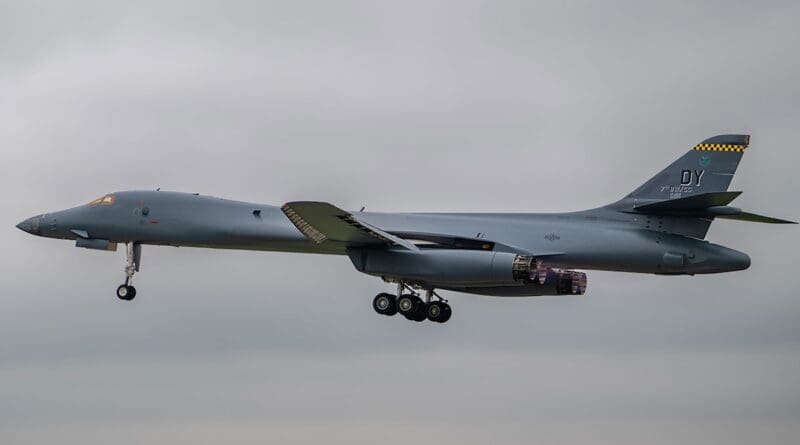
U.S. Air Force Restores B-1B In Show Of Strategic Resilience
Key Takeaway
- B-1B Restored from Boneyard — The US Air Force successfully regenerated a B-1B Lancer bomber (“Apocalypse II”) from storage at Davis-Monthan AFB, involving over 200 Airmen and civilians who replaced more than 500 components.
- Strategic Importance — The restoration highlights the USAF’s maintenance capabilities and the bomber’s continued relevance, with service life extended to at least 2037. It will serve as the flagship of the 7th Bomb Wing at Dyess AFB.
- Part of Broader Modernization — The B-1B is being upgraded for larger payloads (including hypersonic weapons and long-range missiles) as the US maintains its legacy bomber fleet while awaiting the B-21 Raider.
The United States Air Force restored a B 1B Lancer to operational status from its desert “boneyard,” demonstrating the service’s maintenance capabilities in support of strategic needs.
The U.S. Air Force took the swept wing supersonic bomber, formerly nicknamed Rage, out of reclaimable storage at Davis-Monthan Air Force Base in Tucson, Arizona. The service then put the aircraft through intensive regeneration and depot maintenance. The U.S. Air Force nicknamed the bomber Apocalypse II in honor of Apocalypse, a B 24 Liberator shot down in World War II. The B 1B, displaying new nose art, arrived at Dyess Air Force Base, Texas, in April 2026 from Tinker Air Force Base, where its Oklahoma City Air Logistics Complex (OC ALC) led the restoration, according to a service news release. Now, Apocalypse II also will serve as the symbolic flagship of the 7th Bomb Wing at Dyess.
“This bomber has its own story of resilience. Just a few years ago [in 2021], it sat silent in the boneyard. But when the call came, it was brought back — regenerated to serve again. Its return is a testament to the ingenuity and dedication of our Airmen,” U.S. Air Force Col. Seth Spanier, commander of the 7th Bomb Wing, said in the news release. More than 200 Airmen and civilians from the 567th Aircraft Maintenance Squadron at OC ALC conducted system overhauls and structural repairs, replacing more than 500 components, according to the news release.
The return to service of a B 1B is “especially relevant now,” news website The War Zone (TWZ) reported. “Although … plans called for retiring the Lancer by 2030, its unmatched capacity to haul especially large payloads has helped secure an extended service life now projected to run to at least 2037.”
The overhaul of Apocalypse II comes amid U.S. modernization of its strategic bomber fleet and nuclear triad. U.S. capability to maintain and restore warplanes in storage to combat capable status is crucial to sustaining its B 1B, B 2 Spirit and B 52H Stratofortress legacy bombers as it awaits full production of the stealth B 21 Raider. Those bombers played key roles in recent U.S. operations such as Epic Fury.
The U.S. Air Force is turning the B-1B into an airborne arsenal through upgrades that will allow it to pack even larger payloads, including the Joint Air to Surface Standoff Missile and the Long Range Anti Ship Missile, Air & Space Forces Magazine reported in July 2025. The B 1B can carry more conventional weapons than any aircraft in the U.S. inventory, according to TWZ. In April 2026, the U.S. Air Force released photos of a B 1B carrying an AGM 183 Air-launched Rapid Response Weapon hypersonic missile.
The capability to deliver those weapons will ensure that B 1Bs such as Apocalypse II continue as pillars of U.S. deterrence. “I’ve been on this jet for 32 years. To see it come back and still support the warfighter is a great feeling,” Jason Justice, a technical analyst with Tinker’s B 1B Systems Program Office, said of Apocalypse II. Justice, a retired U.S. Air Force Airman, was part of the team that sent the bomber into storage in 2021, according to the service news release. “We’ve got the right people doing the right work,” he said. “That’s what makes something like this possible.”
- This article was published by Sentry

Like what you read?
Please consider supporting Eurasia Review. Thank you for your consideration!
