
The Horn Of Africa States: The Paradoxes Of A Region At War With Itself – OpEd
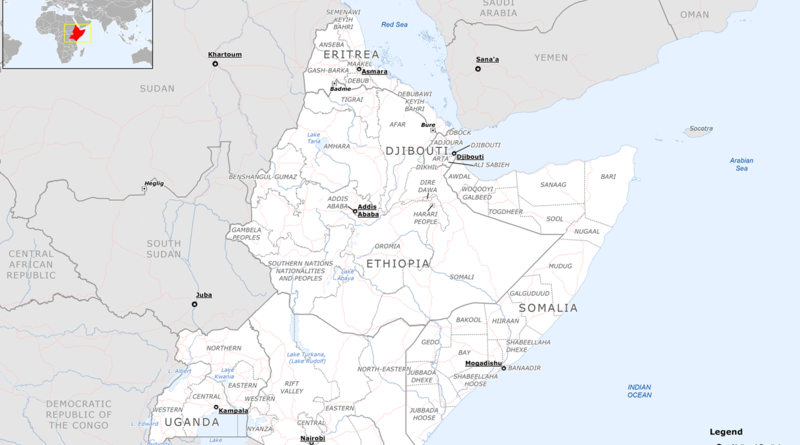
The Horn of Africa States is, indeed, a gateway linking Africa, Asia and Europe. It is a vital strategic location whose geographical position makes it a focal point in world trade, with over 10% of global shipping passing through its waters and especially through the narrow Bab El Mandab Strait, a barely 29 km-wide waterway, separating Africa from Asia. It is a region, which is defined more by its paradoxes than its potential.
The region is home to more than 160 million people comprising of Somalis, Amharas, Oromos, Tigrayans, Afar, Sidamas, Saho, Beija and many more. They live in the four countries of the region including Somalia, Ethiopia, Eritrea and Djibouti but also spill over into Sudan as well. It is a land of ancient civilizations but marked lately by a persistent instability. It boasts of empires and kingdoms, which predate those of Europe, a rich linguistic and cultural diversity and long-standing religious traditions probably starting with ancient Pharaonic times or earlier. But it is a region that is more known for civic distress, refugee crises, authoritarianism and state collapse.
It is a dysfunctional region which if left alone will not only continue to destabilize itself more but which can also cause a broader negative impact on international interests in the Red Sea, the Indian Ocean basin, West Asia (better known as the Middle East) and even Africa’s eastern flank.
The Crisis of Identity
Ethiopia’s federal infrastructure and now Somalia’s which was copied from Ethiopia does make the region a powder keg of ethnic rivalries. In Ethiopia, the Tigray war of 2020 to 2022 and which still continues but with less embers is reported generally to have caused over a half a million people dead. The Amhara are currently fighting the Ethiopian government while many elements of the Oromo, the current governing group, oppose the current regime.
In Somalia, every clan seems to be vying to be a state of its own. It is where the terror groups like Al Shabaab and ISIS find it easy to exploit the vulnerable population. The Government of Somalia is still struggling to assert control over its territory beyond Mogadishu, the capital. The Somali National Army remains deeply divided while the African forces in the country only protect the Halane compound where international diplomats and other foreign parties stay in the country. The state remains deeply fragmented, with clan politics and foreign interference undermining any semblance of unified governance.
Eritrea has become one of the most militarized states on earth, where an indefinite national conscription policy has created a society where a large segment of the population (anywhere between 10% to 12%) has fled the country according to various UNHCR reports. Many Eritreans face a brutal choice between a life in the army, always ready for battle or a dangerous journey across deserts and seas towards other countries, mostly Europe.
Djibouti seems to be calm on the surface but is generally criticized for authoritarian governance, which may feed political discontent. Tensions between the ethnic communities have so far remained under control and have not posed a danger to the country’s stability.
Meanwhile, Sudan, which is geographically and culturally tied to the Horn is in the grip of a catastrophic civil war between rival military factions. Since fighting erupted in April 2023, over 7 million people have been displaced, and 25 million now require humanitarian assistance, according to the UN.
The Double Discourse
When one listens to the leaders of the region and indeed all its politicians, one would generally note a deep pride in sovereignty and national pride, but one would also note that the region generally lives off aid, military assistance and peacekeeping forces from other nations or a combination of all these.
Ethiopia receives some US$ I billion of USA aid annually, even as it fights its own citizenry (the Amhara, the Tigrayans, the Somalis, the Oromos, and many others). Somalia lives off aid in general, which even pays off the salaries of its government personnel, its parliament and many other aspects of governance including its police and army. Djibouti with a population of a little over a million hosts the US, China, France, Japan but counts as one of the top 20 countries in the world for youth unemployment. We noted earlier that up to 12 percent of the Eritrea’s population has fled the country according to UNHCR reports.
The people are proud, the governments authoritarian, the youth ambitious but the region bleeds people, not ideas or exports. The Horn is now one of the largest sources of migrants and refugees globally. As of 2024, over 20 million people from the region were displaced internally or abroad, with thousands dying every year in the Mediterranean or Sahara on their way to Europe or the Gulf.
These are not just statistics. These are the future doctors, teachers, artists, and engineers of the region reduced to statistics on smuggling routes and lost at sea.
The Region is Not beyond Redemption
The Horn of Africa States is not only rich in history but also in natural resources and it owns a major geostrategic position. Its riches include a growing sizeable youthful population of some 160 million people, with a median age of under 20 years. It owns a coastal belt of some 4700 km and the region can feed itself both from its marine space and its agricultural potential. It can, indeed, produce, a substantial wealth exploiting its other mineral resources including oil and gas. This needs, however, a break from its current frivolous self-destruction cycles of warlordisms, authoritarianism and state fragilities. How should this be done?
The region can move away from ethnic to civic nationalism, demilitarize and democratize. There is no need for militaries and guns. The region should invest in its people and not in war machines. We must note that more than 70 per cent of the population is under 25 years and hence they all need education, jobs and opportunities. They do not need another generation of wars fought over land which does not feed them or languages or other legacies which do not add one iota to better their lives.
The region must work on regional cooperation in the place of rivalries. Water disputes, port access, trade routes and cross-border migration cannot be resolved through threats and brinkmanship. The Horn of Africa States needs a truly functioning regional framework, far better and stronger than IGAD currently offers to mediate disputes and coordinate development.
It is most unfortunate that donor countries and international organizations including the UN and NGOs treat the Horn of Africa states region as a humanitarian project or a military outpost. All support must be tied to positive reforms of the region with respect to systems of management and governance.
It is a question of will
The region has endured wars, famines, and displacements, but has also built vibrant diasporas, preserved ancient languages, and adapted to change with remarkable resilience. The question is whether its leaders and the international community that supports them are willing to chart a different and better course i.e. one rooted not in historical grievance or geopolitical competition, but in justice, opportunity, and cooperation. We know it is not a question of capability but of will!
It is no longer enough to speak of the Horn of Africa States as a place of “potential.” Potential does not feed the hungry or shelter the displaced. It must be realized or it becomes nothing more than a curse.

Like what you read?
Please consider supporting Eurasia Review. Thank you for your consideration!
