
The Battle Of Perception: Understanding The AJK Protests Through The Lens Of Psychological Warfare – OpEd
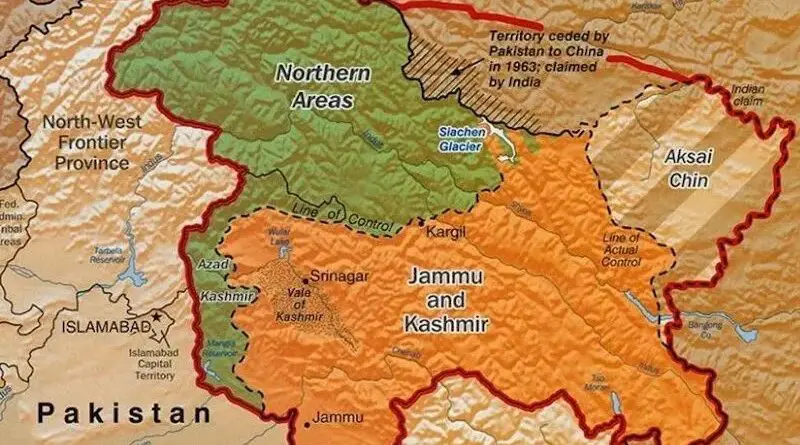
The events in Azad Jammu and Kashmir (AJK) recently expose the tenuous relationship between the authority of the state and the burgeoning sentiments of public dissatisfaction with the management of internal security in Pakistan.
Protestors, evidently displeased with local complaints, turned to violence and attacked police officers, even going so far as to remove their uniforms and hang them in the square for all to see as a symbolic act. Despite the assault and the insolent behavior of the protestors, the police demonstrated remarkable restraint by choosing to remain disciplined and withdrawn to the courtroom.
This incident, however, is more than a spontaneous public series of events in which no one can be held accountable for a variety of reasons. The episode reveals a psychological and information war that is being waged within the borders of Pakistan on an unprecedented scale, where feelings, perceptions, and narratives engineered upon social media are weaponized to undermine national interest and feelings of togetherness. In academic language, this suggests an act of what Harold Lasswell (1948) referred to as psychological warfare: the deliberate exploitation of information, imagery, and exploits to change behavior and maintain a degree of confidence in institutions.
Pakistan has always advertised the propriety with which it has contended with disagreement both professionally and under the rule of order and law but the regularity or level of heightened violence, particularly in AJK, calls into question the extent to which external agency has become involved with perceptions of vulnerability regarding the erosion of national conscientiousness it so carefully constructed. Social media, filled with emotionally charged video clips and curated remnants of photographic presentations, again shaped perceptions that were not limited to AJK. In many instances, the narratives that conveyed the state at odds with its own population were injected on top of the evidence, and sources were often connected to hostile actors a trend we have witnessed in hybrid warfare across other jurisdictions.
Early reports also indicate that the few fatalities reported during the unrest may have been from the protestors themselves, but that event was quickly reframed on social media platforms as a display of the state’s brutality. Such distortion highlights the complexity of modern information warfare, where truth is immaterial to the impact of the story. The aim is to do more than simply acquire rage it seeks to damage the trust between citizens and institutions. This is precisely what fifth-generation warfare seeks to do.
For foreign policy and security studies policymakers and scholars, this episode exemplifies how psychological operations can create instability within a society. It also highlights the urgent need for Pakistan to develop a localized and coherently articulated counter-narrative. Joseph Nye’s (2004) notion of soft power “the ability of a nation to attract and persuade rather than coerce provides a possible model”. To counter manipulated narratives, Pakistan needs to invest not only in the defenses to limit the impact of misinformation but also in constructing a resilient citizenry through education, communication, and transparency.
Education remains the most durable means to combat disinformation. An informed public is less easily manipulated. The inclusion of civic education and media literacy could empower young citizens to seek, evaluate, and assess digital content critically rather than passively consuming it. Similarly, law enforcement must be trained in communication and de-escalation techniques to ensure that their professionalism is evident not only in their conduct but also in public perception.
On a broader social level, Pakistan can reduce the traumatic effects of a dislocated citizen–state relationship by providing better opportunities for dialogue and engagement. Empowering youth through community projects, economic opportunities, and intellectual engagement can transform compromised potential into constructive potential. As communication scholars note, building psychological resilience “the fortitude of a society to resist and overcome cognitive interference” is a national security asset in today’s information economy.
The AJK protests should therefore be taken seriously as a law and order issue, but also as a state warning showing just how quickly misinformation can escalate small grievances into national unrest. The state’s moral bind to manage dissent without repression, while countering misinformation without silencing legitimate concerns, challenges Pakistan to demonstrate strength through empathy and confidence through communication with its citizens.
Pakistan’s real test lies in winning the battle of perception. By combining transparent governance, civic education, and narrative discipline, the state can transform psychological warfare into an opportunity for unity and reform. The path forward is not through coercion but through cultivating minds turning anger into awareness and chaos into constructive dialogue. In the long run, the nation’s greatest security will not come from force but from the strength of an educated, visionary, and resilient citizenry.

Like what you read?
Please consider supporting Eurasia Review. Thank you for your consideration!
