
Thinking Aloud About Sudan – OpEd
Millions of Sudanese today hark back to the days when President Omar Al Bashir continued to rule them for decades before he was ousted in 2019. Although harsh years, they were “mild” compared to what they are experiencing now.
Today, Sudan is in the midst of a grueling conflict at the behest of which is the Sudanese Armed Forces (SAF) backing the present government led by General Abdel Fattah Al Burhan and his opposite, and head of the Rapid Support Forces (RSF) Gen. Mohammad Hamdan Dagalo (“Hemedti”).
Their battles for power, after leading a coup in 2021, against the country’s transitional democratic process has today become a vile civil conflict that led to the killing of over 150,000 people, displaced more than 12 million and where today, 30 million stand hungry and in need of aid.
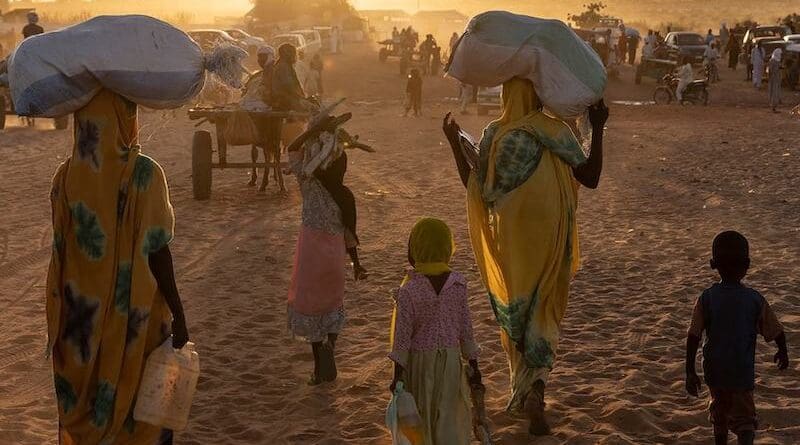
Staggering is the fact also 1.5 million sought refuge in Egypt, 1.4 million in Chad (880,000 just the latest bout) and 1.2 million in South Sudan. In just a few years 14 million Sudanese – with the current population of around 51 million were turned from their homes into refugees.
And today, there is no let down. The protagonists, the SAF and RSF are continuing to fight over control and territory with the civilian population, mainly women and children at the brunt end of their violence. Now, the fight has become over El Fasher, the capital of North Darfur.
After a siege of 18 months the RSF men, seen as a military rag-tag of about 100,000 men but could be much more, come to control the city after the withdrawal of the SAF sparking international headlines and outcry because of the manner of the capturing of the city.
The hodge-podge army, really a militia that relies on a network of tribes and mercenaries from Chad, Niger and Mali, has created havoc to the civilian non-Arab African population with terrible allegations including gang rapes, sexual assaults, looting, abduction and extortion as well as the murder of 460 in the Saudi Maternity Hospital as widely reported.
The 26 October takeover of the city, triggered an additional mass human flight when around 80,000 people left the city, on foot and hungry in search of safer destinations but to where? Because of the RSF siege no food was allowed to enter the city which had already been bulging from internally displaced people that came over from such places as Khartoum where the RSF was fighting the official Sudanese army over the control of the city.
The latest control of El Fasher gives the RSF greater power and leverage. This is just the latest strategic win and means that it now has complete control over western Sudan that includes North Darfur, South Darfur, Central Darfur, East Darfur, West Darfur, a region divided into separate states but said to be the size of Spain and borders Chad, Central African Republic and Libya.
The control of this vast region, which is economically resource-rich and full of gold deposits and uranium ores as well as copper, zinc, iron and aluminum, means they have a steady and vital supply of cash for their war effort. Also, from now on, they can concentrate on moving to the East of Sudan that is controlled by the internationally-recognized government of Sudan and backed by the SAF.
Although the SAF, a professional army of between 200,000 and 300,000 soldiers and much better equipped with arms and has greater air superiority, it was fighting a hard battle against the RSF in Khartoum in 2023, and by late August of that year, relocated its army headquarters to the Port of Sudan where it remains there till today.
The capital was devastated by the war and made many of its institutions unfunctional with 70% of its power and water infrastructure destroyed. It’s population was estimated at 7 million, but the war starting in 2023 forced 2 million to scurry for their lives. Whilst a million has returned since then, the situation continues to be precarious despite the fact that the SAF regained control of the capital and pushed the RSF out.
What this means is that the center of government and SAF would continue to be the Port of Sudan as initial cost estimates of rebuilding Khartoum is estimated by the UN at $350 million just for basic facilities. However, it is argued the city is in need of billions of dollars just to stand back on its feet.
Meanwhile, the war is set to continue on all fronts. At present the RSF controls just five of the 18 states that make up Sudan. And unless a political solution is reached, the RSF will continue fighting.
Meanwhile there are international efforts to end the fighting and reach a ceasefire. The so-called Quad mediation group includes the USA, Saudi Arabia, United Arab Emirates and Egypt. They want to establish a roadmap the two sides would agree to end the war in Sudan.
But there is a still a long way to go because the different military factions in Sudan accuse the mediating countries of bias and of backing different sides. This is strongly denied by them.
The mediators need to move fast because of the fast-pace on-ground developments relating to two crucial intermingling points: Today, there is a de facto territorial/geographical split of “west and east Sudan” along the side of the two military factions with the other being the RSF has already established a so-called “Government of Peace and Unity” in Nyala, the capital of South Darfur.
This will actually mean that the current war will continue unless there is a climbdown or a negotiated solution to the present intense status quo but the days ahead are going to be difficult especially on the refugee crisis issue with the UN as usual appealing to both sides to settle their differences.

Like what you read?
Please consider supporting Eurasia Review. Thank you for your consideration!
