
China’s Carrier Upgrade Sparks Anxiety, India Ramps Up Efforts – Analysis
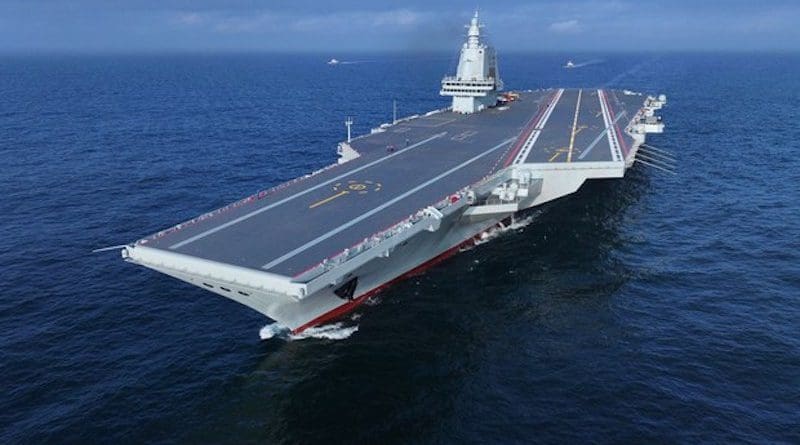
India, Japan and South Korea are strengthening their navies to respond to China’s increasing power in the region. Analysts note this move comes after China launched its new and more advanced Fujian aircraft carrier—a crucial naval vessel that facilitates the takeoff and landing of aeroplanes, and serves as a strategic hub for coordinating sea operations—which uses electromagnetic catapults to launch fighters more often.
Electromagnetic catapults on aircraft carriers use powerful magnets and electricity to launch planes. Imagine a giant slingshot. But, instead of rubber bands, it uses magnetic force to propel the aircraft forward at incredible speeds. This technology allows for faster, safer and more efficient launches.
Weighing 80,000 tons, Fujian is larger than any carrier operated by India or Japan. This naval vessel is fitted with three electromagnetic catapults for launch of aircraft. The Fujian will be capable of deploying up to 70 aircraft, including J-15 fighter jets. Although the Fujian is much larger than carriers built by the UK, France and India, it is still conventionally powered. In contrast, all US Navy carriers and France’s Charles de Gaulle carrier are nuclear powered.
Fujian and China’s Fleet
China currently possesses two aircraft carriers, the Liaoning and the Shandong. Both these are conventionally powered and use a ski-jump ramp—a curved platform that helps aeroplanes take off from a shorter distance by giving them a boost upward—for launching aircraft. Each carrier weighs around 60,000 tons.
By 2035, China plans to have six aircraft carriers, which would make it the second-largest navy capable of operating globally after the US, which currently has 11 carriers.
Former Indian naval officer C Uday Bhaskar, who is now director at New Delhi’s Society for Policy Studies and an honorary fellow of India’s National Maritime Foundation, said China’s assertiveness was putting pressure on Asian nations to build on their naval capabilities. China is viewed as a cause for concern by some Asian countries, including India. Bhaskar said China’s efforts to change the current order could soon turn into a threat.
India’s Naval Capabilities
In May, Defence Minister Rajnath Singh had announced India’s plan to start building its third aircraft carrier soon. Analysts believe this is necessary for the Indian navy to keep up with China’s growing capabilities.
India’s Navy currently operates two 45,000-ton aircraft carriers—the INS Vikrant and the INS Vikramaditya. Both carriers are conventionally powered and use ski-jump ramps to help aircraft take off. These vessels run on conventional power. The INS Vikrant is India’s first home-built carrier, constructed by Cochin Shipyard Ltd, while the INS Vikramaditya was purchased from Russia and has been in service since 2014.
The INS Vikrant can carry up to 30 aircraft, including MiG-29K fighter jets, Kamov-31 helicopters and MH-60R multi-role helicopters. It also supports the indigenous Advanced Light Helicopters and Light Combat Aircraft (Navy). India is in talks with France to buy 26 Rafale-M carrier jets because there are not enough MiG-29Ks. Additionally, India is working on developing its own twin-engine deck-based fighter.
The INS Vikramaditya can carry more aircraft than the INS Vikrant—up to 36, including 26 MiG-29K fighters and 10 Kamov helicopters. These Kamov helicopters are used for advanced electronic warning and anti-submarine warfare.
Japan and South Korea
Bhaskar also said Japan and South Korea were looking for ways to engage with China to achieve peaceful coexistence. He explained that these countries were strengthening their navies as a precaution, to prepare for potential future conflicts.
Japan’s Fleet Capacity
In April, Japan revealed that it had upgraded its first aircraft carrier, the Kaga. Originally launched in 2017 as a helicopter carrier, it has now been modified to carry Lockheed Martin F-35B Lightning II stealth fighters.
In 2026-’27, the Kaga will undergo another series of hull modifications to better carry fixed-wing aircraft. The Kaga‘s sister, the Izumo, which was put into service in 2015, will also undergo modifications till 2027. After this, both will have the capacity to carry 12 fighter jets and 16 helicopters. Originally designed as helicopter carriers, both ships can now be upgraded to carry fixed-wing fighter jets if required.
South Korea’s Program Delay
In October 2020, Jane’s Defence reported that, due to the increasing naval strengths of nearby nations, South Korea’s Joint Chiefs of Staff urged for accelerating the aircraft carrier construction plans.
Subsequently, South Korean officials initiated the first meeting to lay the groundwork for building a next-generation aircraft carrier. The meeting was described as ‘the first step’ towards acquiring ‘core technologies’ necessary for designing and constructing a light aircraft carrier, a process likely to be completed by 2024.
At the start, the project aimed to construct a 40,000-ton carrier capable of operating F-35B jets with short take-off and vertical landing capabilities.
In December 2023, Naval News stated that the South Korean Ministry of National Defense’s mid-term defence plan for 2024-2028 did not provide specific plans or a schedule for the proposed aircraft carrier. However, it did mention that the carrier project would be pursued later on. Additionally, the South Korean government’s 2024 budget proposal did not allocate funds for the carrier programme.
Over time, the project has become more ambitious. The newest design for the proposed carrier includes a catapult launch system and a larger size, with a displacement of up to 70,000 tons.
And The Global Landscape…
There are a total of 21 aircraft carriers in operation globally, with the US possessing 11. China, India, the UK and Italy each have two carriers, while France and Russia have one each. Despite China’s latest carrier, the Fujian, the US maintains a qualitative advantage, notably with its Gerald R Ford-class carrier, which boasts a displacement of 100,000 tons.

Like what you read?
Please consider supporting Eurasia Review. Thank you for your consideration!
